

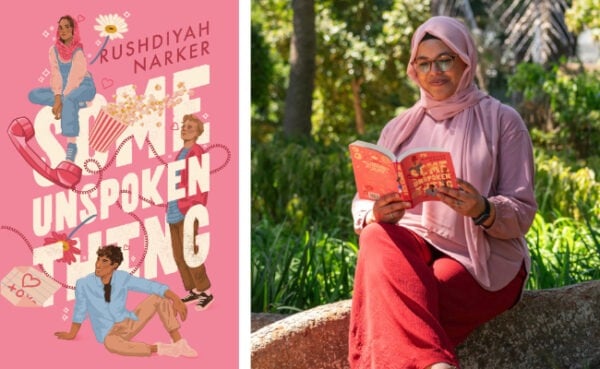
Sometimes social media does its thing and connects you with the right people. TikTok was how I learned about Rushdiyah Narker, author of Some unspoken thing. Here, we discuss her writing process, the influence of her studies on her writing, and her next novel.
…
“I tried to draw on all of that to reflect how wonderful, but also how challenging, first love can be.”
…
Rushdiyah, congratulations on your first book, Some unspoken thing. You’ve shared on TikTok that it started as a vignette. Could you take us through that process – from vignette to full-length novel?
In 2022, I had completed a few writing workshops with Melinda Ferguson, and I was busy with my honours degree in social anthropology, where I was allowed to explore how to write research into fiction for one of my courses. It seemed a natural progression to try and write a scene that had really happened, into a story, and share it.
Facebook felt like a good place to share it, because I had previously shared my poems there, but sharing a longer story felt scarier. But it also felt like it was the next step in what I needed to do, to work on my writing. So, I shared that first chapter, and there were so many comments asking me to write more. The story morphed from being about something that really happened, to characters taking over the narrative while still drawing on my lived experience.
How much of a book needs to be in your mind before you start writing it?
I have to know the beginning, middle and end, and I have to know my characters inside out before I can write their story. Knowing their mannerisms, strengths, weaknesses, hang-ups, etc, makes it easier for me to write the choices they make within the story. Once I have that, I can write the book.
Do you work best at a particular time of the day?
When I started writing, I had taken a gap year in my studies, and as an entrepreneur in the wedding industry I could dictate my own working times. I’d do research in the morning, just after 9:00 am, for about an hour, and then spend the whole day thinking about what I was going to write while working; and then, at night, when everyone was settled, I would write for a set number of hours from 8:00 pm until 12:00 midnight. That’s when the writing flowed best for me. Now that I’m working, I write whenever the idea is fully formed in my head and I have the time. I do not write every day, but I do try to write every week.
I love Maryam as the main character. How did you capture the authenticity of being in love at that age?
Thank you! I spoke to many of my friends about their experiences of falling in love and drew largely on my own experiences.
As an entrepreneur in the wedding industry, I could also speak to brides about their experiences and used my social media to ask questions about first love. The uncertainty of what to expect in a first relationship was common in discussions.
We all seemed to have an idea of what love is supposed to look like because of media. Shows like Beverly Hills 90210, One Tree Hill, Dawson’s Creek and even Days of Our Lives, Dallas and The Bold and the Beautiful were mentioned a lot.
Some of us were more vocal about what we expected or wanted; and some of us didn’t want to be a difficult partner, so we didn’t say anything when something bothered us. I tried to draw on all of that to reflect how wonderful, but also how challenging, first love can be.
Maryam experiences classism at her school and colourism with one of her boyfriends. Do you believe that this – classism and colourism in POC communities – is addressed sufficiently in books, especially books for young people?
I don’t think I’ve read enough books for this age group to answer that question properly. I will say that it is something our kids deal with on a regular basis, and fiction is a great way for someone to feel seen and understood. When I was a teenager, I read historical romances because I love romance, but that was the closest to a Muslim girl’s experience of dating I could find. I believe that children will be more willing to read if the stories reflect their own lives, the language they speak and the things they experience.
Congratulations on your short story “Corner store”, which won the annual Science Fiction and Fantasy South Africa (SFFSA) Nova Short Story Competition. Does your writing change when you switch between different forms of writing like short stories and novels?
Thank you so much; it was a huge surprise.
I don’t think my writing changes. Short stories are faster paced. You have to create intrigue and curiosity pretty quickly for a reader to want to finish the story.
With a manuscript, you need that in the beginning, too, but you can space it out more. It doesn’t feel different when I’m writing. My main aim for both is to create a world that is familiar and easy to understand, with characters that allow the reader to feel exactly what the characters are feeling.
I admire how you publish your work on social media. I loved “The waiting room”, by the way. How does putting your work out to readers influence your writing style or process?
Thank you so much. I think getting feedback from readers helps me improve on what I’m lacking or know what I’m getting right. The feedback motivates me to write more, which makes me think about characters and settings more.
It won’t necessarily affect my writing style, because writing in my own voice is about finding a style that best conveys who I am and what’s important to me in my stories. I wouldn’t change that for fear of losing my writing voice.
You are currently pursuing a master’s degree in social anthropology. What drew you to this specific field of study?
Honestly, I went to university at 38 with big dreams of becoming a psychologist who was going to start an affordable clinic for sexually abused women. From my own experience as an abuse survivor, I saw a huge gap in our communities. In one of our early psychology lectures, we were told to look around the room, and that out of 400 students fewer than half would make it to the end. It put me off completely.
I don’t thrive under competitive environments. I had taken an anthropology class as an elective in my first year, and as I was struggling with this dream I went to university for, I had to accept the hard truth that maybe that wasn’t the path I needed to take. And I was good at anthropology; I loved the theory. It helped me make sense of my own life in a way I can’t explain. I think it gave me the language to explain things I experienced. And I love how I can be creative within this academic space.
I made a menstruation quilt where people came to paint small squares of fabric with their ideas of menstruation, wrote a short story on how women experience endometriosis and even wrote poems as part of my studies. This is exactly where I’m supposed to be.
How does this field of study influence your writing process?
I would say that learning how to research as an anthropology student greatly influences how I write. It has helped me to look at the systems in place and how those systems show up in my characters’ everyday life. Because we don’t go around pointing at things we do daily and say, this is politics. The politics happens in the background and influences what we have access to, how we move in our spaces and how we communicate with each other. I don’t think I would even have thought of becoming a writer if not for social anthropology.
You are currently working on a stand-alone sequel following Gadija – a secondary character from Some unspoken thing. When and at what age will we meet Gadija again?
Gadija’s story takes place immediately after Some unspoken thing. She is about to turn 21 years old and is at her best friend’s wedding, still pining for Fuad, especially now that Maryam is out of the way once and for all. She decides finally to tell him how she feels, but when they’re on their way home, alone in his car, he says something that makes her decide to do something drastic.
Do you want each book to stand on its own, or are you trying to build a body of work with connections between the books?
I would like to have each book stand on its own, but I also enjoy when there are small connections between books about people from the same universe. I guess I’m saying I’m still figuring that out.
When do you want to finish this novel? How are you feeling about it at this moment?
I’m currently on the 7th or 8th draft of Gadija’s book. I wrote the first draft in 2023 because I needed to be sure of Gadija’s story, to be able to work out how she showed up in Some unspoken thing.
I also wanted to get the second book out of my system before I got reader feedback for my first. I’ve read stories by writers who say that the pressure to write a second book can be debilitating. I still feel the pressure to put out a good story, but at least I’m not starting from scratch, and I’m building on the story, like scaffolding, with each edit.
My aim is to have this current draft done by July (fingers crossed). I love watching Gadija be so sure of herself with her friends and become completely different with her dad. So far, I’m feeling good about it. But that might change if you ask me that same question next week – LOL.