

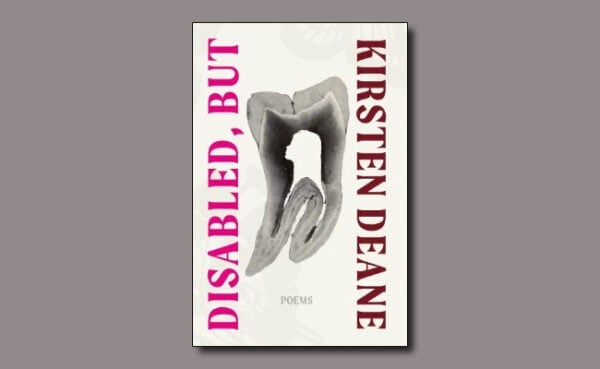
Disabled, but
Kirsten Deane
uHlanga Press, 2026
ISBN: 9781049258331
Kirsten Deane’s debut collection, Disabled, but, is an invitation to the body, and by reading the opening poem you have accepted the invitation. The title might be unconventional with the usage of “but”; however, this is part of Deane’s metaphor for the collection. The “but” takes us on the journey of what comes with disability, and the reader can ask a few questions. The opening poem, with the same title, illustrates how the poet lives within her body and navigates life as a person with a disability.
The body is central in Deane’s collection, which asks the reader to have gratitude towards the body. With these lines in the opening poem: “I’ve heard that my body can be described/ as disabled but also good” (10), the speaker is coming to understand their “disabled” body. Here, the reader is confronted with the idea of gratitude towards the body.
The speaker in the poem “Little pains" is open, honest and direct about the struggles that come with her body, while others might shy away from this type of writing style and topic. Here, we find that boundaries are negated, with lines such as: “Other days, like yesterday, it is my bowel./ I haven't shat in three days. This makes my mother worry” (11). The reader is given an inside view into what is considered as private in society. Deane shows the relationship between the role of the daughter, the “disabled” body and the mother’s concern. It is recognised that the struggle with the “disabled” body is not for one alone, but that there is a shared concern over the “disabled” body.
The speaker seeks comfort from the mother figure in the poem “Bullied”. The lines, “mommy/ tuck me into bed because you know my body bullies me at night”, emphasise the battle with the body (12). The reader is reminded that the speaker’s relationship with their “disabled” body is one that is a continuous battle.
Deane highlights different parts of the body with poem titles such as “Hands”, “Skin and nails”, “Parts of my feet" and “To your vagina”. These focus areas are beautifully woven and show the poetic technique that Deane uses to portray how the body can be separated and still stay within connection. In “Hands”, the speaker is anxious and shows care towards their hands. The speaker reveals bits and pieces of the body through each poem. Often, the speaker in Deane’s collection appears to be exploring the body parts and showing admiration at the same time. This is emphasised by the lines, “I start by chipping away/ at the dead skin” (19). The speaker recognises the dead part of the body, and by “chipping” is removing that which no longer serves the body. Yet, there are also the lines, “The soft, pink skin./ It is obvious here: I was once a baby. It is gentle, smooth” (19). The speaker can find a space where there is redemption for the body; this means that the speaker can recognise different parts of their “disabled” body.
This collection speaks of traditional values; however, the reader will find poems that reveal how traditional values can be undermined. There is strong evidence of how patriarchy and matriarchy influence the speaker’s world. The collection does not shy away from issues that surround the female body and the male gaze. This is shown through the poem “Mommy said”: “She said it’s time you started doing your own hair on a Sunday,/ to make sure it’s done before you see your uncles” (13). Here, the act or routine of washing hair is not done for the owner of the hair, but for the gaze of the uncles, as if to say, “Make yourself pretty for the men of the family.” Additionally, the preparation for men is passed on from mother to daughter, creating a cycle of oppression.
In another poem, “Human nature”, the speaker places the girl at the mercy of the boy, with lines such as, “She believes that his ashy paws/ will make her gentle. She eats what he gives her/ because this is the role of men” (67). Here, Deane positions the girl in a submissive role, where tradition dictates that boys, who eventually become men, are seen as providers. In “Relatives”, the speaker confirms this male gaze with the following lines: “My breasts (and probably yours too)/ have been spoken about/ at family braais on Sunday afternoons” (21). The entire poem shows how women in a family are reduced to body parts, and men are almost praised for just being men. Deane leaves no innuendo about how, even within families, these roles for men and women are put out before girls have had a chance to develop into women. Deane wants to show the reader how women have had the experience of being reduced to a topic at Sunday braais.
Throughout the collection, Deane explores food as a lens to expose different relationships. In the poem “Mommy said”, Deane indicates how the mother is bound through generational traditions to the kitchen, with this stemming from the male (father’s) voice: “Your mother made roast chicken, veggies, and rice/ but didn't eat because she stayed cooking in the kitchen/ because father said it’s what his mother would have done” (13). The speaker illustrates how the mother is placed within the kitchen and is not able to enjoy the meal with the rest of the family. The father inherently places his mother’s role on the mother (wife) – the role of housewife.
This collection does not shy away from addressing eating disorders. The speaker does not name this as such, but illustrates how eating disorders are woven into family dynamics. In “Mommy’s baby”, the opening line, “she force-feeds me” (15), shows that the speaker is rebellious, but that the “she” stands her ground to feed the speaker. This could be an example of a warped version of tough love expressed between the “she” and the speaker. For the rest of the poem, she is waiting for proof that the speaker has eaten the toast. In “How to love your grandparents”, the speaker indicates that the grandmother is pretending not to notice the food on the plate. The speaker is showing the unspoken between family members when it comes to eating disorders. The plate and food are used in the poem “To your vagina” to illustrate how people see that illness is indicated by what is on the plate. In the poem “I'm only looking”, the speaker makes a confession of their weakness through uneaten food. The collection shows that the speaker knows their illness and the influence it has on the people around them. The collection embraces how we often ignore the signs of these illnesses, yet being aware of the small signs helps to start the conversation and recovery.
Kirsten Deane’s debut collection, Disabled, but, is a map of a person living with disability through the lens of poetry. Deane allows her readers to breathe and take note of their bodies (disabled or not). We look forward to what comes after “but” from Deane’s pen.