

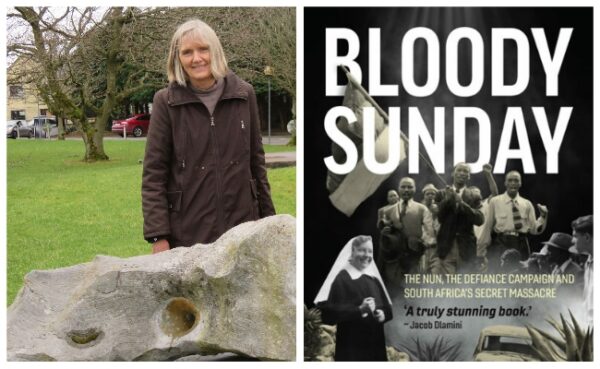
Mignonne with the memorial to Sister Aidan in Tralee, Ireland (picture: provided) and book cover: NB Publishers
Bloody Sunday
Mignonne Breier
NB Publishers
ISBN: 9780624091141
Mignonne Breier, winner of the Sunday Times Literary Award for Non-fiction, answers Naomi Meyer’s questions on Bloody Sunday.
Mignonne, when I saw the title of Bloody Sunday, I immediately associated the phrase with historical events in Ireland (and a U2 song called “Bloody Sunday”, also based on the events over there). Your book starts off with your discovery of the death of Sister Aidan, an Irish nun who lived in the Eastern Cape, and your journey into discovering why she died and the discoveries you made about an important but untold part of this country’s history. Maybe you could start by revisiting the day you opened your mother’s Bible and found the newspaper clip on Sister Aidan and the newspaper clip on the burned-out classroom. And also tell me when you decided that you had to write your discoveries down and turn them into a book.
At some stage in my youth – I don’t remember exactly when – my mother told me about a nun who had been burned to death in the township she served. It was a cautionary tale to discourage me from doing “good works” in the townships across the valley. (I grew up in Grahamstown, which is now called Makhanda.) My parents had lived and worked at various mission schools in what was then the Ciskei and the Transkei in the 1940s and early 1950s, and I knew my mother had been traumatised by events during this period and that this was one of the reasons why they moved to Grahamstown when I was two years old. My mother’s warning made me fearful, but I did not ask for details, and it was many years after my mother’s death that I found out who the nun was when I read an article which mentioned the death of Sister Aidan Quinlan (a Dominican sister and medical doctor also known as Dr Elsie Quinlan). Later, I found in my mother’s Bible two newspaper cuttings that had obviously been very precious to my mother. The one was a photo of Sister Aidan, and the other was of a burned-out classroom. The brief captions said she had been killed and the mission school torched during riots in East London on 9 November 1952. Once I started doing some research, I realised that the events of that day had been largely covered up. Many people I knew, even from the Eastern Cape, had never heard of Sister Aidan, yet she seemed to me to have been a remarkable woman who suffered a tragic fate. Of the few people I knew who were aware of her death, most did not know that there had been a police massacre of location residents before and after her killing. I wrote an academic article which was published in the Journal of Southern African Studies in 2015, but realised that few people were being reached that way, and there was more I wanted to research and say. I resolved to write a book that would explain my personal interest (as my academic field and my PhD were in education, not history) and would be as balanced as possible, so you could not read about the nun without reading about the massacre, and vice versa. I also wanted the book to be accessible to the general reader, while still meeting academic standards of scholarship. The title is intended to resonate with the Bloody Sundays in Irish (1920 and 1972) and Russian (1905) history, in which innocent people were killed by police or army forces. Of course, Sister Aidan was Irish, born and raised in County Cork.
The book is about more than one person’s life story. But you do place your reader in the shoes of the Irish nun it all started with. While reading your book, I thought (and please excuse the oversimplification): countries like Ireland and Northern Ireland sometimes seem to be one country at war with itself. And the same goes for South Africa – albeit with completely different circumstances – the people in one country battling among themselves. I notice that you have travelled to Ireland for research. What have you discovered about the country of Ireland, about its connection to South African events – and about Sister Aidan?
.............
I travelled to Ireland to meet Sister Aidan’s two nephews and niece, who all live in the city of Cork. This is where she lived during her high school and university years. I also wanted to read the 82 letters which she wrote to her family, and which her nephew Maurice has carefully preserved. And I wanted to visit the stone sculpture that was erected in her memory in Tralee. I was surprised at how non-judgmental the family were about what happened to their beloved “Aunty Elsie”. Having been colonised by the British, the Irish understand what it is like to be oppressed and how a violent regime can generate violence between its people. In Irish history, atrocities were suffered; atrocities were committed.
................
I travelled to Ireland to meet Sister Aidan’s two nephews and niece, who all live in the city of Cork. This is where she lived during her high school and university years. I also wanted to read the 82 letters which she wrote to her family, and which her nephew Maurice has carefully preserved. And I wanted to visit the stone sculpture that was erected in her memory in Tralee. I was surprised at how non-judgmental the family were about what happened to their beloved “Aunty Elsie”. Having been colonised by the British, the Irish understand what it is like to be oppressed and how a violent regime can generate violence between its people. In Irish history, atrocities were suffered; atrocities were committed. In the Irish civil war, brothers fought brothers. Sister Aidan’s family might not have experienced the racial antagonism one finds in South Africa, but they had an understanding of police brutality and mob violence. Incidentally, Sister Aidan was an Irish nationalist and a supporter of Éamon de Valera and his policy of neutrality during World War II. This put her in a difficult position when she was studying medicine at Wits during the war. South Africa was fighting for the Allies, and she had many Jewish classmates. But she belonged to a Dominican congregation that originated in Germany, and she came from Ireland, which remained neutral throughout the war, at least officially.
In South Africa, so many historical events can go by unnoticed, it seems. And there have always been invisible people in this country, as well. In Bloemfontein, at the Vrouemonument and South African War Museum, there is a portrait in the Sol Plaatje part of the museum showing black people waiting for trains on the day that the South African War (previously known as the ABW) started. The black people were excluded. And they were excluded from the Remembrance Day events on 9 November 1952, as you tell in your book. They were excluded from important events, but their fate was decided for them, at the same time. Please could you elaborate a bit on your findings about that day - 9 November 1952? Up until the point where Sister Aidan’s car drove by.
Black people were excluded from the Remembrance Day events in 1952 (and in many other years), but they certainly played an important role in both World Wars. As I wrote in my book:
More than half a million South African soldiers served in the two World Wars. Of these, more than a third (over two hundred thousand) were black (African, coloured and Indian). More than eight thousand of these black soldiers were killed and thousands more were injured or taken prisoner. Soldiers of colour worked as trench diggers, stretcher bearers, labourers, hospital attendants, guards, cooks and messengers. They patrolled roads, built bridges, served administrations. With very few exceptions, they were not allowed to carry arms, despite many appeals to do so. Racial prejudices and fears (that blacks who carried arms for their country would have greater claim to the vote or that they might one day use such arms against whites) were at the heart of the government’s insistence that they play a non-combatant role only.
On their return, black and white ex-servicemen were treated very differently. In East London, white ex-servicemen were provided with pleasant, subsidised houses. Black soldiers had to return to their overcrowded locations and gained none of the rights they had been promised during recruitment campaigns. On 9 November 1952, there was a whites-only Remembrance Day service at the Cenotaph in East London at the same time as a meeting of prayer and protest in Duncan Village.
You follow the story of Sister Aidan and why she became a nun. Of course, being part of the Catholic Church in Ireland comes with baggage of its own. And religious practices have caused numerous atrocities throughout history. Mission work can be a tricky subject - one might raise questions about power, control and choices. But having said that: one should not throw the baby out with the bathwater. Sister Aidan wanted to make a difference in South Africa. She came from a deeply divided country with political issues of its own. And she ended up in the Eastern Cape, a few decades after the Frontier Wars in the area. But there are many people from many different backgrounds living in this area. Can one individual’s life choices really change a lot? (I have to say: I thought about another hugely important historical event in the Eastern Cape and one individual’s impact on society – namely Nongqawuse, the Xhosa prophet, and the effects her dreams had on the Eastern Cape.)
.............
I do think the killing of Sister Aidan had an enormous impact on the Eastern Cape, at least. The Defiance Campaign came to an abrupt end after the “Bloody Sunday” and fizzled out elsewhere in the country, so that by the end of the year it was effectively over.
................
I do think the killing of Sister Aidan had an enormous impact on the Eastern Cape, at least. The Defiance Campaign came to an abrupt end after the “Bloody Sunday” and fizzled out elsewhere in the country, so that by the end of the year it was effectively over. The National Party used the event (and the violence in Port Elizabeth, Johannesburg and Kimberley before that) as an excuse to introduce even more draconian legislation. In early 1952, it introduced the laws which made it a criminal offence to break a law by way of protest against that or any other law, introduced severe penalties and allowed the state to declare a state of emergency to maintain public order. In Duncan Village, a pall of shame descended on the location that lingers still for many people, even though they realise that their own losses, at the hands of the police, have not been fully acknowledged. So, it is a mixture of shame and resentment.
It becomes clear that Sister Aidan started caring for the people from all walks of life, in a country where the white people chose not to care about what went on (goes on) in townships. She not only cared, she became involved with important political figures of the time. Some of today’s readers may ask, in fear: but is this the price of freedom, of becoming involved, of caring? Is there no other way – a happier ending to becoming involved and caring? Did your discoveries not sometimes leave you feeling desperate and sad?
We need to remember that in 1952, it was two young African boys from Duncan Village who ran to the mission to warn the remaining nuns (two German, five African) and the Irish priest that they were about to be attacked and ensured they could be driven to safety. They knew the sisters. Women who had been treated by Sister Aidan gave evidence for the prosecution, even though they risked being killed by community members for doing so. One was severely injured in a community attack and “disappeared”. I am sure there have been as many instances of heroic generosity over the years as there have been of savage brutality. But white people cannot ignore the backlog of resentment about the enormous inequalities in this country and the suffering which apartheid, and policies of segregation before it, brought about for black people. The resentments linger still, although the colours of inequality have changed somewhat with the growth of a wealthy black elite. Nonetheless, whites remain the face of oppression. This is what puts us at risk in a black township.
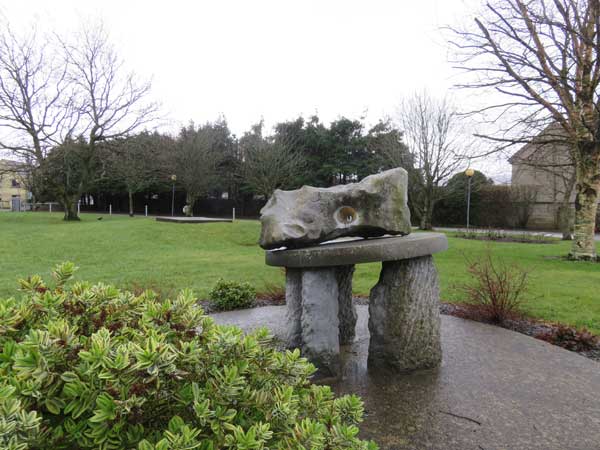
The memorial to Sr Aidan in Tralee, Ireland (picture: provided)
In Bloody Sunday, we read about protests and about violence, about unheard voices and about anger and hurt. How was 9 November 1952 different from today?
Not much. There have been repetitions of police brutality and mob violence over the years. The difference is that the press covered the other events: in 1960, we had the Sharpeville massacre, in which 69 people were killed. In 1985, there was another Duncan Village massacre, in which 32 people were killed by police over a few days. The difference was that the press covered the events extensively. There was a commission of enquiry after Sharpeville, and both that massacre and the 1985 massacre were later explored by the Truth and Reconciliation Commission. The Marikana massacre is a recent reminder of the potential for history to repeat itself if we do not learn from our mistakes.
Why should this story be told? Why should people know all aspects of history, depressing as it may be?
If we are interested in achieving reconciliation across the racial divides in our country, we each need to make an effort to understand the other and to face and acknowledge our own contribution, or that of our ancestors, to the centuries of conflict. We need to learn to tell of the moments in our history when we were perpetrators of evil, as well as the moments when we were victims or heroes.
.............
If we are interested in achieving reconciliation across the racial divides in our country, we each need to make an effort to understand the other and to face and acknowledge our own contribution, or that of our ancestors, to the centuries of conflict. We need to learn to tell of the moments in our history when we were perpetrators of evil, as well as the moments when we were victims or heroes.
...............
There are organisations that are building bridges across our racial divides while also seeking to support the communities in which they are positioned. I think the Sister Aidan Community Centre is an example. It was built in 2016, largely out of donations from the German relatives of a Dominican nun, and is situated at the St Peter Claver parish in Duncan Village, where Sister Aidan used to live and work. Here, local people and Dominican sisters together are involved in a living memorial to the “Sister-Doctor”, running feeding schemes and youth programmes. There is talk of the St Peter Claver site being turned into a place of reconciliation and pilgrimage one day. Having visited it many times, I think it is already such a place.
Your book tells the story of Sister Aidan, but this story illuminates all the other stories which have not been told, now told for the first time. African people died, and their lives mattered as much as Sister Aidan’s or Barend Vorster’s. Is this book also a tribute to them? A way of saying: so many people live in this country; see them, listen to them - while they are alive – but also care about their deaths? “No one was tried or convicted for the killings of black people on Bloody Sunday.” What are your thoughts?
Yes, I do think this book is a tribute to the many people whose deaths on “Bloody Sunday” were not recorded. Although police kept an informal record of numbers, they did not record names, and neither did community members, most likely because anyone associated with the events – even those who were killed by the police – could be regarded as having been involved in the nun’s murder, and their families would also be at risk of arrest. It has generally been thought that no names survived, but I did find the names of eight people whom the police admitted to killing, in an inquest. They are on page 147 of my book, Bloody Sunday. I am now trying to expand this list and have appealed to people to come forward with names.
The story of Bloody Sunday is a story about “love, about killing, about loving again” (236). It is a story filled with pain and with passion. How do you feel, now that you have told the story? Have you heard other people telling their stories?
Since my book came out, many people have contacted me with their memories of the time, including a leader within the Dominican congregation who was 15 at the time and whose father was a lawyer in the Transkei. She said she has known since childhood that hundreds of black people were killed. Other white people from East London have told me that they heard the screams and saw the fires in Duncan Village that day from their homes in white suburbs. Several saw frightened people fleeing the city. At the 70th anniversary event on 9 November this year, elderly Duncan Village residents spoke of their memories of Sister Aidan and of Father O’Malley, the priest at St Peter Claver at the time. “They were the first white people to treat us with respect,” one man said. Several at that meeting said the Catholic Church should declare Sister Aidan a martyr of the faith and a saint, and that a hospital and roads in East London should be named after her.
The future. Can you foresee any effect this particular past event – on Bloody Sunday in the Eastern Cape – might have on the South African future? Also: why should stories be told – painful stories and stories which are not popular to tell?
I hope my book has opened the way for other people to write about the really difficult subjects of our past, when both sides committed atrocities, when the subject matter is regarded as taboo. I hope it will open up conversations about the times when the ANC national leaders such as Nelson Mandela and Walter Sisulu, who have been idolised, were less than heroic. I hope it will remind politicians of the dangers of ignoring the youth and the marginalised and of political infighting when your followers are struggling to survive. On the other side, I want to remind those who seek to do good to learn from the ambiguous relationships and misunderstandings that can occur between missionaries and the people they seek to serve and convert.
Also read:
Press release: Mignonne Breier wins Sunday Times Literary Award for Bloody Sunday