

Ukraine and belonging
A Ukrainian friend, Dzvinka Kachur, known in this magazine[1], invited me to explore how my war poetry is connected with Ukraine and the current war, initiated by Russia in 2014. These autobiographical notes show my connections with the whole region, including former East Prussia (now in current Poland and in the Kaliningrad Oblast), Armenia, Moldova and Ukraine, but in particular the city of Odessa.
Opening the gates of poetry through the eyes of a filmmaker
In 1984, I saw Sergey Parajanov’s film The colour of the pomegranate. The film depicts the phases in the life of a medieval Armenian monk, mystic and poet.

Parajanov filmed in Ukraine and was highly lauded there, as a stamp issued in independent Ukraine in 1999, above[2], shows. Parajanov’s work inspired a series of poems dedicated to my cousin John Fransen, who worked for Medicine without Frontiers and died in a car crash on 30 September 1988 near Komatipoort[3]. I followed John’s spiritual development through the eyes of the Armenian mystic.
The second door of poetry
The downing of Malaysian Air flight MH17 on 17 July 2014, which took the lives of 283 passengers and 15 crew members, started a trail of discoveries through eastern European poetry.
At the Poetry Festival in McGregor in August 2016, I presented a slot, “Poets between war and reconciliation: An iconic journey into Ukrainian-Russian poetry”. I explored a possible poetic dialogue between Ukraine and Russia beyond the increasing conflicts in Luhansk, Donetsk and Crimea, which were initiated by violent Russian interventions and occupations.
“Poets between war and reconciliation” was my first exploration in the rich domain of Ukrainian poetry during the last 200 years, and brought me into close contact with poets like Taras Shevchenko (1814-1861), Ivan Franco (1857-1916), Volodymir Sosiura (1898-1965), Grigori Chubai (1949-982), Boris Khersonsky (1950-) and Oksana Kutsenko (1975-).
Family connections
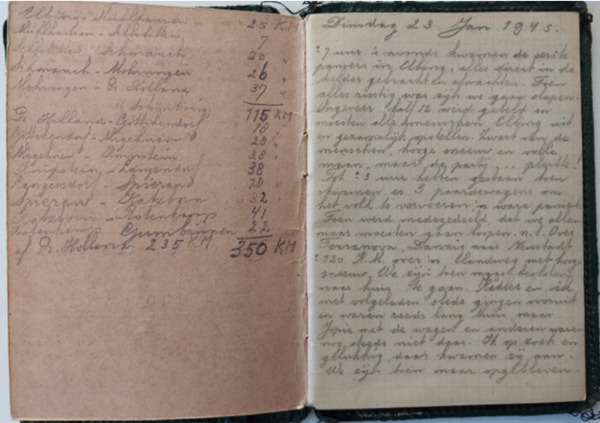
War diary of my father, Jacobus Koetsier (1915-2009), written between 23 January (Elbing) and 18 September (Paris) 1945
The war diary of my father, Jacobus Koetsier (1915-2009), opened another avenue. My father was a violinist. To escape forced labour in the German arms factory, as imposed by the German occupational forces in the Netherlands, he managed to get a job as a violinist in the local orchestra of Elbing in East Prussia (now Elbląg in Poland).
My mother joined him, and my elder brother was born in Elbing on 2 November 1944. At the end of January 1945, the Russian army destroyed Elbing and the family was deported behind enemy lines[4]. They stayed in Ukraine between 23 April and 10 July 1945, among others in the city of Chernivtsi (in the diary called Czernowitz)[5], not far from the current Romanian border.
Not only did my father’s diary raise my attention about Ukraine, but through background studies I learned about the connection between Chernivtsi and the concentration camps in Transnistria in current Moldova[6]. Transnistria is again a problem area in the current war in Ukraine due to Russian military interference.
My parents reached the Netherlands via Paris on 18 September 1945. My brother
never left Paris, as he passed away there on 12 September 1945. Since 2013, some of my close family members have married partners with Ukrainian family connections.
Madame Blavatsky of Dnipropetrovsk (since 2016, Dnipro)
Another connection with Ukraine started through the Theosophical Society and the works of Helena Petrovna Blavatsky (1830-1891).
I was 17 years old when I discovered her work and became a member of the society in 1975. Her work laid the basis for a spiritual connection with Ukraine.
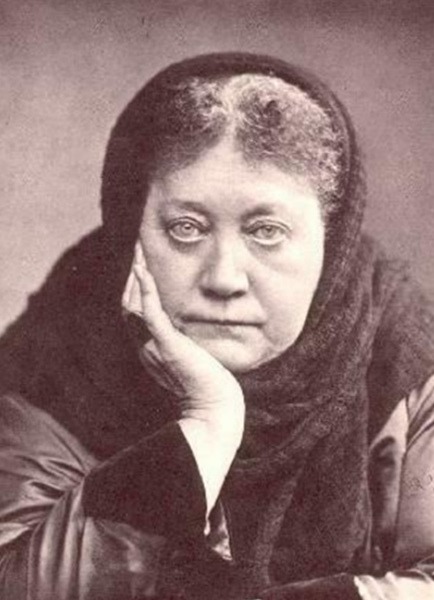
Helena Petrovna Blavatsky (1830-1891)
The objectives of the society are very relevant for the current situation in Ukraine.
There is no religion higher than truth:
- To form a nucleus of the universal brotherhood of humanity, without distinction of race, creed, sex, caste or colour.
- To encourage the comparative study of religion, philosophy and science.
- To investigate unexplained laws of nature and the powers latent in humanity.
A novice in Ukrainian
About three years ago, I started my study of the Ukrainian language. My teacher, Oleysia Loubser, not only guided me through the labyrinth of Ukrainian grammar, but also unfolded the deep Slavonic meaning of the language and its indigenous traditions, which often date back to before the days of early Christianity in Ukraine. I studied songs and poems in Ukrainian, especially those of Ivan Franco and Oksana Kutsenko, and made attempts to write poetry in Ukrainian with the help of Ukrainian native speakers and poets.
My own war poetry since 2014
The tragedy of war, so carved into the memory of my own family, created a base for contemplations about the increasing conflicts between Russia and Ukraine since 2014. The following elegy commemorates the death of 198 of my Dutch countrymen and countrywomen on Flight MH17.
Touching a lifesaving archetypical raft
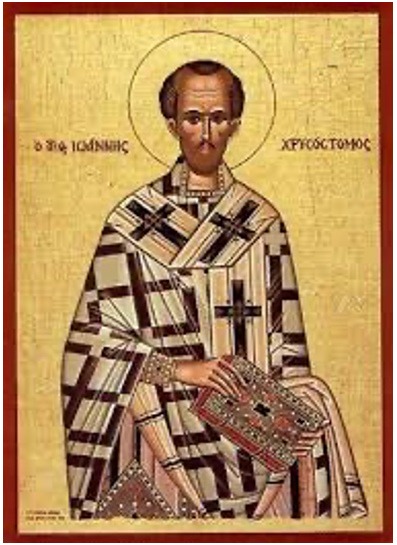
Christos voskrese, Christ is risen[7].
In the dim light of a fading candle, I see Your precious face.
The Basilica is filled with your presence.
My brush strokes recreate you on walls and tablets,
iconic, beyond my ability to depict You.
I touch Your head.
A throbbing pain enters my veins.
Deep bass voices arise in veneration of your everlasting presence.
Chrysostom’s[8] Hymn dedicated by the Patriarch of Old Lore.
Amidst raging winter storms, I write the sacred words that connect us.
But alas, Russians and Ukrainians clash and fight till all humanity is drained.
Missiles are launched and 296 people die.
Am I the magician who may restore their lives?
In the depth of my heart, I search for the power to fulfil my mission.
I surrender on the floor of the half-destroyed church.
The snow slowly descends on the remnants of the altar.
Who are Thou, driver of my inner healer?
The sun rises on snow-clad landscapes.
I enter a farm and rest among the cows.
Their graceful eyes meet mine
as they breathe wafts of warm air that fill the stable.
The seasons change.
The fields are adorned with yellow flowers.
I hear you sing and dance.
You break the dark spells.
In the waving corn the birds are the thinkers.
A red fox and her young, nobody chases them.
The river is as a bloodstream that powers my brain.
I watch till night falls.
The stars accompany me to a bed of straw.
Night is my pillow and the Lord is my Shepherd
on the path I have not yet discovered.
I eat kasha[9] and your homemade vodka lubricates my brain
till everything is transparent and smooth.
– Stellenbosch/Somerset West, 3 September 2014
Obliterated steps
A poster published on 24 August 2022, the 31st Independence Day celebration of Ukraine, to commemorate the death of 376 children, led to the creation of the poem, “Obliterated steps”.
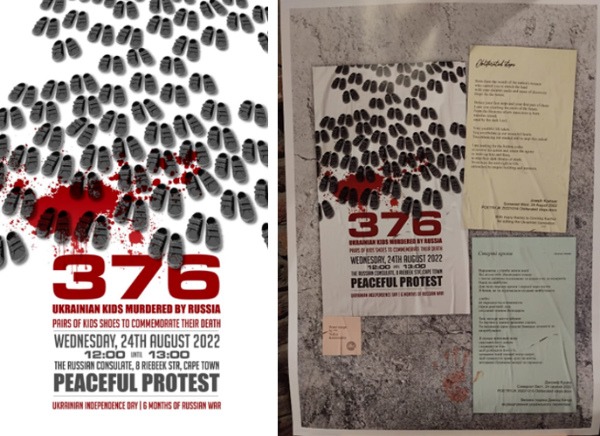
There are versions in English, Dutch and Ukrainian. The English and Ukrainian versions have been published as a poster that was on display on 24 February 2023 in the Homecoming Centre in Cape Town during the commemoration of one year of war in Ukraine on 24 February 2023.
Obliterated steps
Born from the womb of the nation’s women
who carried you to enrich the land
with your childish smile and sense of discovery.
Hope for the future.
Before your first steps and your first pair of shoes
I saw you climbing the stairs of the future.
From the heavens where innocence is born
missiles rained,
sent by the dark Lord.
Your youthful life taken.
You reverberate in our wounded hearts.
You enhance our steeled will to stop this ordeal.
I am looking for the hidden codes
to reverse his action and return the agony
to wake up him and them,
to stop their dark theatre of death.
To reclaim the soul-right to life,
untouched by empire buildings and paranoia.
– Somerset West, 24 August 2022
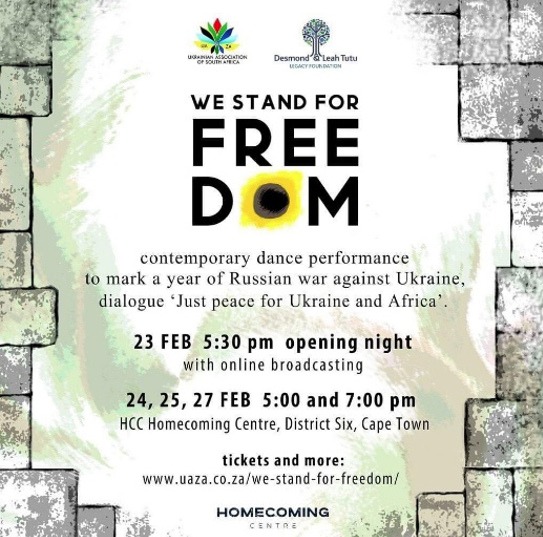
A ballet and music for strings in four tableaux
On that day, a cross-cultural ballet was performed, created by Ukrainian choreographer Kateryna Aloshyna. The ballet explored the experience of freedom and how to process the pain of conflicts and wars in a common space between Ukraine and South Africa.[10]

Scene setting
I am in hiding but remain visible for the world.
I weave carpets of possibilities on the grids of four closed doors
and park my luggage at the frontiers of my beloved realm:
a suitcase,
my child’s backpack,
a bear.
The daily news narrated by the airwaves of self-proclaimed heroes
scatters my being.
I wander in the borderlands where violence has no access
to discover that every problem has a solution.
Four bodies express the acrobatics of a universe of feelings.
Music and poetic lines show the direction for further explorations.
While I review the webs spun by the past
I weave another carpet in the safe zone of a quite backstage scene.
The wildness of emotional eruptions reached its fulfilment.
A carpet in eternal blue and yellow emerges,
adorning the goodness of the African hosts.
Do I return home driven by the anxiety of belonging?
Agonising female and male pain.
From the underground we crawl back into the light.
I am again weaving a carpet of possibilities.
How to experience my self-imposed captivity?
Eight hands showing squares in a tableau vivant.
I take a still picture to capture the moment,
and to allow maturation in solitary confinement.
Eight hands weave again.
More strings are attached.
The women untie the grids.
The men follow.
The open doors move and line up as a passage to freedom,
with a central heart.
Again, new red ribbons are added to ever-moving patterns of complexity.
And we, the audience, are invited onstage to add more strings.
Odessa in my father’s war diary
My father hoped to reach Odessa to find a route out of the USSR. My parents ultimately took a different route over land, via Berlin, which ended in Paris in August 1945.
I explored issues related to the destruction of museum collections in eastern Ukraine and followed up warnings published from Egypt[11] about the protection of Egyptian collections in Ukraine. This brought me again to Odessa.
Black Sea
My poetic link with Odessa generated the poem, “Black Sea”, dedicated to the poets of Ukraine and in particular to Boris Khersonsky, who lives in Odessa, having decided to stay put there.
Black Sea
Dedicated to the poets of Ukraine
Who speak all languages of the world
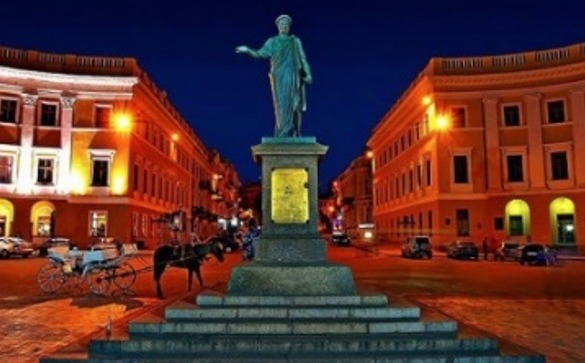
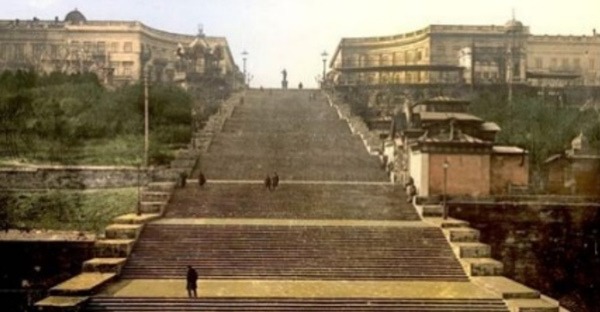
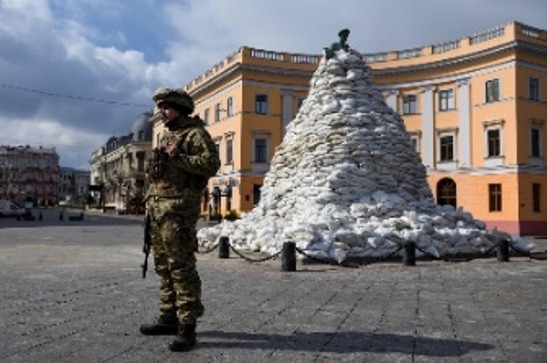
Potemkin’s steps with an exit to the sea.
The jewel in the crown,
Odessa under siege.
Shock waves penetrate the streets,
man-made earthquakes!
I hide behind the barricades of sand bags near museums and statues.
We protect our treasures with an indomitable spirit.
They shall not destroy the art of ages.
We hide them in corridors,
in the underground labyrinth of the city.
You and I fill more bags with the sand from our beloved beaches
to keep the shrapnel out.
In the darkness of the night the sea creates
a new horizon of the future.
Boris Khersonsky composes a poem.
Facebook carries his imagination beyond dreams.
We will unwrap the statues when time is ripe
and the missile-conducted tsunamis are over.
The joyful voices of playing children in the parks have returned.
We speak each other’s languages,
beyond any considerations of spelling and intonation.
The evil fleet rests at the bottom of the attacking sea.
The waves turn to the south and crash on the Turkish coast.
The last Sultan sends his grace over the adjacent lands,
reciting the suras with the precious names of Allah[15].
Epilogue
May the war in Ukraine be a wake-up call for the whole of humanity and lead us beyond the male archetypical dictator syndrome on our planet.
There is a sacred feminine calling, but also a sacred masculine energy in all of us. We need, as a human family, a more active engagement with that dimension of being.
Joseph Koetsier, Somerset West, 2 June 2023
[1] Dzvinka Kachur, Hannah Yanovska, “Stories from Stellenbosch and Kharkiv” (3 March 2022 at 9:50), LitNet 2022-03-03. www.linet.co.za/stories-from-stellenbosch-and-kharkiv-dzvinka-kachur-and-hannah-yanovska
[2] https://parajanov.com/stamps/parajanov-com-sergei-parajanov-ukrainian-stamp/
[3] Jos Koetsier, John (1949-1988) of de spiegel van een leven / John (1949-1988) or the mirror of a life. Groningen, 1989, and Somerset West, 2018 (partially bilingual Dutch/English).
[4] See the site of the “Society of the German minority in Elbing” about that period. Click on https://www.elbing-land-familienforschung.de/seite117.html for detailed historical information about the rebuilding of Elbing/Elbląg. The site is available in German and English.
[5] They stayed there between 25 April and 3 June 1945.
[6] Marianne Hirsch and Leo Spitzer. Ghosts of home: The afterlife of Czernowitz in Jewish memory. University of California Press, 2010. 362 pages.
[7] Church Slavonic (Христос Воскресе) for “Christus surrexit, Christ is risen”.
[8] John Chrysostom (347-407), Archbishop of Constantinople, venerated in Western and Orthodox Eastern Christian traditions (see www.orthodoxwiki.org/John_Chrystom).
[9] Buckwheat, staple food in Russia and the Ukraine.
[10] https://citylifearts.co.za/we-stand-for-freedom-dance-piece-created-bysouth-african-and-ukraine-artists-puts-spotlight-on-role-of-art-in-war-situations/
The “We stand for freedom” dance piece, created by South African and Ukraine artists, puts a spotlight on the role of art in war situations. 20 February 2023, by Edward Tsumele, Citylife/Arts editor.
Also see https://www.uaza.co.za/we-stand-for-freedom/.
[11]Gomaa, Ahmed, “Egyptian antiquities at risk in Ukraine”, Al Monitor, 10 March 2022.
This article became the basis for a more detailed study and a lecture about the situation in Odessa in “Joseph Koetsier, Ukrainian Egyptology and the Egyptian Collection in the Odessa Museum of Archaeology”. The Egyptian Society of South Africa (Tessa), 24 May 2022.
[12] https://discover-ukraine.info/places/southern-ukraine/odesa/783
[13] https://www.facebook.com/705238579526534/posts/contemporary-ukrainian-poetry-by-boris-khersonsky/5290542407662772/
[14] https://www.rollingstone.com/politics/politics-features/ukraine-odessa-russia-putin-invasion-1321204/
[15] https://en.wikipedia.org/wiki/Names_of_God_in_Islam
Reference: POETRYJK 20230602 Between War and Reconciliation An engagement with Ukraine through film a war diary and poetry.docx/pdf
See also:
Godsdiens, oorlog en sneeuklokkies in die winter van Oekraïne
Kommentaar
Excellent essay!
Bravo, Jos Koetsier. Beautiful, poignant!!