

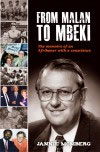
 Title:From Malan to Mbeki
Subtitle: The memoirs of an Afrikaner with a conscience
Author: Jannie Momberg
Publisher: Benedic Books
ISBN: 978098144088-0
Click here to buy From Malan to Mbeki from Benedic Books.
The book From Malan to Mbeki was published by Benedic Books. Nico Elema tells Naomi Meyer some of the stories behind Jannie Momberg, the man who stood up for what he believed.
Hi Nico, and thanks for the opportunity to have a chat about the book From Malan to Mbeki. Please give our readers some background about this book. What drew you to the material in the first place, ie what was the main reason you published this book?
For me, this book is not about agreeing or disagreeing with Jannie Momberg's political viewpoints; this book is about a man who believed in and followed his conscience.
We all do things that other approve or disapprove of, but in the end, I see Jannie Momberg as someone who did things for what he believed in. So this book is Jannie Momberg's memoirs, taking the reader on a fascinating, and sometimes humorous, journey from his early years growing up in a Nationalist household with family friends, among others, Dr DF Malan and John Vorster. Jannie further recalls his days as member of the National Party and sports administrator where, among other things, he was Zola Budd's manager. Jannie also recalls the time when he left the National Party, the forming of the Democratic Party and his subsequent joining of the ANC. A chapter in the book is also devoted to his time as ambassador to Greece until his retirement. The book concludes with letters from Pieter Labuschagne (Zola's trainer at one time) and Dr Nkosazana Dlamini Zuma, written after his death in January 2011. We also sourced two of his most notable speeches from parliament which provide fascinating reading. Notably, the foreword of the book was written by Ahmed Kathrada.
This book is about an Afrikaner in parliament – a man who worked for the NP, but who started questioning everything the NP stood for. It was really interesting for me at the book launch to listen to Trevor Manuel’s words about Momberg (“Parliament is a boring place now that Momberg isn’t here anymore”). Clearly a colourful man who touched people’s lives across cultural boundaries. But are fellow “Afrikaners” still interested in stories like his? Why read a story about Momberg now?
This book was not written just for “Afrikaners” – who, in any case, I know will find this an interesting read. Many "Afrikaners" saw him a traitor for leaving the NP and eventually ending in the ANC, but more than a decade later this book provides insights into why he did what he did. The book was further written for a wider audience, as is evident from the fact that the book was originally written in Jannie's plain-spoken English, and an easy read for everyone.
Talking about Trevor Manuel at the book launch: the launch took place in a very unusual place – parliament in Cape Town. Lovely setting, and unique. But why parliament? Would it not have been more inclusive for the wider public to have had the launch elsewhere as well?
Jannie recalls in the book that one of his biggest dreams was to become a Member of Parliament, and for this reason we saw it as fitting to have the media launch in parliament, with senior politicians, friends, family and selected guests. But people also want to interact with the writer, so in the absence of Jannie himself, we are planning book discussions where a wider audience can meet Jannie’s widow, Trienie, and his sons, who will also recollect their experiences as penned by the late Jannie in his memoirs.
Which part of the book is your favourite – or which part do you find the most interesting – and why?
There are many very interesting parts in the book. Maybe the behind-the-scenes look during the Helderberg elections with Chris Heunis, and also the time when Jannie joined the ANC, where he also recalls the time when he anticipated a gunshot in the back walking from his parked car to his house. The speeches from parliament are also very insightful.
There are also various humorous anecdotes, such as the incident where Jannie and three friends were asked to dig the grave of the late DF Malan where the soil was so hard that they asked the local, coloured, grave-digger to dig – with no one any the wiser!
This book is no murder mystery, nor a love story. It is not packaged as a holiday read. If you had to give people a reason to buy this book, what would it be?
Why is it not a holiday read? For anyone who knew Jannie Momberg, or knew about him, or anyone who is in the least interested in South African politics, this book makes for interesting and fascinating reading. It was also written in “plain English”, if I may call it that, and really is an easy read for anyone, any time.