

Marina Louw of the Climate Justice Campaign answers a few questions about the anti-fracking rally that was held in Nieu-Bethesda.
Nieu-Bethesda's anti-fracking rally was held on the weekend of 28-29 July. What was the motivation for organising the event, and why specifically in Nieu-Bethesda?
Earlier this year I was commissioned by UKZN to write a case study on environmental justice as it pertains to the proposed plans for shale gas development in the Karoo, as part of the forthcoming CCS-EJOLT report on resistance to fossil fuel extraction in Africa. I decided to co-author this study with Jolynn Minnaar, a film-maker who is originally from Nieu-Bethesda, who is currently making a documentary about fracking called Unearthed. Jolynn's interviews with emerging farmers and other community members in Nieu-Bethesda formed a large part of our report.
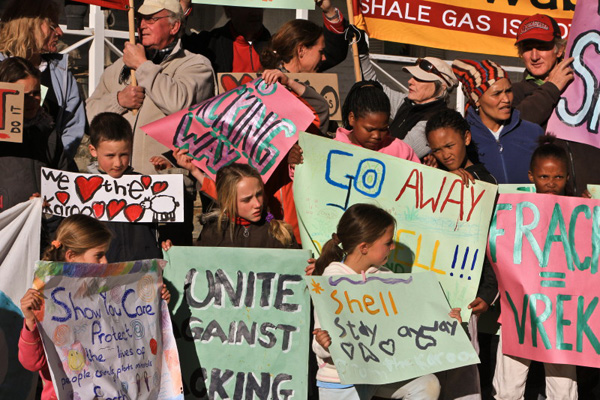
A diverse array of people gathered to protest the prospect of fracking in
South Africa in Nieu Bethesda on 28 July, Global Anti-fracking day.
They included schoolchildren, emerging farmers, commercial farmers,
Khoi-San representatives and Bikers against Fracking.
Our conclusion was that environmental justice was already being threatened for marginalised, rural Karoo communities, as they have been largely uninformed and excluded from the national debate on fracking. We identified a lack of simplified resource materials, without industry bias, as a key limiting factor in reaching out and informing these communities, and as an outflow of our study we decided to develop such materials. We also found that where these communities have been made aware of the plans to drill for shale gas, and the environmental and social repercussions this is likely to have, they were as concerned and opposed to these plans as landowners and others opposed to fracking. People in the Karoo regard water as holy, and are deeply concerned about both water scarcity and the possibility of contamination.
We had already been planning to do a workshop to introduce the material we had developed in Nieu-Bethesda, where Jolynn's family had offered to host us, when we became aware that Mikey Wentworth was organising an anti-fracking weekend, with a concert by Steve Newmann and Greg Georgiades on 28 July. It became a simple matter of joining in the weekend's activities by adding our workshop to the programme. Mikey also supported the idea of an anti-fracking rally, to give a platform to the many and diverse voices against fracking that were already present in Nieu-Bethesda, but that were not being heard. (There were also anti-fracking rallies in other parts of the world on 28 July as part of Global Anti-fracking Day, so this coincided rather nicely with our own local efforts.)
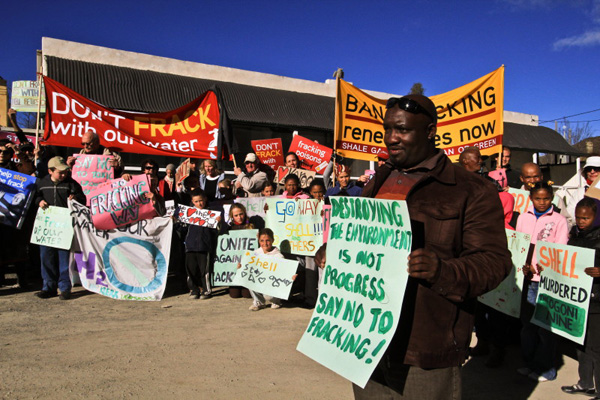
Amos Dyasi of the Southern Cape Land Committee (an NGO supporting farmworkers and emerging farmers)
voices his worries that fracking will result in job losses on farms.
What were the most important outcomes of the event? Did you guys as a group set any concrete goals to achieve, or did it have to do mainly with raising awareness?
The workshop and rally had different goals. The purpose of the workshop was to introduce and make available the simplified resource materials we had developed to reach marginalised, rural communities. Unless those with resources reach out to those who don't, to inform them and empower them to take part in a discussion on a subject that will profoundly affect their immediate environment and future, environmental justice will not be achieved. We included a strategy session at the workshop, to discuss ways in which this could be facilitated. The outcome was positive, but is still in the early stages - much more needs to be done to get this project off the ground, but at least we have started a conversation and very positive connections have been made.
The workshop was widely advertised, and all were welcome, but we also specifically invited the Sneeuberg Emerging Farmers Association in Nieu-Bethesda and the Southern Cape Land Committee, which has been doing excellent work in spreading awareness about fracking among landless people and emerging farmers in the Karoo. We also invited landowners from the area and throughout the Karoo, as well as many others who are already involved in the fight against fracking.
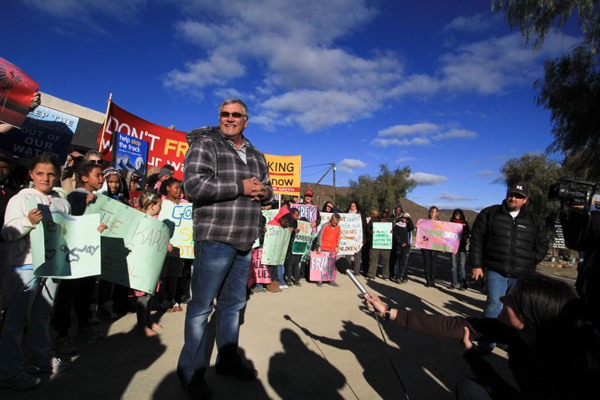
Professor Gerrit van Tonder of the University of Free State’s
Institute for Groundwater Studies told the crowd that his studies over the past few months
had led to his conviction that fracking fluids WILL contaminate groundwater if it is allowed.
Although the purpose of the rally was also to raise awareness, in the first instance it was to give a platform to the voices in the Karoo that we knew were already there, such as those of the Sneeuberg Emerging Farmers and other locals from Nieu-Bethesda. With the media coverage that we received, particularly through SABC’s 50/50, which came to film the events, we hope that we achieved that. Everyone who was at the workshop also joined the locals at the rally.
On Facebook and the karoospace.co.za website quite a lot of emphasis is placed on the fact that "fracking is not divided along racial lines". Mike Wentworth also mentioned, "Many people still see the entire South African anti-fracking lobby as serving the interests of white middle-class landowners ..." Do you agree with this? How did the weekend's rally challenge these perceptions?
There has been a concerted effort by politicians like Chris Nissen to divide the anti-fracking campaign along racial lines and to create the impression that it is mainly white, middle-class landowners who are against fracking. The Karoo Shale Gas Forum, which is funded and supported by Nissen, claims to speak for all the coloured residents of the Karoo, who are supposed to be in favour of fracking. However, this is patently false. First of all, many black leaders such as Dini Sobukwe and some municipalities in the Karoo have already spoken out against fracking, as has the Southern Cape Land Committee - the Karoo Shale Gas Forum certainly does not represent their views or have their support. Secondly, we found that there are many voices in the Karoo among emerging farmers, and even in poor rural communities, who understand the threat that fracking poses to the scarce water supplies in the Karoo, and that no short-lived economic boom is worth the pollution and contamination that will ensue. The rally in Nieu-Bethesda aimed to give some of these voices a platform in the national debate on fracking.
Phumi Booysen of the SCLC put it very clearly when he said at the rally that "One of our key challenges is to ensure that this campaign is not seen as one where white people alone say no to fracking. Black people also say no to fracking. Fracking will affect every one of us, no matter who we are."
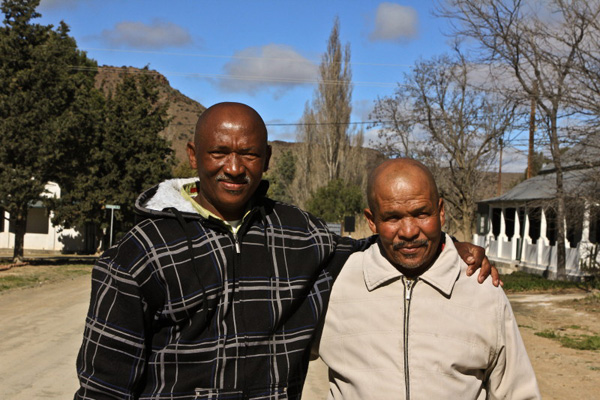
Danyl Vywers and Jan Lottering of the Sneeuberg Emerging Farmers Association, say they fear that
fracking will take away what farming has given them – a chance for dignity and income.
A very diverse group of people was present at the rally, ranging from scientists to farm workers. Did the organisers set out with the goal of bringing together such a diverse group, or do you find that people from these backgrounds step forward to express their interest and concerns of their own accord?
We did not specifically set out to bring together such a diverse group, but because of the nature of the events on the weekend which culminated in the rally, it naturally developed like that. Mikey Wentworth had organised the rally locally, including people from all sectors of society in Nieu-Bethesda. Those who had attended the workshop then joined the locals at the rally. Some of the local people (like Aunty Evelyne Olifant) came forward to speak of their own accord, but I had also asked specific individuals, such as Danyl Vywers, an emerging farmer whom I had come to know through the Unearthed interviews, to speak. Gerrit van Tonder, the groundwater scientist from Bloemfontein, was in town for an interview with 50/50 and graciously agreed also to say a few words at the rally, as did Roy Stauth, an environmental economist based in Graaff-Reinet.
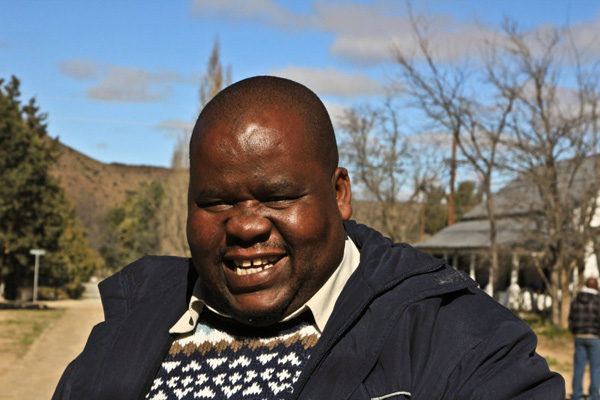
Phumi Booysen of the Southern Cape Land Committee said
one of the key challenges was to make sure that the campaign
against fracking was not seen to be only a white one. Black people were also saying no to fracking.
“It will affect us all, whether we are black or white.
The emerging farmers from the Nieu-Bethesda district were joined by the Southern Cape Land Committee representing farm workers and emerging farmers in the Central and Eastern Karoo, as well as local commercial farmers, townspeople and schoolchildren of all races. Other individuals from all over South Africa had heard of the rally through the media and came to give their support. These included Soweto-born Mthunzi Ndimande and renowned photographer Santu Mofokeng, who came all the way from Johannesburg, Khoi-San representatives Priscilla de Wet from the First Indigenous Women's Movement, Joy Owen from Grahamstown, and a group of Bikers against Fracking who drove up from Plettenberg Bay.
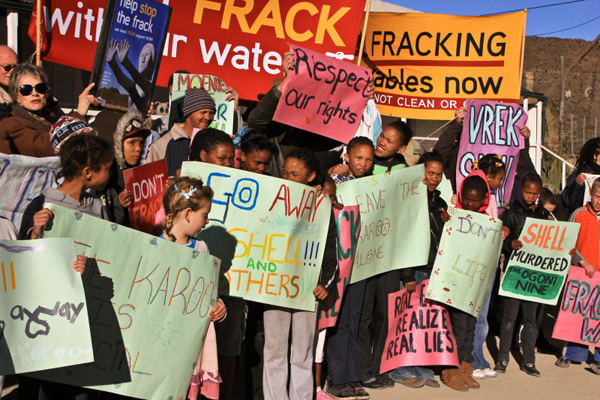
The anti-fracking rally included members of all communities in and around Nieu Bethesda and Graaff-Reinet,
and attracted people from as far afield as Cape Town and Johannesburg.
What kind of further rallies and awareness campaigns are being planned to follow up on the weekend's event? How can these events have a real impact on the issue?
Unless people speak up and let their voices be heard, decisions will be made on their behalf which do not necessarily have their best interest at heart. So far our government has failed to engage Karoo communities on this issue. We hope that the rally has helped to amplify these voices from the Karoo, so that our government will take note and listen. It will be a travesty of environmental justice if the Karoo was to be handed over to multinational oil and gas companies such as Shell, who have a history of environmental and human rights abuses, at the expense of the people of the Karoo, who at the very least have a right to know how this will affect them. The workshop and rally in Nieu-Bethesda are hopefully just the beginning of many more, and we hope that they will have served both to raise awareness and to inspire others to join in the campaign against fracking.
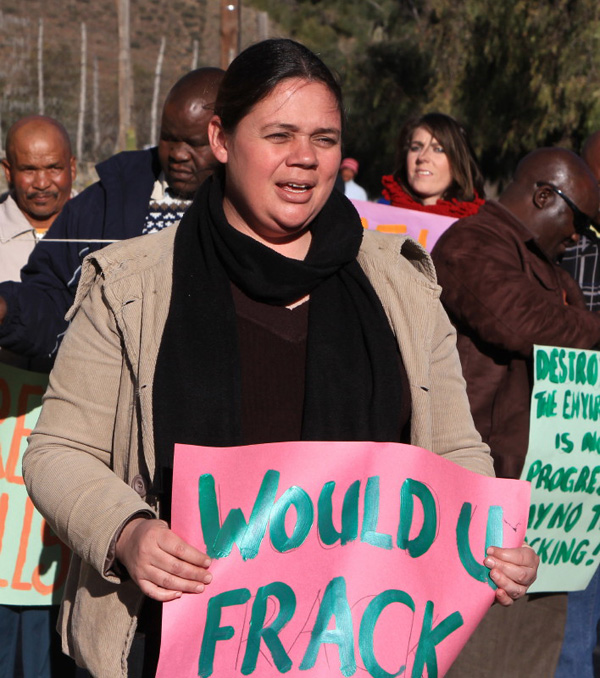
Chriszanne Janse van Rensburg of the Southern Cape Land Committee said it was worrying
that if farmworkers lost their jobs because of fracking, they also lost their homes.
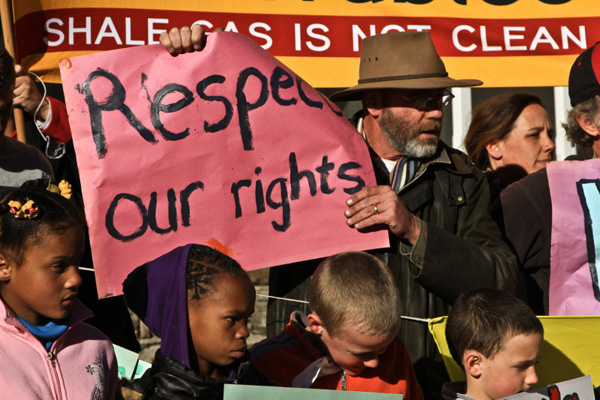
Farmer Kevin Watermeyer surrounded by children protesting against the prospect of fracking in the Karoo.
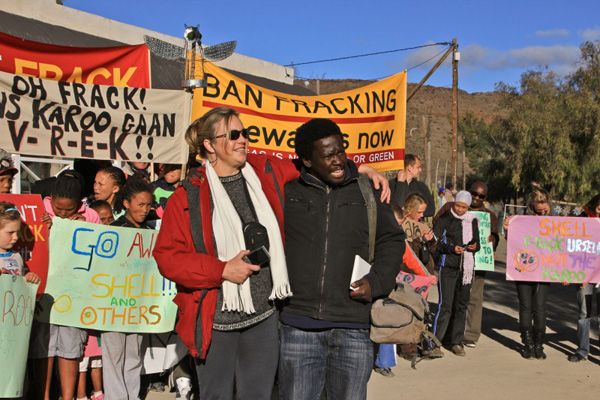
Marina Louw of the Climate Justice Campaign in Cape Town and Mthunzi Ndimande, who has seen
Johannesburg’s mine dumps and acid mine water devastate the environment the environment, spoke against fracking. Ndimande said he was very proud to see Nieu Bethesda’s community stand up against fracking before the environment was damaged.
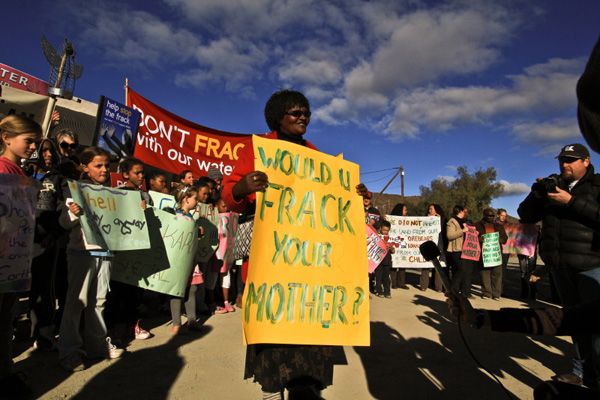
Auntie Evelyne Olifant runs a restaurant serving boerekos to tourists in Nieu Bethesda’s township.
She said the people of Nieu Bethesda lived together and will fight fracking together.
“Because otherwise it will break our environment, right down to the rocks.”
Pictures: Chris Marais, Karoo Space.
Kommentaar
Dankie Henry vir die prominensie wat jy aan hierdie saak gee. Te hel met Shell en ander wat hul koppe in dieselfde giftige mus wil indruk.
South Africa is facing a lot challenges especially in the health category. Fracking will add to the health challenges because the process leaks methane gas to underground water streams that so many people in rural areas depend upon. I hope our government will listen to the voice of the people instead of those who stand to gain in destroying both our health and the environment.