

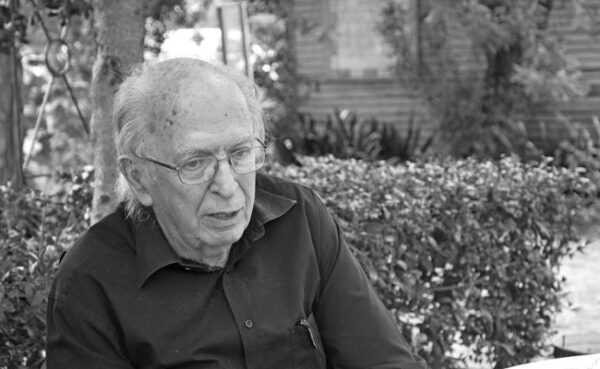
André du Toit (Photo: Riaan de Villiers)
In an excellent tribute on LitNet, a former student, Pieter Duvenage, has expressed his surprise about the “deafening silence” surrounding the death of the political philosopher André du Toit, who has passed away in Cape Town at age 88. He went on to write:
Met die heengaan van André du Toit verloor die land nie net ’n vooraanstaande politieke filosoof nie, maar ook iets skaarser: ’n intellektueel wat oor dekades heen die spanning tussen geskiedenis en geregtigheid met besondere integriteit beliggaam het.
I can only concur. André was a moral and intellectual giant of my generation. Specifically, he and his mentor and later colleague at Stellenbosch University, Johann Degenaar, created moral and intellectual space, specifically in the Afrikaner intellectual community, that had not existed before.
I was privileged to study under both of them, in the Department of Political Philosophy at Stellenbosch University – for me and many others, a life-changing experience. In those days, Afrikaners – also in academia – who unequivocally opposed Afrikaner nationalism as well as the apartheid order were few and far between. In the sea of conformity and timidity constituting the Afrikaner intellectual establishment, Degenaar and André were beacons of thorough and principled dissent.
As is well known, the department had been created to remove Degenaar’s “heretical” influence over the “tokkelokke” (theology students), for whom philosophy was a compulsory subject. For a number of years, the two departments coexisted uneasily.
When, in 1967, I landed at Stellenbosch, Degenaar was teaching the “renegade” course of political philosophy on his own. While centred on the “softer” subjects of existentialism and phenomenology and their contemporary political offshoots, such as Marxist humanism, liberation theology and so on (after all, this was the 1960s, the age of the youth revolution in Europe and America), he also did some important political groundwork – notably, using his celebrated Socratic method, working us systematically through a critical appraisal and rejection of Afrikaner nationalism as the foundation for the apartheid ideology and social order.
Halfway through our undergraduate course, he was joined by André as second lecturer – a tall, forbidding figure with penetrating, light-blue eyes behind thick lenses and a very high forehead, fresh from six years and a doctorate in philosophy at Leiden University. (He already held a PhD from Stellenbosch.) Behind his reserve, he was very friendly and probably rather shy.
André gave our studies a new dimension. It soon turned out that, besides an encyclopaedic knowledge of the history of philosophy, he had a formidable grasp of systematic, more technical philosophy (for want of a better term) – much of this recorded in copious notes in his precise, microscopic handwriting. I have some of them still. Specifically, he became known for his formidable analytical abilities, which he also applied in the field of praxis.
*
I wasn’t a good student – it was a turbulent age, both personally and nationally, and I need to draw a veil over some of my conduct. Suffice it to say that, despite a mediocre undergraduate record, I decided to do an honours degree, specifically under André, and he agreed.
Tuition took place after hours, at his house in Die Laan. (To the best of my knowledge, after his return from Leiden, André lived in only two houses, both Victorian mansions with wide stoeps – the first in Die Laan, and the second at 5 Bonair Road in Rondebosch – both big enough to house a family of four children, a lot of art, books and music, and sundry animals.) Despite the rigour of the lectures, the atmosphere was relaxed and informal. André’s wife, Maretha, occasionally wandered in to give him a hug.
Among other things, André was unfailingly courteous. I saw him angry only once – when, during one session at his home in Die Laan, it emerged that none of us had done the reading he had asked us to do the previous week. We were taken aback and ashamed, and mended our ways thereafter.
Notably, this was a more technical and demanding course in analytical philosophy, including the so-called “linguistic turn” and an emerging methodological understanding of philosophy as a second-order discipline. It was a good schooling – several of my classmates during those two years would go on to teach philosophy themselves.
Significantly, Andre also worked us through different conceptions of democracy, including consent theory and its implications for government and the legitimate – or illegitimate – use of state power.
My personal circumstances still weren’t great – among other things, I had started to work full-time, and had to drive from Cape Town to Stellenbosch after work to attend the classes, and back again. At the end of the year, I realised that I had not gained from the course what I had set out to gain, and asked André whether I could do it all over again. (At that stage, university admin was far more lackadaisical than it is today, and one could still do that sort of thing.)
If, at that point, he was privately dismayed, he did not show it, and we pressed on. In the event, I attended classes more regularly, got a better grip on the work, and passed. Most importantly, I gained from the course what I had sensed I could gain: not only – or even primarily – a substantive knowledge of philosophy, but analytical tools which I would draw on throughout my working life.
*
In the mid-1980s, after gruelling reporting stints with English newspapers in Johannesburg and Cape Town, I became involved in Die Suid-Afrikaan, the dissident Afrikaans journal launched by André and his long-standing collaborator, the historian Hermann Giliomee. (By then, both Giliomee and André had moved from Stellenbosch to UCT.)
A major event in the magazine’s life (and ours) was the talks in Dakar. We all had ties with Van Zyl Slabbert, and we all went – Giliomee, André and I. The arrangements were semi-clandestine. Slabbert asked me to meet him and Alex Boraine in an office somewhere, where he asked me to attend and briefed me on the cloak-and-dagger arrangements. We weren’t supposed to tell anybody about it, but by then I knew Giliomee would go as well. Infinitely scrupulous, André wouldn’t even tell me or Giliomee that he had also been invited.
In the event, André played a massive role at the talks, which remains largely unacknowledged to this day. They were divided into several sessions. The first was on the dominant theme of “Strategies for change”, inclusive of the key issues of political violence – including the ANC’s turn to “armed struggle” – and its attempted monopoly over the struggle against apartheid. Both of these could have deadlocked the talks. This was followed by sessions on national unity, the structure of government and the economy.
It turned out that Slabbert had asked André to prepare a background paper on the first theme and its underlying issues – in my recollection, the only one delivered by a domestic participant. (Indeed – as a friend who later served on the Idasa board has reminded me – André was one of few people, certainly one of very few Afrikaner academics, whom Slabbert still listened to.)
In the event, André used his analytical skills to defuse these potentially intractable issues, and to place the debate on another level. Briefly stated, he argued that, while a political settlement remained a moral imperative, the armed struggle (as well as state violence) had to be accepted as a historical reality. At the same time, one had to consider whether the turn to armed struggle was working for or against the chances of a political settlement.
Options for challenging the apartheid state were limited. Rather than challenging the state where it was strongest – namely, in terms of coercive power – it should be challenged where it was weakest, namely, in the political sphere. Uncontrolled violence was counterproductive, in that it merely alienated whites and allowed the further unleashing of state violence.
Future national unity could only be achieved by involving organisations and leaders who had played a major role in popular opposition and resistance. However, no organisation, even the ANC, should claim a monopoly of popular legitimacy, or enforce the hegemony of its ideological line. The plural nature of the opposition and resistance movement itself should be accepted. “In building national unity, we must look towards creating the social and political space to accommodate all forces.”
This brief summary does not do the paper justice. In my view, while not widely known or recognised, it remains one of the most significant documents in our recent political history.
*
After my stint at Die Suid-Afrikaan, I did not see André for many years, most of which I again spent in Johannesburg, eventually as an editor and contract publisher. In this time, before retiring from UCT, he had built up a formidable academic record, both domestically and internationally, which is on public record. Among other things, he had done a lot of work on political violence and democratic transitions, including at American and European universities.
Well into the next century, and following my return to Cape Town, we reconnected at some event, and I attended his 80th birthday on the shaded stoep of Bonair 5. It was good to see him again, and to express my appreciation of his role in my life. Maretha had passed away years before.
A while later, André contacted me to ask me for help with a stalled project. It gradually emerged that he had, over a number of years, written a massive study of the Truth and Reconciliation Commission and the preceding amnesty negotiations, which he had had difficulty in publishing. As he noted drily in the prelims to the Amnesty chronicles: “Finding a publisher for a long and complex manuscript such as the Amnesty chronicles proved a frustrating process. To my surprise, South African publishers seem to have reached some sort of consensus that there is no longer a viable readership for TRC-related publications.” He went on to ascribe this to the “multiple misunderstandings and mystifications” of both the history of the negotiated settlement and the nature of the TRC, which had – regrettably – “become fixed features of the current South African discourse”.
As regards the genesis of the study, there’ s a backstory as well, recorded in the front matter of both publications. In the early 1990s, he became a board member of Idasa and was closely involved in preparatory discussions about the TRC, under the aegis of the NGO Justice in Transition, established by Alex Boraine. He was nominated as a TRC commissioner, but was not selected. Later, he and Boraine discussed the possibility of his becoming the TRC’s director of research (a position eventually filled by Charles Villa-Vicencio), but agreed that he could play a more valuable role by keeping a watching brief on the commission and its works – as he put it, acting as a “supportive but critical interpreter”.
Following the launch of the commission, he began to work on some issues arising from its activities, largely those raised by the earlier victim hearings. He eagerly awaited its final report, expecting it to provide a “definitive framing of and conclusion to the TRC project” – but studying it turned out to be a frustrating exercise:
Its major findings were clear and important. But this could not be said about the proliferation of other findings, particularly its findings of accountability, which later provoked a serious confrontation with the ANC government. Also, while the text dealt with important issues and events, it did not do so in an accessible and coherent way. … All of this raised the question: How had it come about that, despite its initial promise, the TRC had produced such a problematic and inaccessible report?
As a result, he decided to embark on a “historical reconstruction of the process that had resulted in the report” – among other things, by searching for an amnesty deal underpinning the TRC’s truth-for-amnesty model, which everyone believed had been made, but in fact did not exist. Amusingly, he likened the “negative evidence” about such a deal (between Mandela and “the generals”, for example) to the Sherlock Holmes story about a dog that did not bark in the night, thereby signifying that it knew the perpetrator of the crime in question.
According to André, the time taken to complete the study also had its benefits, as it allowed him to take account not only of the pre-history of the TRC report, but also of its aftermath. This was a rather sorry tale of “unfinished business”, along with the complications of the amnesty process, which had become its main activity. Among other things, it became clear that the negotiated settlement had not fully resolved the amnesty issue. He wrote:
More recently, I was surprised to find to what extent amnesty still remained a central concern even a decade and more after the submission of the TRC’s 1998 report. The burden of its “unfinished business” not only signifies the lack of closure to the TRC process, but also reflects a more general failure to address past political offences in a way that could become a starting point for public accountability in a democratic, post-apartheid South Africa. In key respects, therefore, amnesty remains an open question in South African political life.
I need hardly add that, almost 30 years later, the consequences are still playing themselves out in front of the Khampepe Commission.
*
Over the next few years, I was privileged to help André bring the project to fruition. It resulted in two volumes, one about the amnesty negotiations and the other about the TRC and its aftermath, funded by an academic subsidy from UCT, and published – appropriately – by the Beyers Naudé Centre for Public Theology at Stellenbosch University. Valuable additional funding was provided by the theatre figure André Roothman, another appreciative former student, via the Roothman Family Trust. It has been widely acclaimed, both in South Africa and abroad, as a definitive new study, combining fine-grained historiography with outstanding conceptual analysis.
*
Over the years in which the project took shape, I frequently visited Bonair 5, always in the late mornings, and always looked forward to it. Invariably we would have tea, with all the makings assembled on a tray. There would be a plate of rusks or biscuits, of which I would invariably eat too many. Depending on the weather, we would sit in André’s study, lined with thousands of books, or on the stoep, fringed with trees and ferns, surrounded by dogs and cats.
We did have minor disagreements – notably about the TRC’s (admittedly rather haphazard) “findings of accountability”, which had a major bearing on the fate of the commission, drastically influencing both its internal methodology and its subsequent relations with major political role players. As readers of volume two will discover, André believed that the commission had the discretion not to make those findings, which had turned out to be a prime cause of its disastrous fall-out with the ANC government.
I disagreed, as I believed that – whatever the commission’s choices of method or its consequences might have been – it was compelled to make these findings by its terms of reference. For once, I thought André was parsing out a conceptual distinction where none existed. But, in the best spirit of collegiality, we agreed to disagree.
There were several launches in Stellenbosch and Cape Town, as well as seminars at all three Cape universities – UCT, Stellenbosch and the Western Cape. All these events were attended by an array of former colleagues, students, friends, TRC commissioners and researchers, all displaying a sense of personal appreciation of André’s life and career. Once again, those privileged to attend were struck by the clarity with which André described and explained the study, and responded to questions.
I gained a huge sense of satisfaction out of helping André to bring this project to fruition, and I hope and believe he did, too. Towards the end of last year, André fell several times, sustaining head injuries, and spent time in hospital. Slowly, his magnificent mind began to falter.
*
Clearly, André was a public intellectual in the best sense; he believed, in principle, that intellectuals should engage with (or be placed at the disposal of) practical politics – notably, in his case, via the critical scrutiny and elucidation of political ideas and ideologies. Three examples come to mind. The first is the Report of the Spro-Cas Political Commission titled South Africa's political alternatives (1973). Spro-Cas was the Study Project on Christianity in Apartheid Society. A joint initiative of the Christian Institute and the South African Council of Churches, it analysed the apartheid order through six commissions (dealing with education, law, politics, economics, society and the church). André served on the political commission, and wrote the report. It certainly was marked by his conceptual clarity, and broke new theoretical ground.
Vitally, it argued that the dilemma of political domination by an ethnic or racial majority in a plural society could be defused or resolved via a systematic devolution of power, thereby allowing the realisation of liberal-democratic rights and values in a diverse society. It remains a compelling notion and (characteristically) broke through the conventional political deadlock of that time. (Among other things, it could be argued that the architects of the 1996 Constitution should have studied this far more closely.)
*
The second is André’s paper at Dakar. The third is his celebrated expert testimony at the trial of the (later) academic Lungisile Ntsebeza, his brother Dumisa Ntsebeza (who later, among other things, served as a TRC commissioner), their sister, MaThuse, as well as the Eastern Cape activist Matthew Goniwe (later assassinated as a member of the Cradock Four), on charges of contravening the Suppression of Communism Act.
Heard in what was then the Transkei in 1977, the case centred on their membership of a network of political study groups, among other things focusing on Marxist literature. Called as an expert witness (to counteract the RAU academic Stoffel van der Merwe, who testified for the state), André argued that there were different forms of Marxism and communism, and that the brand of Marxism espoused by the group did not conform to the brand of communism as defined in the Act.
He also argued that the phrase “The days of peaceful pleadings are over”, found in one of their documents and highlighted by the prosecution, did not necessarily imply a commitment to the violent overthrow of the state, but could also mean civil disobedience, boycotts and stay-aways, which were neither violent nor illegal.
The group was found guilty, and sentenced to four years’ imprisonment. Influenced by André’s testimony, Lungisile decided to study philosophy and political science through Unisa, and later became a prominent academic and university administrator.
*
All these interventions were marked by André’s particular genius for conceptual elucidation. The amnesty and TRC studies are no exceptions. A personal favourite appears in the first volume, where he suggests that, instead of blanket amnesties, a distinction could or should have been drawn between serious or gross human rights violations (murder, assassination and torture), which would not be eligible for amnesty, and less serious ones, which could in fact be pardoned.
This means that – like with Eugene de Kock – people like Craig Williamson and the Eastern Cape security police, including Gideon Nieuwoudt, Harold Snyman, Eric Taylor, Gerhardus Lotz, “Sakkie” van Zyl and others should simply have been prosecuted, without recourse to the TRC – as with Robert McBride, Adriaan Basson, Barend Strydom, Stefaans Coetzee and the killers of Amy Biehl. The impact on the subsequent workings of the TRC – and the broader issue of transitional justice and national reconciliation – would have been profound.
In fact, my main takeaway from our workshops and seminars is a lingering or ongoing sense of bitterness about the price paid for the TRC – that younger black people, in particular, believe that the sacrifice made by their elders for participation in the TRC and accepting its “truth-for-amnesty” compromise was largely in vain. Hardly the hallmark of national reconciliation. This places a question mark over the novel “truth-for-amnesty” compromise devised by Boraine and Dullah Omar, later accepted – it must be said – by the first representative parliament in the form of the legislation setting up the TRC.
As the study and seminars have underlined, the TRC’s achievements were and remain undeniable – notably, in the words of the respected commissioner Mary Burton, uncovering some (her emphasis) truths about the apartheid era. For what it’s worth, though, I have come to agree with those young people, and believe that – despite the arguments about the limited capacity of the state in transition, and tricky issues surrounding reciprocity – most or all of those people – and others – could and should have been prosecuted.
*
To return to Pieter Duvenage, and his surprise – in effect, implied indignation – at the silence surrounding André’s death, I can only concur once again. In this callous, dismaying age, it is yet another symptom of our collective amnesia: about our painful journey to becoming a democracy, laced with violence; about the failure of most Afrikaner intellectuals to challenge the apartheid order; and about the pioneering role played by those who did. I can only hope that André’s legacy will remain a bulwark in our particular “struggle of memory against forgetting”.
See also:
André du Toit (1938–2026): ’n Filosoof tussen geskiedenis en gewete
Kommentaar
This is an enormously important tribute to André du Toit; an historical document in its own right. In harness with the earlier deeply insightful piece by Pieter Duvenhage, I think LitNet has performed a valuable public service in bringing to national attention the life and work of Dr du Toit - truly a 'giant in hiding'.
I was also one of those privileged to have been one of André's students, and can only subscribe to Riaan de Villiers' description of his character and moral integrity. He set a high bar.
Dankie, Riaan.
Thank you Riaan, for this thorough and lucid tribute to our philosophy teacher, André du Toit.