

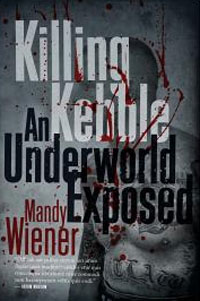
Bibi Slippers asked Mandy Wiener a few questions about writing his Alan Paton Award-nominated book Killing Kebble.
In Margaret Atwood’s book on writing, Negotiating with the Dead, she compiles a list of hundreds of reasons why writers write. Some of the reasons on the list are:
- To record the world as it is.
- To set down the past before it is all forgotten / To excavate the past because it has been forgotten.
- To satisfy my desire for revenge.
- Because I knew I had to keep writing or else I would die.
- To produce order out of chaos.
- To hold a mirror up to the reader.
- To show the bastards.
- To make money so my children could have shoes.
- To attract the love of a beautiful woman / To attract the love of any woman at all.
- To serve History.
If you were to name your main reasons for writing this specific book, what would they be?
My primary reason for writing Killing Kebble was to record events for posterity, to serve history and to create order out of chaos by concisely telling one of the most complex and convoluted stories in our country’s recent history. The Kebble murder was one of the most defining events in South Africa’s post-democratic era and the subsequent chain of events impacted greatly on the path the country would follow. For me, it was important that the reading public understood the significance of the story and the way it affected their lives. I often say that I hope people don’t read the book and lose hope in the criminal justice system and become negative about the country – I hope that they read it and ask themselves what they can learn from the story to ensure we never allow it to happen again. And yet the story is repeating itself over and over again.
Could you describe how you came to write this story? Did the story find you or did you seek it out?
Oh, the story absolutely sought me out. I was sent by my editor to report on the Kebble murder when it happened and stayed with the story through its evolution over a six-year period. By the end of that time, what we had initially thought was just a murder had evolved into a story which included a corrupt national police commissioner, an assisted suicide, hired guns, an international drug smuggling syndicate, political interference by the president and the suspension of the country’s most senior prosecutor. The book was begging to be written.
What is the most important thing you learned or discovered while writing your nominated book?
Interestingly, this is something I address in the acknowledgements section of Killing Kebble. I say, “If there is anything I have learnt during the process of writing this book, it has been the inherent value of the concepts of loyalty and trust. For many of those I interviewed, the value placed on a person’s word far outweighs that of a legal documents or a signature. Most have placed their faith in me on the basis of my undertaking that I would handle their stories with objectivity, rectitude and integrity.” This is still very much the case. I’ve learnt the value of integrity and credibility and how important it is as a journalist to earn trust and to maintain that trust.

Do you have a "first reader"? And related to this question, who is your ideal reader?
I am grateful for the most fabulous “first reader”, who is very good friend and someone I have known for most of my life. She is a closet publisher and an excellent schoolteacher and nothing went to the publishers before it went through her. Having said that, though, with this being my first book, my publisher, Andrea Nattrass, worked very closely with the very raw, very rough first drafts. With regard to my ideal reader – one of the greatest joys I have experienced with the success of Killing Kebble is the fact that so many people who have never read a book have read this one. I’ve had an overwhelming number of people e-mail, call and tweet me to say it’s the first book they’ve ever bought. That for me is ideal if it means people are reading.
Have you decided on the next issue or story you will tackle?
Not quite yet. South Africa is so rich with fabulous stories to tell and there is so much fodder for a non-fiction author, but the difficulty is deciding what story to pick. I was also so fortunate with the Kebble story … there was murder, intrigue, mobsters, crooked cops, you name it! It’s going to be a tough act to follow.
What has been your favourite South African read of 2011/2012?
To be honest, I’ve had so little time to read – I’m still to work my way though both the fiction and non-fiction shortlists! I’ll let you know right after I find some time to have a holiday and hit the beach/bush with a bag full of books.
Which one of the nominated books would you place your betting money on to walk away with this year’s prize?
You want me to pick one out of this year’s finalists?! That is an impossibility and would just be foolish!