

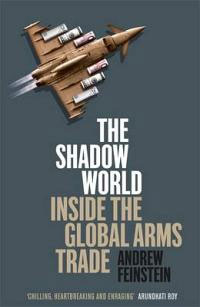
Bibi Slippers asked Andrew Feinstein a few questions about writing his Alan Paton Award-nominated book The Shadow World.
In Margaret Atwood’s book on writing, Negotiating with the Dead, she compiles a list of hundreds of reasons why writers write. Some of the reasons on the list are:
- To record the world as it is.
- To set down the past before it is all forgotten / To excavate the past because it has been forgotten.
- To satisfy my desire for revenge.
- Because I knew I had to keep writing or else I would die.
- To produce order out of chaos.
- To hold a mirror up to the reader.
- To show the bastards.
- To make money so my children could have shoes.
- To attract the love of a beautiful woman / To attract the love of any woman at all.
- To serve History.
If you were to name your main reasons for writing this specific book, what would they be?
To expose the global arms trade for what it is: collusion between governments, their intelligence agencies, large arms companies and arms dealers of dubious repute. To reveal how the trade - operating in something of a parallel legal universe - makes the world a less democratic place, a more corrupt place, a poorer place and a more dangerous place.
To break the silence about this trade: the last meaningful book on the global arms trade was written in 1979 – Anthony Sampson’s Arms Bazaar. I know two UK writers who wrote books about it that were not published.
By breaking this silence I hope to put the arms trade back on the political agenda and indicate to citizens what is being done in their name, with their hard-earned tax rands/dollars/pounds/euros.
To beseech active citizenship on this and many other crucial issues of our day about which we are all too passive, in a world which is governed for a tiny elite at the expense of the vast majority.
Could you describe how you came to write this story? Did the story find you or did you seek it out?
After leaving Parliament in protest at the ANC’s refusal to allow a meaningful investigation into South Africa’s shameful arms deal – that will ultimately cost the country about R70 billion, with around R2 billion of bribes paid – I wrote After the Party about my experience in the ANC trying to investigate the deal. While writing that book I felt that I wanted to write about how this happens globally and expose the corruptors as much as the corrupted.
After the Party led to prosecutors, investigators, journos and whistle-blowers from around the world approaching me with information. So I suppose I knew that I wanted to write it, but also felt obliged to do so by the flood of information I received from people deeply frustrated that these issues are so seldom written about.
What is the most important thing you learned or discovered while writing your nominated book?
That the so-called clean government-to-government trade in weapons is inextricably bound up with, and dependent on, the illegal or black market trade. To distinguish between the two, as large defence companies try to do, is misleading and disingenuous. In sum, this trade accounts for around 40% of all corruption in world trade!
Photo: Simone Sultana
Do you have a "first reader"? And related to this question, who is your ideal reader?
My incredible researchers, Paul Holden and Barnaby Pace, also acted as first readers.
Ideally someone who both knows a huge amount about the arms trade and also has a feel for exciting narrative prose. An amalgam of the researchers and my global publisher, Simon Prosser of Hamish Hamilton/Penguin.
Have you decided on the next issue or story you will tackle?
I’m torn between wanting to write a thriller set in the arms trade - no endnotes after a book with 2 800 of them - and an exposé of how the large banks act as financial facilitators for the world’s criminals, dictators and other odious characters – a sort of “Bankers to the Bastards”.
What has been your favourite South African read of 2011/2012?
I found all of the nominated books extraordinary. Hugh Lewin’s Stones Against the Mirror is emotionally devastating and brilliantly written. It captures the naiveté, passion and commitment of the ARM and describes the trauma of betrayal by one’s closest friend and comrade.
Which one of the nominated books would you place your betting money on to walk away with this year’sprize?
If I was a betting man I would hedge my bets between Hugh’s book and Mandy Wiener’s Killing Kebble.