

Audience members were brought to the edge of their seats as a fervent debate ping-ponged between a panel of Twitter adjudicators at the Trial by Twitter event at the Franschhoek Literary Festival. On the panel were Sam Wilson, digital content strategist for Woolworths; Julian Rademeyer, award-winning journalist and author of the best-seller Killing for Profit; Ann Crotty, Business Day journalist; and Fiona Snyckers, author of the Trinity series.
While each member offered interesting and diverse opinions about the usefulness (or uselessness) of Twitter, it was Sam Wilson who ardently and most convincingly defended Twitter. She claims that Twitter is the most important social platform for her, and that she no longer reads newspapers or watches TV, as she gets all her news via Twitter. When asked by Fiona Snyckers if her stance is “pro-Twitter”, Wilson explains that it isn't a question about liking or not liking it, as it is now a “very real part of society”. The way she sees it is that “to ignore Twitter is to be an ostrich”. But for the purposes of the debate, Wilson holds that she would be “pro-Twitter” as she believes it is the “best way to get information these days, the best way to connect with people” and that it is a “fantastic curation mechanism”.
Julian Rademeyer confesses that he is conflicted and often cynical about Twitter. While he views it a “useful tool for gathering and spreading news” he also claims that “a lot of it is noise”. Rademeyer believes that Twitter enjoys a “status it doesn't deserve” as he holds that it is “nothing more than a tool”. He also feels that Twitter is a self-promotional tool and that he often “unfollows” people when they “retweet” compliments.
Wilson launched a counter-argument, saying that Twitter is actually a bad promotional tool, and that it is more of a social tool. She also interjected that “self-promotion is having a personality and talking to people”.
“I don't think I could ever tweet, ’cause I'm too old to change, or I would change if I thought it worthwhile,” was Ann Crotty's response. In a nutshell, Crotty, who has been tweeting for three weeks in preparation for this event, appreciates the benefits of tweeting and doesn't “doubt that anything can be reduced to a tweet, including the bible”, but mostly she sees Twitter as “cheapening traditional journalism”.
Wilson again played devil's advocate when Crotty suggested that new ways of learning “affects how we learn”. Wilson argued that “there is a paradox with people who say ‘we're not learning well’ because we're learning through different media, but then those very people “are not prepared to learn how to use that media”.
Crotty dislikes the fact that “Twitter opens up another avalanche of information” – something she doesn't necessarily want. She also opposes Wilson's suggestion about better managing one's Twitter stream, arguing that this is a very idealistic answer.
Questions were diverted to the audience when temperatures on the panel started rising to a near uncomfortable degree. Crotty had a bright red T-shirt handy that read "TOO LAZY TO TWEET" for the best comment from an audience member. The T-shirt went to a Somerset College pupil who related how he had received a new iPad and iPod touch for free after he had tweeted a complaint to Apple.
A big, unresolved question related to the topic of privacy and the blurred boundary between the personal and the professional sphere on Twitter. On privacy Wilson said, “If you're doing stuff you don't want anyone to know about, then maybe you shouldn't be doing it”, suggesting a no-holds-barred approach to tweeting. Conversely, Rademeyer believes that more privacy is needed and pointed out that Twitter and other social networks can potentially make us vulnerable to crime, especially with photo-mapping technology.
An unresolved issue for all the members on the panel was the question of social responsibility. On the one hand it was noted that tweeting is publishing and that what public servants or employees of major corporations tweet about may reflect on the companies they work for. But on the other hand, as Wilson and Snyckers argued, “We are not extensions of the companies we work for.”
Snyckers was very adamant about this and had the last word on the matter: “Corporations need to grow up and realise that their employees don't damage the brand ... they need to stop overreacting.”
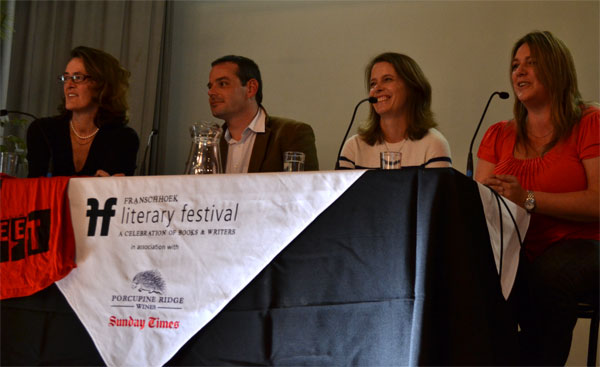
The panel: Ann Crotty, Julian Rademeyer, Fiona Snyckers and Sam Wilson.
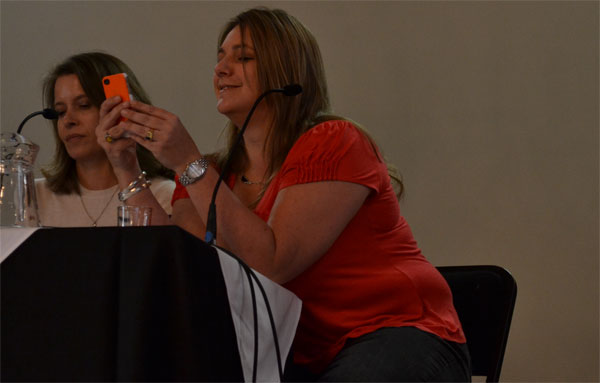
Pro-tweeting Sam Wilson (to her left is Fiona Snyckers).
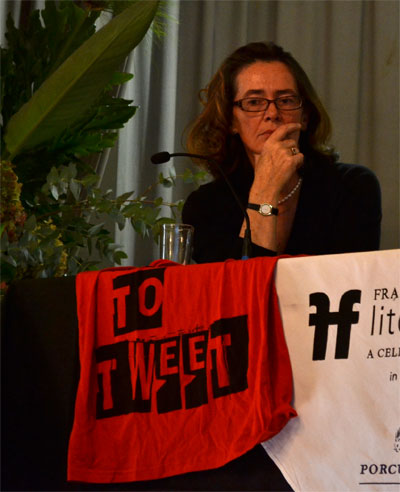
Ann Crotty seemed sceptical.
Photos © Chrizane van Zyl
This report was written by a member of the Contemporary Literary Practice (English) honours group at Stellenbosch University. The CLP module includes report-writing in the mould of literary journalism, along with other forms of writing and literary practitionership. The report was co-edited by group facilitator Leon de Kock.
Teken in op LitNet se gratis weeklikse nuusbrief. | Sign up for LitNet's free weekly newsletter.