

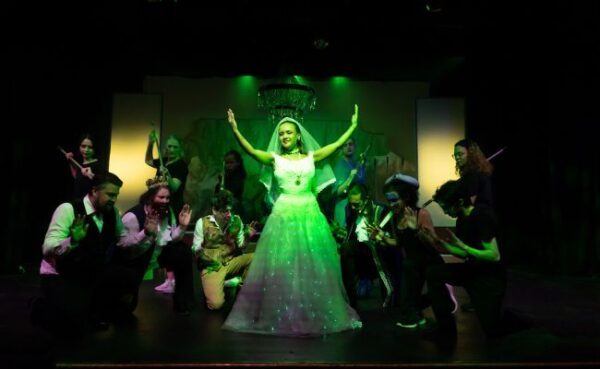
Sydney de Klerk and cast: picture by Faeron Wheeler
Naomi Meyer talks to Savannah Steyn, author and director of The princess and the pea, now showing at the Masque Theatre in Cape Town.
Hi, Savannah. I hear you wrote the script for The princess and the pea, a family show which opens at the Masque Theatre in Cape Town soon. The story was originally written by Hans Christian Andersen – and it’s about a prince who wanted to establish whether the girl he was about to marry was a true princess. In order to prove this, his mother hides a pea under a stack of mattresses, and when the girl who sleeps on these mattresses after arriving at the palace one dark and stormy night, cannot sleep, the secret is out: she is, in fact, a true princess! A strange story, actually, if you think about it. Tell me about your version of the story. On which aspects did you focus? How did you make this a contemporary and relevant story for a South African audience in 2025? Why not simply sit at home and watch Stranger Things instead of making a trip to the theatre?
What drew me to The princess and the pea wasn’t the test of “true” royalty, but the deeper question underneath it: Who gets to belong? Who gets to be recognised, valued and welcomed? My version moves away from ideas of bloodlines and pedigree, and instead explores community, care and the quiet resilience of people who are often overlooked.
I’ve set the story in a playful, fairytale kingdom version of Cape Town – a city where mountain and ocean meet magic, where cultures mix and where the definition of “royal” is shaped by kindness, courage and compassion rather than status. Our princess arrives not as a mysterious aristocrat, but as someone carrying her own struggles, her own grit and her own humour – very much like the people who make up our South African communities today.
To make the story contemporary, I focused on themes that feel urgent in 2025:
- belonging in a world that often decides your worth before you walk through the door;
- resilience in the face of instability and inequality;
- the strength of community – showing a kingdom where ordinary people lift one another up; and
- importantly, joy – because joy is also political, especially now.
As for why not stay home and watch Stranger Things – well, theatre gives you something streaming never can: the thrill of sharing a story with real people breathing the same air as you. It’s unpredictable, alive, communal. When a child gasps, when adults laugh together, when a cast pours their hearts out just metres away from you – that’s a kind of magic no screen can replicate.
........
As for why not stay home and watch Stranger Things – well, theatre gives you something streaming never can: the thrill of sharing a story with real people breathing the same air as you. It’s unpredictable, alive, communal. When a child gasps, when adults laugh together, when a cast pours their hearts out just metres away from you – that’s a kind of magic no screen can replicate.
........
And in times like these, gathering to celebrate imagination, generosity and togetherness feels not only relevant, but necessary.
Your own story is also a point to ponder. You started off as production secretary intern, I hear, and then moved on to stage manager, set designer and now writer and director. These are all very different roles. Which ones do you like best, and could you tell me if all your different positions helped you prepare for this role you have taken on for The princess and the pea as writer and director?
It’s always difficult for me to choose a single “favourite” area in theatre, because I genuinely love so many different parts of the creative process. Each one stretches a different muscle – directing, writing, performing, designing – and they all feed me in different ways.
But if I’m honest, stage management and production management hold a very special place in my heart. There’s something incredibly fulfilling about being the person who supports everyone else so they can shine. I love coordinating all the moving parts, making sure the creative vision becomes a lived, working reality.
It’s the quiet magic of holding the room together, of being both the backbone and the safety net. Helping actors feel secure, helping designers execute their ideas, keeping the team connected and seeing it all run smoothly on opening night – that’s the work that makes me feel most alive.
.......
It’s the quiet magic of holding the room together, of being both the backbone and the safety net. Helping actors feel secure, helping designers execute their ideas, keeping the team connected and seeing it all run smoothly on opening night – that’s the work that makes me feel most alive.
........
So, while it’s hard to choose, the organisational heartbeat of a production is where I feel completely at home.
I read up a bit more on The princess and the pea, and it seems that Hans Christian Andersen actually personally had a difficult time, as a writer, being accepted as worthwhile during his life. He aspired to be like the royalty in the story of The princess and the pea, and he also, in a way, laughed at their silly ways of finding out who is truly a success or, putting it in a different way, truly a princess. Did you think about these aspects of the story while writing the script or directing the show? Or did you decide to make the story fun for the whole family to enjoy?
Absolutely – those aspects of Andersen’s life and the themes beneath The princess and the pea were very present for me while I was shaping this version of the story. What struck me most was the idea of worthiness – who gets to be recognised, who gets to belong and who is dismissed before they even open their mouth. Andersen himself struggled deeply with acceptance, and that tension between longing for validation and critiquing elitism runs through many of his tales.
........
Absolutely – those aspects of Andersen’s life and the themes beneath The princess and the pea were very present for me while I was shaping this version of the story. What struck me most was the idea of worthiness – who gets to be recognised, who gets to belong and who is dismissed before they even open their mouth. Andersen himself struggled deeply with acceptance, and that tension between longing for validation and critiquing elitism runs through many of his tales.
........
When I approached the Masque Theatre’s long-loved fairytale tradition, I knew I wanted to contribute a story that reflects what I stand for both as a storyteller and as a member of society. Diversity and inclusion are not optional extras for me – they’re foundational. I wanted a tale where worth isn’t measured by bloodline or pedigree, but by compassion, courage and the richness of community. A story where audiences – especially young ones – can see characters who look like them, sound like them and navigate challenges they recognise.
So, yes, I did think deeply about those themes of acceptance, belonging and the absurdity of measuring someone’s value with something as ridiculous as a pea. But I also wanted to make the story joyful, magical and fun for the whole family. For me, those goals aren’t opposites; they feed each other. When you centre inclusion, when you imagine a fairytale kingdom where everyone has a place, the joy becomes bigger, brighter and far more meaningful.
In the end, I hoped to create a show that honours Andersen’s emotional truth while offering a version of the story that feels honest, contemporary and welcoming to a 2025 South African audience.
Tell me about the Masque Theatre. Where is it, and what is special about it? Also tell me about the cast of the production, please.
The Masque Theatre, based in the heart of Muizenberg, is so much more than a venue – it’s a community. It’s a cultural hub, yes, but it’s also a space that actively tries to share knowledge, build skills and offer people of all ages a safe place to explore and express their creativity. What makes it special is that it’s run by people who genuinely care about keeping the arts accessible, nurturing emerging talent and creating room for voices that might not always be heard.
As for the cast of The princess and the pea, I feel incredibly lucky. They’re a vibrant group of performers who bring warmth, humour, heart and a real sense of play to the stage. Each person brings their own flavour and personality, and together they’ve created an ensemble that is joyful, generous and deeply connected – exactly the kind of spirit the Masque stands for.
Practicalities: Where do people buy tickets, what are the costs and how do they get to the theatre?
The princess and the pea runs at the Masque from 12 December to 11 January. Bookings can be made at Quicket.
The Masque is situated at 37 Main Rd, Muizenberg, Cape Town, 7950, South Africa.
The show is recommended for ages 5+.
Enjoy the fairy parade after all matinees!
Ticket costs:
Adults: R160
Pensioners: R130
Under 18s: R130
Family discount: 4 tickets for R500 (R125 each)