

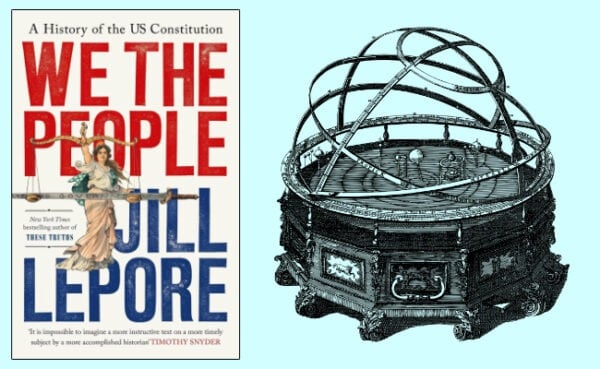
Lepore, Jill. 2026. We the People: A History of the U.S. Constitution. New York: Liveright. Orrery by Gordon Johnson from Pixabay
In the sweltering Philadelphia summer of 1787, as the Framers (delegates of the 1787 Constitutional Convention who drafted the US Constitution) laboured over the beginnings of a new republic, a watchmaker in Boston named Joseph Pope was completing a different kind of masterpiece: a grand orrery, a mechanical model of the solar system whose brass arms traced the orbits of planets in obedient, celestial order. The image is almost too apt, which may be why Jill Lepore, never innocent of the well-placed metaphor, places it at the conceptual centre of We the People, her Pulitzer Prize-winning history of 2026.
...
And so the Framers, with unusual candour about their own impermanence, installed a mechanism for repair: Article V.
...
The Framers, she argues, understood government through a Newtonian machine lens, as a system of counterweights, gears, springs and opposing forces held in dynamic equipoise. But machines, as any watchmaker knows, require winding. Springs go slack. Teeth wear down. And so the Framers, with unusual candour about their own impermanence, installed a mechanism for repair: Article V. Article V was to act as an amendment process, a lever by which a supermajority of a democratic republic might alter its own foundational text.
Lepore’s contention is that the “philosophy of amendment” – the conviction that a constitution must endure through adaptation rather than against it – is not a peripheral feature of American constitutionalism, but its animating principle. What she chronicles across several hundred pages of meticulous and often brilliant historical recovery is the slow strangling of that principle. The constitutional door, once flung wide in the decades of Reconstruction and the Progressive Era, has since 1971 been, in her words, “slammed shut”. The Americans who live on the other side of that door are not “the people” the Framers imagined.
As a historian, Lepore is obviously drawn to the margins of the historical archive: the pamphlets and petitions, the letters and legal briefs that official historiography tends to leave uncatalogued. The chapters she devotes to the excluded from the “we the people” are among the finest she writes. The phrase “We the People” is subjected to an almost forensic examination. In 1787 it referred to a narrow political fiction of propertied white males. Its universalism was an act of imaginative overreach. That this invented people spoke so confidently in the name of humanity was not merely ironic but constitutive of the republic’s deepest contradictions, contradictions that today have matured into the ticks of oligarchy infesting the American republic.
...
The excluded – women, enslaved people, Native nations – did not passively await inclusion but actively contested that fiction.
...
The excluded – women, enslaved people, Native nations – did not passively await inclusion but actively contested that fiction. The women Lepore recovers are sharp-witted and politically alert. Anne Willing Bingham, one of the great epistolary minds of the early American republic, observed with pointed acuity that while French women moved in the corridors of empire, their American counterparts were expected to confine themselves to soothing their husbands’ pleasures. The “female congress” of Edenton, those North Carolina women who signed their own non-importation agreement in 1774 and were savaged in the British press for it, understood perfectly well that constitutional politics did not begin or end with men in wigs. Something about them anticipates, however faintly, the later murmurings of movements like #MeToo.
The chapters on enslaved people are no less compelling. Lemuel Haynes and Caesar Sankey, Black veterans of the Revolutionary War, read the Declaration of Independence strategically as an emancipation proclamation, holding the new nation to the letter of its own principles in ways that would echo through the Civil Rights Movement and into Black Lives Matter. In the sections on Native Nations, Lepore details the sophisticated constitutional arrangements of the Haudenosaunee Confederacy, whose own “diplomatic constitution” offered a model of confederated governance that the Framers, for all their classical learning, declined to learn from. What the Haudenosaunee and their neighbours received in return was neither the negotiation for land rights they sought, nor the respect for treaties they signed, but what Lepore, with mordant economy, calls “big knives” – the violence that followed before the ink had hardly dried.
All of this historical recovery serves a larger argument: that the history of the American amendment process is inseparable from the history of inclusion, and that the paralysis of Article V is therefore not merely procedural but democratic in the deepest sense. Lepore demonstrates with precision that requiring a two-thirds majority in both houses of Congress and ratification by three-quarters of state legislatures is, in a country as polarised and unequally represented as the contemporary United States, to require something very close to the impossible. Since 1971, when the voting age was lowered to eighteen, only one amendment has been ratified – the Twenty-Seventh Amendment on congressional pay, which had been languishing since 1789. This basically means that the world’s most self-proclaimed democracy has effectively frozen its own constitutional process.
The consequences of this freezing led Lepore into her most intellectually ambitious territory: a sustained critique of Originalism. She argues that Originalism did not emerge from a coherent jurisprudential philosophy so much as from the ruins of Article V itself. When formal amendment became functionally impossible, Americans turned to the Supreme Court as a site of constitutional transformation – what Lepore calls “informal amendment”.
The Warren Court’s decisions on desegregation, criminal procedure and privacy became a form of constitution-making by other means, compensating for legislative incapacity. The conservative backlash produced Originalism as a counter-theory insisting that only Article V could legitimately alter constitutional meaning. Yet Lepore identifies a paradox she is right to press hard upon. The Originalists who most loudly defended Article V as the sole legitimate vehicle for constitutional change – Robert Bork and Antonin Scalia among them – privately acknowledged that Article V had become, in Bork’s phrase, a “constitutional barricade”. They insisted on a door they knew to be locked.
The deeper objection Lepore raises against Originalism is perhaps the book’s most pertinent critique. Originalism requires a stable and recoverable “original public meaning” for constitutional text, determinable from the documents and debates of the founding era. But whose records survive? The gentlemen of Independence Hall left voluminous traces. The women at Edenton, the Black veterans of New England, the Haudenosaunee sachems with their own sophisticated thinking about federal arrangements – these figures left records too, but they are not the records Originalist jurisprudence has tended to consult. For Lepore, this is not an incidental methodological failing but a fatal one. Originalism, as conventionally practised, enshrines the partiality of the archive as constitutional meaning.
For a South African reader this diagnosis does not feel distant, but uncomfortably familiar. South Africa’s Constitution, unlike its American counterpart, was drafted not to stabilise an existing order but to overturn one. Its text does not conceal its transformative ambition; it announces it. Section 9(2) explicitly authorises measures designed to advance those disadvantaged by unfair discrimination. Yet, like all constitutional provisions, it exists within a system of competing guarantees – most notably the commitment to equality before the law. The interpretive labour required to reconcile these principles has, for three decades now, fallen heavily upon the judiciary.
This is where Lepore’s “hydraulic” principle finds precise relevance in the South African case. In the United States, the closure of Article V shifted constitutional change to the courts. In South Africa, the persistence of structural inequality has produced something similar. The Constitutional Court has repeatedly been called upon to realise, through interpretation, what the political branches have failed to deliver through policy: housing, healthcare, education. This is not the reinterpretation of an ossified text but the enforcement of a transformative one. The structural strains in the two constitutions are comparable. A constitution that relies on courts to compensate for legislative and executive inadequacy is a constitution under continuous stress.
...
A constitution that relies on courts to compensate for legislative and executive inadequacy is a constitution under continuous stress.
...
The current wave of litigation around Broad-Based Black Economic Empowerment and employment equity makes this strain particularly visible in our country. When the Gauteng High Court dismissed, as a fait accompli, the urgent attempt by the National Employers’ Association of South Africa and Sakeliga to interdict new sectoral employment targets, it did so on procedural grounds: The Minister had already acted; the regulations were in force. The Supreme Court of Appeal agreed there was no reasonable prospect of success on appeal, although the substantive constitutional challenge remains pending.
This, in turn, emboldened major white-owned commercial law firms (Webber Wentzel, Werksmans, Deneys Reitz and Bowmans) to challenge the Legal Sector Code, arguing that its ownership and control targets are irrational and practically unattainable. Their case is framed carefully in the language of administrative law – consultation defects, procedural irregularities, failures of rationality, etc. Yet, as with the American turn to Originalism, the formal argument cannot be disentangled from its political stakes, because the procedural claim (whether the Minister consulted adequately, whether the targets are empirically grounded) is also a claim about authority – about who determines the pace of redress, who bears its costs, and when the demands of history have been sufficiently met. The law speaks in the idiom of legality, but the dispute it contains is irreducibly political.
One of the most dangerous developments in contemporary American politics is the rise of a far-right movement that claims the problem in the United States is not too much democracy, but too little. This movement is embodied by Reform UK in the UK. They believe that elections should give the winning side broad authority to govern without significant restraint. Courts, bureaucracies, universities, the media, and constitutional checks are increasingly viewed not as safeguards of democracy, but as obstacles to the “will of the people”. The far right white conservatives in South Africa hold the opposite mainly because they know themselves to be the minority, and so instead they flirt with notions of secession, the creation of Orania or an independent Cape.
What makes this significant is that this Occidental radical right is not rejecting democracy outright; rather, it embraces a more majoritarian version of it. In this view, winning an election becomes a mandate to reshape institutions, weaken checks and balances, and override established norms in order to carry out the desires of the electoral majority. Liberal democracy’s protections for minorities, dissenters and institutional independence are seen as undemocratic barriers imposed by elites.
Lepore contrasts this with the original constitutional philosophy of the United States, which was designed not only to prevent monarchy but also to guard against what James Madison called the “tyranny of the majority”. The American system of checks and balances was intended to ensure that no temporary majority could exercise unlimited power, even after winning elections.
The contemporary crisis, she suggests, is therefore a conflict between two understandings of democracy: one that combines popular rule with constitutional restraint, and another that treats electoral victory as permission to dominate institutions and bypass limits on power. As trust in institutions declines and political polarisation deepens, more Americans are becoming attracted to this impatient, unrestricted vision of democracy. The danger, Lepore warns, is that democracy without constitutional restraint can become a form of majoritarian authoritarianism, which the current president of the United States, Donald Trump, is doing his best to achieve.
A South African reader cannot encounter this argument without recognising echoes of similar anxieties emerging within our own political culture. South Africa’s constitutional order was deliberately designed as a restraint on absolute power, even democratically elected power, because the country’s history had already demonstrated how parliamentary majorities could weaponise the law for oppression and to suppress democratic dispensation. The post-1994 settlement therefore embedded strong courts, entrenched rights, provincial autonomy, institutional watchdogs, and a constitutional supremacy intended to ensure that no governing party, however electorally dominant, could govern without limits. Yet there are increasingly voices across the political spectrum that treat these very restraints as obstacles to “the will of the people”. Courts are accused of frustrating transformation; Chapter Nine institutions are dismissed as politically captured whenever they inconvenience power; constitutional protections themselves are sometimes portrayed as compromises that excessively constrain democratic majorities from acting decisively on land, race, crime, or economic redistribution. The danger here resembles the one Lepore identifies in the United States: the gradual erosion of the distinction between electoral victory and unlimited authority. A constitutional democracy depends not only on elections, but on a shared acceptance that even majorities must remain bound by law, institutional restraint, and the rights of those who did not vote for them. Once that civic restraint weakens, politics begins to slide from constitutional democracy toward a permanent struggle for unconstrained power.
In We the People Lepore concludes by examining what she calls the “hydraulic” relationship between formal amendment and judicial interpretation – the principle that when pressure on one diminishes, it increases on the other. It is a useful and largely correct observation, though it risks flattening a deeper normative question: whether informal amendment through the judiciary is simply a legitimacy problem, or whether it can sometimes serve as an acceptable workaround for structural legislative failure.
For South Africa, this question carries particular urgency. Law here has not merely protected liberty; it has also historically organised oppression. Yet during the long years of state capture it was largely the judiciary that resisted capture. The executive and legislature often appeared as toothless institutions, while the courts remained among the few functioning restraints on power. Lepore is more diagnostician than prescriber, which is both an intellectual virtue and a mild frustration. She wants to reopen the constitutional door, to restore amendment as the primary vehicle for constitutional change, but she is candid about the scale of the obstacles.
The “vestigial provisions” she identifies – the Electoral College, Senate malapportionment, the absence of explicit rights to healthcare, education and a clean environment – are not merely anachronisms. They are mechanisms through which minority political preferences may be constitutionalised against majority will. That this amounts to what Lepore calls a “tyranny of the minority” is demonstrable by the oligarchical turn the US republic is slowly taking a turn towards. So her broader structural diagnosis is difficult to refute.
There is, moreover, a South African version of Lepore’s “vestigial provisions” problem. The negotiated settlement of 1994 – reached, as all negotiations are, through compromise and concession – embedded protections for property and limitations on redistribution that many within the African National Congress accepted as the price of a peaceful transition. Three decades later, those compromises no longer appear merely prudent. They increasingly resemble constitutional constraints on the very transformation the Constitution promises elsewhere.
...
The land question remains the clearest example. The founding text acknowledges the wound while simultaneously limiting the mechanisms available to heal it.
...
The land question remains the clearest example. The founding text acknowledges the wound while simultaneously limiting the mechanisms available to heal it. That the amendment process has itself been invoked – haltingly and contentiously – to address this is, in its own way, a vindication of Lepore’s central argument: that amendment is not a threat to constitutional order but a necessary means of renewal. Whether South Africa possesses the political coherence and democratic good faith required to carry such a process through remains uncertain and an argument for another time.
Lepore, in one of her book’s most intimate passages, writes of her dying friend and her newborn child: “Each day carried my baby closer to life and her closer to death.” The sentence captures a dual movement – creation and loss, progress and closure – unfurling simultaneously. South Africa’s constitutional project exists within a similar temporal structure. Apartheid is both historical fact and continuing condition. The Constitution was written to address both, but it cannot collapse the distance between them.
This is where the analogy of the machine returns with its sharpest edge. The American problem, as Lepore presents it, is a machine that can no longer repair itself because its mechanisms have seized. The South African problem is a machine still being repaired while in operation, its components contested and its engineers divided on the design. In one case, the danger is paralysis; in the other, fracture.
Both raise the same underlying question: What sustains constitutional legitimacy over time? If a constitution cannot be amended, it risks becoming what Jefferson feared: a dead hand governing the living. If it mandates transformation but cannot secure agreement on how that transformation is to occur, it risks becoming something else: a perpetual site of contestation where legality substitutes for political settlement, which is what is happening now in both republics.
Lepore’s answer is deceptively simple: Mend it. Restore the capacity for democratic revision. Reopen the constitutional door. But as she herself recognises, no constitutional text can guarantee that those who most need the door will be able to pass through it.
We the People is, in the end, a book about the relationship between the living and the dead, between the generation that wrote a constitution and the generations that must live under it. Jefferson’s famous proposal that constitutions should expire every 19 years – one generation’s natural span – is a touchstone Lepore returns to repeatedly. The alternative to periodic democratic renewal is what she calls “a dead man’s last will and testament”: a text that governs the living by the choices of people who have been in the earth for centuries.
The Constitution, Lepore insists, is not an orrery whose orbits were fixed forever by a clockmaker’s hand. It is, or ought to be, “a sturdily woven fabric”, and the living retain both the right and the obligation to sew new threads.
Whether that mending remains possible – whether the super-majority thresholds that once made amendment difficult have now made it impossible – is a question history cannot answer. What Lepore has given us instead is the fullest and most honest account yet of how a republic that began by excluding most of its people from its founding text has remained haunted by that original sin, and how the machinery designed to correct it has, for now, ground to a halt.
We the People is a timely and unsettling work, especially when read against the current political condition of the United States, and against the unresolved constitutional tensions of South Africa.
See also:
On land, constitutional law and social justice | Etienne van Heerden Veldsoirée 2023