

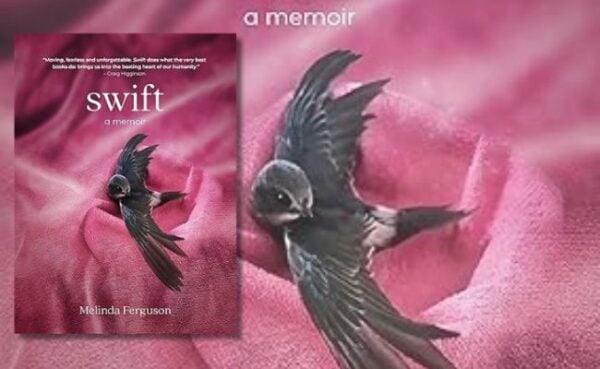
Book cover: RIDE OR DIE PRESS| Melinda Ferguson Books
Janet van Eeden:
Melinda Ferguson has an uncanny way of telling stories that cut to the quick, with zero artifice or dissembling. Her honesty is so refreshing and unusual in today’s world of striving to project perfection only, that she has created a loyal following on social media platforms. Melinda shares her life openly with tens of thousands of followers. She has the gift of getting to the heart of the matter of life, death and everything in between. Her previous memoirs were also captivating and un-put-down-able, especially her initial book, Smacked, in which she details her journey into the hopelessly dark world of drug addiction and coming out on the other side.
Melinda wrote her most recent memoir, Swift, in six straight weeks after her beloved soulmate, Mathius de Fleuriot, died from a heart attack. It is written with an immediacy that keeps the reader glued to the page, and I devoured the book in just two sittings, even though I’ve been unable to read a book these past few months due to difficult personal circumstances. Along with Melinda’s loyal online followers, I’d watched her Facebook Live broadcasts telling the story of, initially, trying to keep a hatchling swift alive, and then – quite horrifyingly – discovering her partner, Mat, dead in the home they shared together in Cape Town. Tens of thousands of viewers shared Melinda’s dramatic and deeply moving experience, living her life alongside her, as she bared her soul online.
Melinda Ferguson is a born storyteller, and the memoir moves along at a compelling pace. Melinda spares no one, especially not herself, in her retelling of the details of those weeks just before and after Mat’s death. Her ability to rehabilitate the swift to the point where it was able to fledge and then fly off on its own, with the help of Mat’s advice before he died – and a synchronistic meeting with a swift activist in the UK – is enough to make a captivating narrative. The harsh shock of finding her beloved dead in his bed when she came home from a visit to her cabin, takes the memoir into the heart-breaking world of the bureaucracy of death and of dealing with the emotions of one’s self, as well as those of other loved ones mourning the loss of a dearly beloved soul.
This memoir is visceral and deeply sincere. It’s impossible not to be moved by Melinda’s heart-wrenching experiences. The retelling of Melinda’s life events encapsulates what Lao Tzu, the Ancient Chinese philosopher, said: "Life and death are one thread, the same line viewed from different sides."
I recommend it highly.
Q and A
Melinda, do you decide consciously to bare your soul when you write a memoir, or do you simply have an intense desire to tell the truth and nothing but the truth about your life (which I find enormously admirable)? Does that give you the freedom to write as fast and honestly as you do? To cut to the chase of the question: Do you plan your writing, or is your writing instinctive?
I don’t intentionally try and tell the truth. I just tell it, because I can’t help it – a bit like Tourette syndrome, I guess. It just comes out of me. Telling the truth doesn’t always endear you to people. I’ve pissed off quite a few people in my life. I guess I like to stir up things, get conversations going, make people think. Cause a bit of chaos. There’s something provocative when one tells the truth and lays one’s soul bare. And I guess honesty is provocative, and, like a fire horse, that kind of feeds me and inspires me. Writing Swift was not planned. It had to come out of me.
The events you describe in Swift are horrifying on the one hand (finding your beloved’s body after you’ve had to break into your locked house), and absolutely exhilarating (the rescue and release of the swift) on the other hand. I’ve found, at times, in my own life that certain life-enhancing events can be followed so swiftly (sorry) by absolute heartbreak in the next moment. Do you find this, too, apart from the most recent tragedy? How do you cope with the juxtaposition of life’s sometimes cruel paradoxes?
I actually find that heartbreaking events or difficult times in my life are always followed by times of joy and enlightenment. That’s the eternal see-saw, the magic and mystery of life.
This is not my first rodeo into darkness and pain. I’ve lived a very full life that’s seen me struggling through addictions, a father dying in front of me when I was four, a Ferrari crash and other crazy stuff. Back in 1999, I came very close to losing my life when I was an addict, as told in my first book, Smacked. I have always lived life on the edge and quite dangerously. I guess I thrive on extremes.
With the sudden and tragic death of my beloved soulmate, Mat, now, perhaps more so than ever, I have begun to accept life in all its horror and cruelty, as well as its beauty and miraculous amazingness. I think that it’s kind of been in my DNA since early childhood, with the sudden death of my dad, to expect that at every corner something wonderful or disastrous can happen.
I have become someone who embraces the idea that things are both good and bad, light and dark, and that it can all transform at any moment, if we let the light through the crack. It’s all about life and death and the details we create in between. This is the challenge that we as humans are faced with. To surrender to these juxtapositions. Now, as I look at my life without my precious Mat, my mission is to find joy and spread light, after having navigated so much darkness in my past. Rescuing the baby, half-dead bird, Swifty, and then throwing myself into the writing of Swift two weeks after Mat died, and within days of the bird fledging, was an enormous push from deep within me to find the light in the darkest of hours.
I recognise your need to work when disaster looms. You wrote this book as a white-hot draft immediately after Mat’s awful death. Do you find that your resilience comes from having been through some of the worst things that life can throw at you (thinking about your experiences at your lowest points which you write about in Smacked), or do you find, like I do, that when the proverbial bicycle begins to wobble, you have to pedal faster to regain your “rigting”?
I think I’ve answered that in the previous question, but yeah, I guess I am a “ride or die” kind of person. I don’t easily accept defeat, because I’ve got this inborn instinct to try and conquer anything that stands in the way of my endgame, which is a concerted search for joy in a world gone mad.
I experienced much of what you write about in Swift by following your Facebook Live posts during the rescue and subsequent release of the swift and the discovery of Mat’s body. You live your life like an open book, pretty much the way I do my own. Have you found that those around you who share much less than you do, criticise you for sharing much more than they would?
Oh, I’ve had a few strangers or trolls inboxing me, saying things like: “Why don’t you just shut up about your pathetic life” or “Nobody is interested in your stupid stories”. I find this really strange and, in a way, fascinating – why people, complete strangers, would do that. Why would they even take the time to watch something that they don’t like and then go to all the trouble of slagging me off? I find the cruelty on social media difficult and hurtful to navigate, but I just try to shake it off and see it as a bit of butterfly shit that I can flick off my cheek.
Your experience of finding Mat’s body and having to deep-clean the house immediately after he was removed made me think of how women always have to keep the cogs of life turning, even if they’ve faced the most devastating tragedies. I remember that after seeing my younger brother’s body in the mortuary, I had to go home and make pancakes for my two boys, who were still very young, before going to my brother’s funeral. How did you reconcile these contradictions, and manage to keep going even though your soulmate was gone and your life with him had been destroyed?
I honestly don’t know how I did it. I think that the focus of having this baby swift, which urgently needed to get to its perfect “fledgling” state (the right weight and the correct wingspan, etc), really kept me holding on.
Once I started feeding it crickets – like sometimes 100 a day! – that little bedraggled bird grew like a boss in front of my eyes. It felt like I had no choice but to try and get it to fly. Of course, Hannah, the swift activist from the UK who magically landed up in my inbox, was a massive factor in getting me to succeed in getting Swifty to leave in time, before he began to starve himself, which is what swifts do if they don’t fledge in time. During the rescue, I think I lost all sense of time and decorum around grief and what the “real” world was requiring of me, because I just put everything into rescuing the bird, which I believed would carry Mat’s tortured soul into the hereafter. The stories we tell ourselves are everything.
Your Facebook Live posts have an enormous following. I watched as some of them reached more than 10 000 views on occasion. Has this following built up over the years, or was it a result of the extraordinary events of last year?
Actually, the first Facebook Live got over 60 000 views – the one in which I told people that I had discovered Mat dead in bed, after breaking a window to get into the house. I held the baby swift and wept as I shared the news. There were many people trying to find out what had happened, because Mat’s death was so sudden and unexpected. So, I just shared from the depths of my shattered heart.
I think talking about death and grief and love and loss from a raw and emotional space really resonated with people. I’ve always had quite a lot of traction on social media, but this definitely brought streams of visitors to my page. It felt very strange, but somehow it helped me and seemed to help others who were experiencing terrible grief. These days, I find it quite hard to keep sharing, as I often wonder: Aren’t people fucking sick of me already?
You write about the advent of Hannah Bourne-Taylor in your life. Could you explain to the readers how this other-worldly soul came into your life?
I honestly would love people to read the book to get to experience the real magic and miracle of Hannah and how she entered my world within hours of Mat dying. Google “Hannah Bourne-Taylor” and “The feather speech”, where gorgeous, tattooed Hannah walked naked through London in 2023, in order to bring attention to the plight of the swift in the UK. She is the main character in the second half of the book, and without her amazing presence from across the ocean, the swift would surely have died. I would never have written the book, and I may very possibly not have made it through to the other side, as all I wanted to do was die, after Mat died. Hannah is one of my favourite people on this planet – a beautiful, other-worldly, magical bird-woman and an incredible force for nature.
I’m amazed at your ability to look after birds. You’ve successfully rehabilitated a ring-necked dove, Messi, who still comes to visit you. And now, your remarkable and against-the-odds rescue of a swift, one of the most difficult creatures to hand-rear, makes you a bird whisperer of note. Where do you think this ability comes from?
Mat was the one who really drove the rescue of the dove in 2021, and I learned a lot from him during the “Messi time” – who, by the way, still comes to visit and eat every single day. Mat loved birds; he was an incredibly compassionate animal person. From when he was a child, he was rescuing injured birds and fledglings. This is from the book:
The fledgling swift came into our lives a week before Mat, my beautiful soulmate, died on 23 November 2025. Suddenly and inexplicably.
Mathias understood the swift before I did.
In the days before he left, he told me many things about these miracle birds: how they eat, drink, sleep and mate on the wing. How they can fly for up to two years without landing. How they are aeronautically the most sophisticated pilots in the entire bird kingdom. How they can hit 110 km/h in level flight, rivalling falcons in velocity but beating them in agility. Their feather microstructure reduces drag, and their forked tails act as control fins, enabling precision steering even at insane speeds.
Before I kissed him goodbye for what would be the final time, he looked at our tiny fledgling in the palm of my hand with a glint in his eye, as if he knew something huge and extraordinary was about to happen.
One of the last things he ever said to me was, “Take care of it. You are the swift’s mother.”
After he left this earth, I looked at the search history on his iPad, desperate for any clues as to what might have led to his untimely death. It was mostly about swifts. What to feed them. How they fly. How their precious wings work.
I didn’t know anything back then, but Time had already begun to behave strangely, loosening its usual predictable grip, slipping out of sequence. I didn’t know back then that Mat was orchestrating events to help me to nurse the baby swift, to get it ready to fledge, so that he could have a vehicle for his restless soul to leave this earth.
The stories we tell ourselves are everything.
........
The stories we tell ourselves are everything.
.........
Matt died of an enormous heart attack, his autopsy showed. I’ve learned through my own bereavements that a sudden death takes longer to recover from than a slow, drawn-out demise. Does the result of the autopsy give you closure, now that you’ve found the exact cause?
All I can say is that reading the autopsy was beyond awful. It was probably the darkest point of my grief journey so far. I just found the language so brutal. They referred to my darling as a case number; they didn’t call him by his name. That broke me.
Within weeks of him dying, I knew that he had had a massive heart attack because the pathologist managed to get hold of me on the phone, but seeing it in brutal detail was horrendous. I guess it does give one some kind of closure because I know now, for absolute sure, that Mat’s body is dead. And that he was very, very ill with extreme heart disease that neither of us was aware of. He was a doctor. He never went to any other doctors. And when he died, it was the last thing that either of us expected. His sudden departure has changed my DNA forever.
Your remarkable ability to keep busy after such a bereavement is admirable. What are your plans for the future, to keep you busy and focused in the way you do so well? Is there another book on the horizon? Is your Melinda Ferguson Books venture doing well enough to keep you occupied for the foreseeable future?
Two months before Mat died, I took the courage to go independent from my previous publishing company, a joint venture with Media24. Then Mat died two months later. I would never have gone solo if I knew that my precious partner, my absolute rock, would be leaving so soon. But there I was. And I had no choice but to, as Sol Kerzner often said, “box on”. I’d already signed up a whole lot of books for the New Year. I had the second Sol Kerzner book to publish, Escaping the sun. I had My boss, Mrs Mandela to edit and publish. And then, in the middle of it all, I got given Swift to write in a period of intense grief and madness. And then all the festivals!
So, yeah, it has been an insanely busy period for me, and thank God I’ve had work. I have really got to realise during this time, that we humans are much more powerful than we think. I’ve also been blessed with an incredible amount of energy, courtesy of the swift, to manage this whole new indie venture of mine, which is called Ride or Die Press / MF Books. I’ve got a number of books to work on at the moment: Pumla Dineo Gqola’s first memoir, Little things are the hinges of the universe; Megan Choritz’s incredible second novel, The sound of ice; and two other yet to be announced titles. So, I’m just trying to focus on building my indie company and creating my own place in this world, without Mat. My broken heart is now the place where much magic and building and healing are taking place.
Also read: