

 |
| Screening details: Date: 23 November 2013 Place: Ster Kinekor Noveau, V&A Waterfront Time: 16:00 Tickets cost R20. Mail Marcelle at marcelledutoit@gmail.com to secure your booking. |
Hallo Marcelle. You guys seem excited for the screening of Wegkruipertjie (“hide-and-go-seek”) at The V&A Waterfront Ster Kinekor Nouveau this coming Saturday.
We are! We've just completed the finishing touches on the productions and we're excited to see the final product on screen!
Tell us more about the team behind Wegkruipertjie?
The Wegkruipertjie team are tough, hard working and persevering. The animator and production designer is Chantré Crafford. She focuses on stop-motion animation and also has vast experience in pixilation animation. I am the producer of this project and have worked closely with Chantré for the past three years on numerous projects across departments, including our pixilation animation Like Clockwork, which was nominated for a CILECT award this year and also showcased at the Short Film Corner at Cannes. Philippa Muller has joined the team for the second time as a very patient and focused cinematographer. Garrick Simpson, who has previously worked on Chantré's animations, is the editor for this project. Our new crew member is our lecturer and head of the CMS (Costume, Make-up and Styling) department at AFDA, Michael Ivy, who did the character construction, character wardrobe and styling. The team have been working together on this project for the past ten months and look forward to screening it to a large audience.
The story is about a young girl, but it doesn't seem like an innocent tale ...
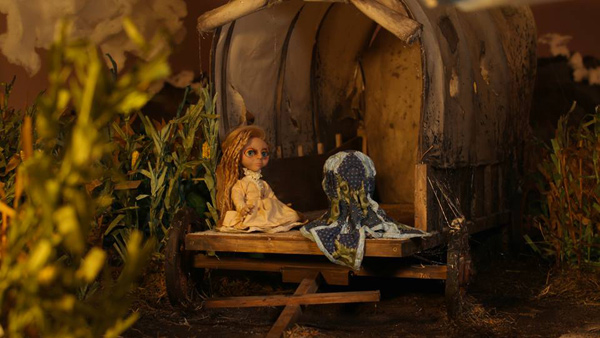
Wegkruipertjie is a coming-of-age film about a little girl, Anna, who loses her parents in the Anglo-Boer War (or the South African War, as some now prefer to call it). The story follows Anna as she tries to overcome their loss by creating an imaginary friend in the form of a “lappieskombers” (patchwork blanket) to keep her company.
Our intention with the story was to discover and research the processes of loss that an individual goes through after losing someone they loved dearly. Anna is in denial throughout the film, living in an imaginary fantasy world with her blanket companion instead of facing reality. This is, however, a perfectly normal reaction for a child to have after having been abandoned in such a manner. Children often create imaginary friends to help them overcome the reality of traumatic loss, and we wanted to explore the emotional side.
It seems that your team has worked with animation techniques for quite some time. What are some of the most rewarding aspects of working with this medium?
Stop-motion animation is the most tedious and time-consuming method of filmmaking known, but the results are always rewarding enough to encourage us to move forward and do the next project. We love working in this medium because every project is completely different from the previous one. This medium has so many different angles from which it can be approached that every time we start a new project it feels like we are creating something new. It's every artist's dream.
And some other, perhaps more challenging aspects?
The most challenging aspect of working in stop-motion is learning to be patient in waiting for results. In live-action filmmaking, when a shot is taken, the director can immediately review the shot and decide whether or not he/she wants to do another take of that shot. In stop-motion, we often work for hours on end without having enough frames to review a shot properly. If after spending half the day on one shot we look at the playback, and the shot could maybe not be up to standard and we have lost half a day's work. The most challenging part comes then, when we have to decide whether to do a second take and make the shot look better, or to move on to the next shot. These kind of decisions make a crucial difference to the film, and when mistakes are made regarding these decisions, the film could take a turn for the worse.
Please explain this technique to those of us not familiar with stop-motion animation.
Imagine a series of images used to create motion. Objects or marionettes (puppets) are used in these images by adjusting or positioning them to create each frame, which is individually filmed to show the motion.
Until now, the technique hasn't been used by many South African filmmakers, right? Why did you decide to work in stop-motion?
We decided to work in stop-motion because it's a medium that combines the best about live-action filmmaking and animation. Although the medium is rare in South Africa, it's still a young and growing medium that will hopefully soon take South Africa by storm the way it has everywhere else in the world. We feel hopeful, since three of five of the animated films that were nominated for an Academy Award this year happened to be stop-motion animated, indicating that the future of stop-motion animation could be great if the right people pursue it. We would like to start slowly with projects like Wegkruipertjie and work our way to developing this new industry in South Africa.
What cameras and lenses did you use?
We chose to work with the Canon 5D and the Canon 7D. These two cameras were the only ones available to us that were compatible with the animation program that we used (Dragonframe). We started off shooting with the Canon 5D with the following lenses; 16–35 mm; 70–200 mm; 50 mm. Mid-shoot, a 60 mm Macro lens, became available to the production. As this lens didn’t fit on the Canon 5D, we used my personal Canon 7D. Therefore we shot all the extreme close-up shots with the Canon 7D.
Did you use any other special effects during and post-production?
Special effects for stop-motion animated films are slightly different from what we see in live-action filmmaking. The special effects included in Wegkruipertjie were creating realistic wind, rain, fire and water. This meant hours of sculpting different stages of water falling out of a bucket from Vaseline, slowly guiding glycerine drops on the windows and on the characters’ skin, as well as sculpting the different stages of raindrops falling on to different surfaces. This kind of attention to detail is what changes a production, but what we are doing is still minimal and we are learning from every production and enhancing our methods to improve every new project we do.

Tell us more about the puppet, Anna, and what it took to make her come to life
Constructing Anna started with a strong focus on the conceptualisation of the character and the psychology that relate to the specific fictional character. Primarily the script and the protagonist are conceptualised for the consumption of a pin-pointed target viewing audience.
First the scale of the doll needs to be decided on. Both the body and the head need to be scaled in relation to the overarching design concept given by the production designer. With Anna it was decided to stylise her slightly by enlarging her head in relation to the rest of her body. This was to amplify her various emotional states and character traits. Skin tones, eye shape, colouring and hair are finalised and captured in a final character design.
Now Anna is ready to be sculpted in special sculpting clay. This process takes a very long time and you need to ensure that the armature within the body of the character has the ability to move freely where the various limbs need to move. The specific process of stop-motion must be kept in mind at all times.
After sculpting, Anna would be ready to start the process of moulding. Another lengthy and very time-consuming process involves wet clay, liquid plastic, glass fibre and various other chemicals in creating the mould. When the mould is done, the process of casting can take place. Special imported silicones are mixed together to match Anna’s desired skin tone. Small red fibres and skin-toned pigments are added into the mixture to ensure that the final result is a beautiful translucent skin tone.
After the casting process has been completed, Anna is painted and her make-up is done. Make-up is applied with various oil paints and lighter fluid. Her individual hairs are literally punched in one by one. Again, a very time-consuming and expensive process. Small wires were weaved and glued into Anna’s Victoria-inspired hairstyle to enable the process of stop-animation.
Anna’s costume had to be completed by hand, as the individual pattern pieces were too small to effectively fit under the foot of a sewing machine. Anna’s costume was inspired by actual Voortrekker artwork with a strong reference and influence of Victorian costume.
Anna was highly effective in affecting our and our target viewing audiences’ moods and emotions. For such a small girl she was extremely difficult to create and even more so to animate, but offered us great learning.
What will happen to Anna once the production is finished?
Anna helped us to let go and for that we are forever thankful. The fear and anxiety of letting go of a loved one is difficult, but through her journey she offers edutainment and healing.
Just as there are various stages of mourning there is a time for everything.
Anna has been working very hard these past few months and besides some burnout, she has sustained some injuries. For now, Anna will take a much-needed rest until … perhaps ... a sequel!
The Wegkruipertjie crew:
|
Producer: Marcelle du Toit |
Animator and production designer: |
Cinematographer: |



|
Editor: Garrick Simpson |
Character construction, wardrobe and styling: Michael Ivy |

Teken in op LitNet se gratis weeklikse nuusbrief. | Sign up for LitNet's free weekly newsletter.