

LitNet Akademies se nuwe reeks met Mercia Coetzee as projekleier stel nuwe navorsers en hul interessante navorsing aan LitNet-lesers bekend.
’n Lys met Afrikaanse vakterme, soos karapaks en apikale, word by elke bydrae verskaf.
Lees die Engelse weergawe ter verwysing.
*
Spoeg, spin en oorleef: Suider-Afrika se spoegspinnekopdiversiteit
Dr Ruan Booysen

Oorpronklike titel van proefskrif:
Revision and molecular phylogeny of the spitting spiders (Araneae: Scytodidae) of southern Africa
Studieleier:
Prof Charles Haddad
Departement Dierkunde en Entomologie, Fakulteit Natuur- en Landbouwetenskappe, Universiteit van die Vrystaat (UV).
*
Agtergrond van studie
Die doel met hierdie studie was om die diversiteit van spoegspinnekoppe (Scytodidae) van die genus Scytodes in Suider-Afrika te bestudeer met die doel om ’n geïntegreerde molekulêre filogenese van die verwantskappe binne hierdie genus saam te stel. Dit is hoofsaaklik gedoen deur alle beskikbare Scytodidae-materiaal vir spesiediversiteit, verspreiding en Rooilysstatus te ondersoek. Verder behels die studie dat verskillende DNS-data (genetiese inligting) en sekere fisiese eienskappe (molekulêre inligting) vergelyk is om te bepaal hoe die organismes fisies en evolusionêr (filogeneties) verwant is. Die morfologiese en genetiese data is uit drie gene (DNS-merkers) verkry: die mitochondriale geen sitochroomoksidase I (COI), die kern-geen Histoon (H3), en die ribosomale RNS (18S). Filogenetiese (evolusionêre verwantskappe) en fenetiese (fisiese ooreenkomste) ontledings is toegepas om verwantskappe en spesiegroepe te bepaal.
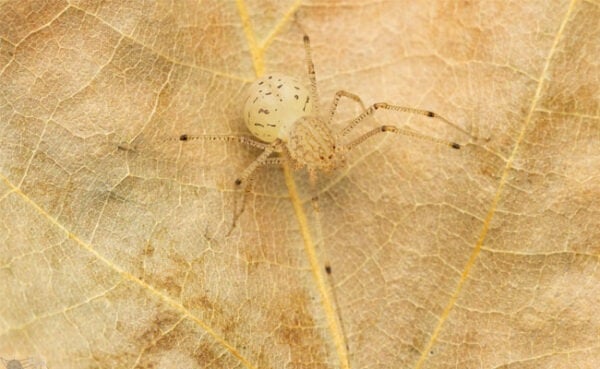
Scytodes maritima, wyfie, Ndumo (Foto: Ruan Booysen)
Taksonomiese geskiedenis
Tot op hede is daar geen omvattende filogenetiese studie van die Scytodes in Suider-Afrika uitgevoer nie, alhoewel duisende Scytodes-spesies oor die afgelope eeu in Suid-Afrikaanse museums en in nasionale en internasionale versamelings opgeneem is. Daar is egter wel sekere genetiese data en verskeie ongepubliseerde inligting uit onafhanklike opnames beskikbaar.
Die familie Scytodidae is deur Blackwall (1864) gevestig, met Aranea thoracica (deur Latreille, 1802) as die oorspronklike tipespesienaam. Met verloop van tyd is verskeie genera by die familie Scytodidae ingesluit en het die familie verskeie taksonomiese wysigings ondergaan. Scytodidae bestaan tans uit twee subfamilies, naamlik Scytodinae en Scyloxinae, wat onderskei word op grond van die lengte van die vingeragtige uitsteeksel op die simbium (kaaktaster) in verhouding tot die bulbus (korter as die bulbus by Scytodinae en afwesig by Scyloxinae), asook die teenwoordigheid van die postepigastriese skleriet (’n verharde plaat) met posisioneringsriwwe by Scytodinae, wat by Scyloxinae ontbreek. Purcell (1904) het die eerste sleutel vir Suid-Afrikaanse Scytodes-spesies saamgestel, waarin 14 wyfies en agt mannetjies onderskei is op grond van die vorm van die postgastriese skild/plaat, palpmorfologie, liggaamskleur en die patrone op die bene en karapaks (kopborsstuk).
Die genus Scytodes kan van die ander Scytodinae-genus, Dictis, onderskei word deur die teenwoordigheid van drie tarsale kloue, teenoor twee kloue by Dictis. Scytodes kan verder van die subfamilie Scyloxinae (Scyloxes, Stedocys) onderskei word deur die teenwoordigheid van drie tarsale kloue (teenoor twee by Scyloxinae), postgastriese skild/plaat en posisioneringsriwwe by wyfies (afwesig by Scyloxinae), en mannetjies wat ’n subapikaal geplaaste bulb op die simbium dra, asook apikale makrosetae op die digivorme uitsteeksel van die simbium. Die mannetjies van Scyloxinae ontbreek die digivorme uitsteeksel, en die bulb is apikaal op die simbium ingeplant.
Daar is tans 36 Scytodes-spesies wat uit Suider-Afrika aangeteken is, waar Suider-Afrika vir die doeleindes van hierdie studie gedefinieer word as alle lande suid, maar met uitsluiting van Angola, die Demokratiese Republiek die Kongo (DRK) en Tanzanië. Scytodes is tans die enigste genus van Scytodidae wat uit Suider-Afrika aangeteken is.
Fisiese beskrywing
Spoegspinnekoppe (Scytodidae) sluit ’n diverse groep spinnekoppe in wat wêreldwyd aangetref word. Hulle wissel van klein (2,1 mm) tot groot (10,6 mm), en kom voor in skakerings van wit, bruin, swart, geel, oranje of rooi. Spoegspinnekoppe het ’n lateraal-uitstaande klipeus (kopskild) met afgeronde laterale rande en ’n koepelvormige karapaks, versier met donkerbruin tot swart dorsale strepe, dikwels met geel kolle binne die strepe en laterale rande met sigsagpatrone, bande of strepe. Die karapaks is langer as breed, het ’n smal oogstreek met ses oë in drie pare en is bedek met akuleate setae (stekelvormige, stywe hare). Die sternum (die borsplaat aan die onderkant van die kopborsstuk) is ovaal, soms met swart laterale strepe en mediane kolle. Spoegspinnekoppe se agt bene is lank en dun en bedek met fyn sensoriese vibrasiehaartjies. Hulle bene is gewoonlik donkerbruin, maar het ook soms kolle, strepe of vlekke.
Die abdomen van spoegspinnekoppe is rond en yl bedek met setae, met abdominale patrone wat kan bestaan uit twee groot mediane driehoeke of kolle anterior (na voor), twee rye groot kolle posterior (na agter) in die rigting van die spinnetjies, drie tot vier transversale bande op die anterior helfte, terwyl die laterale en ventrale abdomen kleiner kolle of geen patrone het nie. Die spinorgaangebied het ses spinorgane en ’n kolulus met setae tussen die anterior laterale spinorgaan (ALS), ’n posterior laterale spinorgaan (PLS), en ‘n posterior mediane spinorgaan (PMS). Wyfies het ’n duidelike, verharde geslagsplaat (gynale skild) en een paar aparte verharde strukture agter die maag, terwyl mannetjies se geslagsorgane spesiale palpe weerskante van hulle monddele is. Aan die punt hiervan is ’n simbium vir spermoordrag.
Spoegspinnekoppe word aangetref in rotsskeure, grotte, onder dooie stompe en bas, in en rondom die basis van graspolle, in boomholtes, in die skuilplekke van ander spinnekoppe en in sinantropiese omgewings (in die omgewing van mense en hul wonings). Sommige spoegspinnekopsoorte woon in klein groepies in digte webstrukture, terwyl ander subsosiaal is. Spoegspinnekoppe bou gewoonlik nie skuilplekke vir jagdoeleindes nie, hoewel wyfies wel ’n skuiling kan bou vir eierlegging en moontlike ouersorg. Die wyfie dra ’n eiersak – wat met sy rondom die eiertjies gespin is – in haar chelicerae (kaakkloue) totdat die kleintjies uitbroei. Die kleintjies sal dan enkele kere vervel voordat hulle wegbeweeg. Dié wat nie groei nie, word deur die ander opgeëet.
Spoegspinnekoppe is nagtelike jagters wat rondswerf op soek na prooi. Hulle het slymkliere wat ’n klewerige mengsel van slym, sy en gif produseer wat hulle oor ’n afstand van 1,5 cm tot 2 cm na die prooi spoeg. Wanneer die mengsel met lug in aanraking kom, stol en krimp dit en word die prooi daarin vasgevang voordat die spinnekop dit met sy chelicerae (kaakkloue) en giftande vergiftig. Wanneer die mengsel slegs uitwendig op die prooi beland, het dit geen uitwerking nie; effektiewe vergiftiging vereis dat die prooi met die giftande deurboor word. Spoegspinnekoppe is nie aggressief nie en maak soms gebruik van tanatose (die voorgee van dood wees) wanneer hulle versteur word.
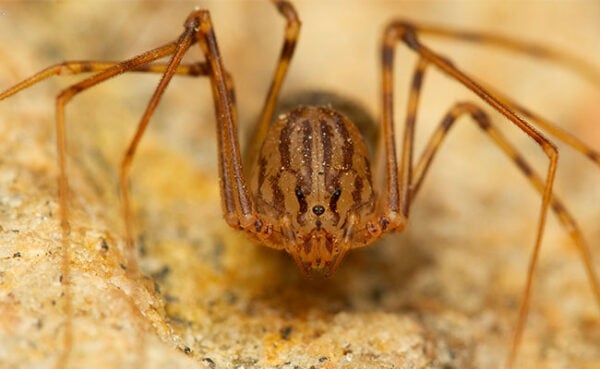
Scytodes sp., wyfie, Sendelingsdrif (Foto: Ruan Booysen)
Dataversameling
Vir hierdie studie is spoegspinnekoppe tydens velduitstappies regoor Suid-Afrika versamel. Bykomende materiaal is ook uit verskeie nasionale en internasionale versamelings verkry om die diversiteit van hierdie groep volledig te ondersoek. Metodes vir die versameling van Scytodidae het klopmonsterneming, veegmonsterneming, handversameling van rotse, stompe, boombas en graspolle, asook putvalle, blaarstrooisifting en boomkruinberoking ingesluit.
Spesimen-ondersoek
Die spinnekopmonsters is in etanol verwerk en onder ’n stereomikroskoop, toegerus met ’n Olympus SC50-kamera, ondersoek en gefotografeer. Foto’s en metings van die habitus en genitalieë is binne die cellSense™-beeldsagteware geneem. Die vroulike genitale skild/plaat (gynale skild/plaat) is met ’n naald gedissekteer en met behulp van ’n Labcon-ultrasoniese bad skoongemaak. Enige oortollige organiese materiaal is met ’n naald verwyder. Die manlike linkerpalpe is met ’n naald en tang gedissekteer. Gepreserveerde spinnekoppe is gefotografeer, en beelde is geneem van die habitus, die ventrale vroulike genitalieë en endogyn, asook die ventrale en retrolaterale aansigte van die manlike palpe. Digitale lyntekeninge is met CorelDraw X8 gedoen, waarna verdere lyntekeninge en skakering met die hand aangebring is.
Molekulêre resultate: COI, 18S en H3
Sitoschroomoksidase subeenheid I (COI), ook bekend as die DNS-strepieskodegeen, is uitnemend geskik vir die oplossing van spesievlakverwantskappe. In hierdie studie is al 45 isolate vir DNS-strepieskodering voorberei, maar slegs agt van die 45 het enige bruikbare DNS opgelewer. Van hierdie agt kon geen bruikbare Scytodes-kontigs saamgestel word nie weens groot verskille tussen die voorwaartse en terugwaartse stringe. Om hierdie redes is besluit om geen COI-resultate hier aan te bied nie, aangesien dit as onbruikbaar beskou is.
Dieselfde datastel is vir die H3- en 18S-streke ontleed. In totaal is 31 kontigs tussen hierdie twee streke gedeel (25 uit nuwe materiaal en 6 uit GenBank). Ongelukkig is hierdie data nie voldoende om ’n molekulêre filogenie uitsluitlik op grond van twee gekonserveerde streke te konstrueer nie. Ideaal gesproke is spesievlakresolusie nodig, wat verkry kan word deur addisionele, hoëgehalte-COI-data in te sluit.
Kladistieke en fenetieke resultate
Hierdie studie het talle nuwe Scytodes-rekords vir Suid-Afrika gegenereer, asook nuwe materiaal in museumversamelings vir Suider-Afrika geïdentifiseer. Die studie het gelei tot die beskrywing van 38 nuwe Scytodes-spesies en die bywerking van die beskrywings van 27 uit die 35 bestaande spesies wat oorspronklik uit Suider-Afrika aangeteken is. Daarbenewens is die mannetjie van S. maritima (deur Lawrence, 1938), en die wyfie van S. elizabethae (deur Purcell, 1904) vir die eerste keer beskryf.
Volgens die Rooilysdata vir Scytodes-spesies in Suider-Afrika is daar 16 spesies wat as “byna bedreig” beskou word, en drie spesies wat as “kwesbaar” geklassifiseer word. Die data is op huidige versamelings- en steekproefdata gebaseer en moet as voorlopig beskou word, aangesien hierdie klassifikasie waarskynlik sal verander namate verdere navorsing gedoen word.
Ten slotte
Beperkings van hierdie projek sluit in dat nie al die tipespesimens vir herbeskrywing verkry kon word nie, en ook weens die swak toestand van sommige van die tipesmateriaal. Slegs 68 van die 164+ spesies wat tydens dataversameling ontdek is, is behandel.
Molekulêre ontledings was nie suksesvol in die volgordebepaling van die COI-streek nie, maar beter resultate is met die 18S- en H3-streke verkry. Die data was onvoldoende om ’n robuuste molekulêre filogenie van Scytodes in Suider-Afrika saam te stel, maar 11 spesiegroepe is op grond van ’n ooreenkomsmatriks voorgestel. Rooilysdata vir alle spesies wat in hierdie proefskrif ingesluit is, is ook verskaf.
Daar blyk ’n uiters hoë spesiediversiteit in hierdie genus in Suider-Afrika te wees, waarvan die meeste in Suid-Afrika versamel is. Die diversiteit van Scytodes in Suider-Afrika is swak ondersoek en uitgebreide monsterneming is nodig om die werklike diversiteit in alle Suider-Afrikaanse lande te ontbloot. Verder is addisionele navorsing noodsaaklik oor waarom die COI-streek van hierdie genus/familie so moeilik is om met standaard universele arthropode-primers te sekwenseer, aangesien dit beter filogenetiese resolusie sal moontlik maak.
Vakterme
Akuleate setae: setae (hare of borsels) wat skerp, stekelagtig of naaldvormig is
Apikale: aan die punt of eindpunt
Bulbus: die gespesialiseerde manlike voortplantingsorgaan aan die punt van die palpus (die mannetjie se geslagsorgaan)
Chelicerae (enkelvoud chelicera): die eerste paar monddele van spinnekoppe; dit verwys na die kaakkloue of gifkake
Simbiale uitsteeksel: verlenging van die simbium. Die vorm, grootte en posisie daarvan is dikwels belangrike taksonomiese kenmerke wat gebruik word om spesies te onderskei.
Simbium: die eindsegment van die manlike palpus wat die bulbus ondersteun en waarop die manlike geslagsorgaan geleë is
Endogyn: die interne vroulike geslagstrukture van ’n spinnekop, insluitend die spermateke, bevrugtingskanale en ander interne strukture wat vir spesie-identifikasie gebruik word
Filogenetiese studie: ’n studie wat die evolusionêre geskiedenis en verwantskappe van organismes ondersoek deur ooreenkomste en verskille in eienskappe, dikwels insluitend morfologiese en molekulêre data, te ontleed
Genitale skild/plaat: verharde kutikulêre strukture buite die geslagsgebied wat deel vorm van die voortplantingsapparaat en wat ondersteuning, beskerming of spesifieke funksies tydens paring kan verskaf
Karapaks: die verharde boonste gedeelte van die prosoma wat die oë, brein, chelicerae, pedipalpe en die aanhegtingspunte van die pote bevat
Kolulus: ’n klein mediaangeleë aanhangsel op die ventrale oppervlak van die agterlyf, net voor die spinnerette, wat as 'n oorblyfsel van ’n voorouerlike spinneret beskou word
Kontigs: ’n deurlopende DNS-volgorde wat deur bioinformatiese samestelling verkry word deur korter volgordes wat oorvleuel aan mekaar te heg
Postgastriese skild: ’n verharde deel van die onderste oppervlak van die opistosoma (agterlyf) wat agter die gastriese/epigastriese gebied geleë is
Setae: haaragtige uitgroeisels op die liggaam van geleedpotiges soos spinnekoppe en insekte.
Inligtingsbronne
Addisionele bronne waarna verwys word, sluit in:
- Blackwall, J. 1864. A history of the spiders of Great Britain and Ireland. Londen: Ray Society.
- Clements, R en D Li. 2005. Regulation and non-toxicity of the spit from the pale spitting spider Scytodes pallida (Araneae: Scytodidae). Ethology, 111:311.
- Dippenaar-Schoeman, AS, CR Haddad, R Booysen, SH Foord en LN Lotz. 2021. The Scytodidae of South Africa. Version 1. South African National Survey of Arachnida Photo Identification Guide, Irene.
- Foelix, RF. 2011. Biology of the spiders. New York: Oxford Publishers.
- Latreille, PA. 1802. Famille seconde. Arachnides. In Latreille, PA (red). Histoire naturelle, générale et particulière des crustacés et des insectes. Tome troisième. F Dufart, Parys, ble 48–59.
- Lawrence, RF. 1938. A collection of spiders from Natal and Zululand. Annals of the Natal Museum, 8:455–524.
- Purcell, WF. 1904. Descriptions of new genera and species of South African spiders. Transactions of the South African Philosophical Society, 15:115–73.
- Suter, RB en GE Stratton. 2009. Spitting performance parameters and their biomechanical implications in the spitting spider, Scytodes thoracica. Journal of Insect Science, 9:62.
- Zamani, A, M Stockmann, ILF Magalhaes en CA Rheims. 2022. New taxonomic considerations in the spitting spider family Scytodidae (Arachnida: Araneae). Zootaxa, 5092(2):151–75.
- Zobel-Thropp, PA, SM Correa, JE Garb en GJ Binford. 2014. Spit and venom from Scytodes spiders a diverse and distinct cocktail. Journal of Proteome Research, 13(2):817–35.
Lees onderstaande Engelse weergawe van die studie ter verwysing:
LitNet Akademies’s new series, with Mercia Coetzee as project leader, introduces new researchers and their interesting research to LitNet readers.
A list of technical terms is provided with each contribution.
*
Spit, spin and survive: Southern Africa’s spitting spiders’ diversity
Dr Ruan Booysen
Original title of dissertation:
Revision and molecular phylogeny of the spitting spiders (Araneae: Scytodidae) of southern Africa
Supervisor: Professor Charles Haddad
Department of Zoology and Entomology, Faculty of Natural and Agricultural Sciences, University of the Free State (UFS)
*
Study background
The aim of this study was to investigate the diversity of spitting spiders (Scytodidae) of the genus Scytodes in southern Africa, with the objective of constructing an integrated molecular phylogeny of the relationships within this genus. This was primarily achieved by examining all available Scytodidae material to determine species diversity, distribution and Red List status. Furthermore, the study involved comparing different DNA datasets (genetic information) and physical characteristics (morphological information) to determine the physical and evolutionary (phylogenetic) relationships among the organisms. The morphological and genetic data was obtained from three genes (DNA markers): the mitochondrial gene cytochrome c oxidase subunit I (COI), the nuclear gene Histone H3 (H3) and the ribosomal RNA gene (18S). Phylogenetic (evolutionary relationship) and phenetic (physical similarity) analyses were conducted to determine relationships and species groups.
Scytodes maritima, female, Ndumo (Photo: Ruan Booysen)
Taxonomic history
To date, no comprehensive phylogenetic study of Scytodes in southern Africa has been conducted, despite thousands of Scytodes specimens having been deposited in South African museums and national and international collections over the past century. However, some genetic data and several unpublished records from independent surveys are available.
The family Scytodidae was established by Blackwall (1864), with Aranea thoracica (Latreille, 1802) by original designation as the type species. Over time, several genera have been included in the family Scytodidae, and the family has undergone numerous taxonomic revisions. Scytodidae currently comprises two subfamilies, namely Scytodinae and Scyloxinae. These subfamilies are distinguished based on the length of the finger-like projection on the cymbium (last segment on the pedipalp) relative to the bulbus (shorter than the bulbus in Scytodinae and absent in Scyloxinae), as well as the presence of the postgastral scutula (hardened plates) with positioning ridges in Scytodinae, which is absent in Scyloxinae. Purcell (1904) compiled the first key for South African Scytodes species, distinguishing 14 females and eight males based on the shape of the postgastral scutula, palpal morphology, body colouration, and the patterns on the legs and carapace.
The genus Scytodes can be distinguished from the other Scytodinae genus, Dictis, by the presence of three tarsal claws, compared with two claws in Dictis. Scytodes can further be distinguished from the subfamily Scyloxinae (Scyloxes, Stedocys) by the presence of three tarsal claws (compared with two in Scyloxinae), postgastral scutula and positioning ridges in females (absent in Scyloxinae), and males bearing a subapically positioned bulbus on the cymbium, as well as apical macrosetae on the digiform projection of the cymbium. Males of Scyloxinae lack the digiform projection, and the bulbus is inserted apically on the cymbium.
Currently, 35 Scytodes species have been recorded in southern Africa, where southern Africa is defined for the purposes of this study as all countries south of the equator, excluding Angola, the Democratic Republic of the Congo (DRC) and Tanzania. Scytodes is currently the only genus of Scytodidae recorded in southern Africa.
Physical description
Spitting spiders (Scytodidae) comprise a diverse group of spiders that occur worldwide. They range in size from small (2,1 mm) to large (10,6 mm) and occur in shades of white, brown, black, yellow, orange and red. Spitting spiders have a laterally projecting clypeus (region between eyes and chelicerae) with rounded lateral margins and a dome-shaped carapace (top half of cephalothorax), ornamented with dark brown to black dorsal stripes, often containing yellow spots within the stripes, and lateral margins with zigzag patterns, bands or stripes. The carapace is longer than wide, has a narrow eye region with six eyes arranged in three pairs, and is covered with aculeate setae (stiff spine-like hairs). The sternum (the plate on the underside of the cephalothorax) is oval, sometimes with black lateral stripes and median markings. The eight legs of spitting spiders are elongated and slender, covered with fine sensory vibration hairs. Their legs are usually dark brown, but may also have spots, bands or markings.
The abdomen of spitting spiders is rounded and sparsely covered with setae, with abdominal patterns that may consist of two large median triangles or spots anteriorly, two rows of large spots posteriorly towards the spinnerets, and three to four transverse bands on the anterior half. The lateral and ventral surfaces of the abdomen have smaller spots or may lack patterns. The spinneret region contains six spinnerets and a colulus with setae positioned between the anterior lateral spinnerets (ALS), posterior lateral spinnerets (PLS) and posterior median spinnerets (PMS). Females have a distinct, hardened genital plate (gynal scutum) and one pair of separate hardened structures posterior to the stomach, whereas the male genital organs consist of specialised palps situated on either side of the mouthparts. At the tip of each palp is the cymbium with a bulbus (tegulum) involved in sperm transfer.
Spitting spiders occur in rock crevices and caves, beneath dead logs and bark, in and around the bases of grass tussocks, in tree cavities, in the retreats of other spiders, and in synanthropic environments (areas associated with humans and human dwellings). Some spitting spider species live in small groups within dense web structures, whereas others are subsocial. Spitting spiders generally do not construct retreats for hunting purposes, although females may construct retreats for egg laying and possible parental care. The female carries an egg sac – spun with silk around the eggs – in her chelicerae (fangs) until the spiderlings hatch. The spiderlings then moult several times before dispersing. Those that fail to develop are consumed by the others.
Spitting spiders are nocturnal hunters that actively wander in search of prey. They possess slime glands that produce a sticky mixture of slime, silk and venom, which they eject towards prey over 1,5 cm to 2 cm. When the mixture encounters air, it solidifies and contracts, trapping the prey before the spider envenomates it using its chelicerae and venomous fangs. When the mixture only lands externally on the prey, it has no effect; effective envenomation requires the prey to be penetrated by the fangs. Spitting spiders are not aggressive and may sometimes employ thanatosis (feigning death) when disturbed.
Scytodes sp., female, Sendelingsdrif (Photo: Ruan Booysen)
Data collection
For this study, spitting spiders were collected during field excursions throughout South Africa. Additional material was obtained from several national and international collections to ensure a comprehensive investigation of the diversity of this group. Collecting methods for Scytodidae included beating sampling; sweep sampling; hand collection from rocks, logs, tree bark and grass tussocks; as well as pitfall traps, leaf-litter sifting and canopy fogging.
Specimen examination
The spider specimens were preserved in ethanol and examined and photographed under a stereomicroscope equipped with an Olympus SC50 camera. Photographs and measurements of the habitus and genitalia were obtained using cellSens™ imaging software. The female genitalia (gynal scutum) were dissected using a needle and cleaned using a Labcon ultrasonic bath. Any excess organic material was removed with a needle. The left male palps were dissected using a needle and forceps. Preserved spiders were photographed, and images were captured of the habitus, the female genitalia and endogyne, as well as the ventral and retrolateral views of the male palps. Digital line drawings were prepared using CorelDRAW X8, after which additional line work and shading was added manually.
Molecular results: COI, 18S and H3
Cytochrome c oxidase subunit I (COI), also known as the DNA barcoding gene, is highly suitable for resolving species-level relationships. In this study, all 45 isolates were prepared for DNA barcoding, but only eight of the 45 yielded usable DNA. No usable Scytodes contigs could be assembled from these eight samples, due to substantial differences between the forward and reverse sequences. For these reasons, it was decided not to present any COI results, as they were considered unusable.
The same dataset was analysed for the H3 and 18S regions. A total of 31 contigs were shared between these two regions (25 from newly generated material and six from GenBank). Unfortunately, this data was insufficient to construct a molecular phylogeny based solely on two conserved regions. Ideally, species-level resolution is required, which could be achieved through the inclusion of additional high quality COI data.
Cladistic and phenetic results
This study generated numerous new Scytodes records for South Africa, as well as identifying new material in museum collections throughout southern Africa. The study resulted in the description of 38 new Scytodes species and the updated descriptions of 27 of the 35 existing species originally recorded in southern Africa. In addition, the male of S maritima (Lawrence, 1938) and the female of S elizabethae (Purcell, 1904) were described for the first time.
According to Red List data for Scytodes species in southern Africa, 16 species are considered near threatened, and three species are classified as vulnerable. This data is based on current collection and sampling records and should be regarded as preliminary, as these classifications are likely to change as further research is conducted.
Conclusion
Limitations of this project include the inability to obtain all type specimens for redescriptions, as well as the poor condition of some of the type of material. Only 68 of the 164+ species discovered during data collection were included in the study.
Molecular analyses were unsuccessful in sequencing the COI region; however, better results were obtained for the 18S and H3 regions. The data was insufficient to construct a robust molecular phylogeny of Scytodes in southern Africa, but 11 species groups were proposed based on a similarity matrix. Red List data for all species included in this dissertation was also provided.
The genus appears to exhibit exceptionally high species diversity in southern Africa, with most species collected in South Africa. The diversity of Scytodes in southern Africa remains poorly studied, and extensive sampling is required to reveal the true diversity across all southern African countries. Furthermore, additional research into why the COI region of this genus/family is so difficult to sequence using standard universal arthropod primers is essential, as this would enable improved phylogenetic resolution.
Technical terms
Aculeate setae: Setae (hairs or bristles) that are sharp, spine-like or needle-shaped
Apical: Located at the tip or endpoint
Bulbus: The specialised male reproductive organ situated at the tip of the palp (the male sexual organ)
Carapace: The hardened upper section of the prosoma that contains the eyes, brain, chelicerae, pedipalps and attachment points of the legs
Chelicerae: (singular: chelicera) The first pair of mouthparts of spiders, referring to the fangs or venom-injecting jaws
Colulus: A small median appendage on the ventral surface of the abdomen, immediately anterior to the spinnerets, considered to be a remnant of an ancestral spinneret
Contigs: Continuous DNA sequences obtained through bioinformatic assembly by joining shorter overlapping sequences
Cymbial projection: A projection arising from the cymbium. Its shape, size and position are often important taxonomic characteristics used to distinguish species
Cymbium: The terminal segment of the male palp that supports the bulbus and on which the male reproductive organ is situated
Endogyne: The internal female genital structures of a spider, including the spermathecae, fertilisation ducts and other internal structures used for species identification
Gynal scutum: Hardened cuticular structures located around or within the genital region that form part of the reproductive apparatus and may provide support, protection or specific functions during mating
Phylogenetic study: A study that investigates the evolutionary history and relationships of organisms by analysing similarities and differences in characteristics, often including morphological and molecular data
Postgastral scutula: A hardened structure on the lower surface of the opisthosoma (abdomen), situated posterior to the gastric/epigastric region
Setae: Hair-like projections on the bodies of arthropods such as spiders and insects
References
Additional sources referred to include:
- Blackwall, J. 1864. A history of the spiders of Great Britain and Ireland. London: Ray Society.
- Clements, R and Li, D. 2005. Regulation and non-toxicity of the spit from the pale spitting spider Scytodes pallida (Araneae: Scytodidae). Ethology 111:311.
- Dippenaar-Schoeman, AS, Haddad, CR, Booysen, R, Foord, SH, and Lotz, LN. 2021. The Scytodidae of South Africa. Version 1. South African National Survey of Arachnida Photo Identification Guide, Irene.
- Foelix, RF. 2011. Biology of the spiders. New York: Oxford Publishers.
- Latreille, PA. 1802. Famille seconde. Arachnides. In: Latreille, PA (ed), Histoire naturelle, générale et particulière des crustacés et des insectes. Tome troisième. F Dufart, Paris, pages 48-59.
- Lawrence, RF. 1938. A collection of spiders from Natal and Zululand. Annals of the Natal Museum 8:455-524.
- Purcell, WF. 1904. Descriptions of new genera and species of South African spiders. Transactions of the South African Philosophical Society 15:115-73.
- Suter, RB and Stratton, GE. 2009. Spitting performance parameters and their biomechanical implications in the spitting spider Scytodes thoracica. Journal of Insect Science 9:62.
- Zamani, A, Stockmann, M, Magalhaes, ILF, and Rheims, CA. 2022. New taxonomic considerations in the spitting spider family Scytodidae (Arachnida: Araneae). Zootaxa 5092(2):151-75.
- Zobel-Thropp, PA, Correa, SM, Garb, JE, and Binford, GJ. 2014. Spit and venom from Scytodes spiders a diverse and distinct cocktail. Journal of Proteome Research 13(2):817-35.