

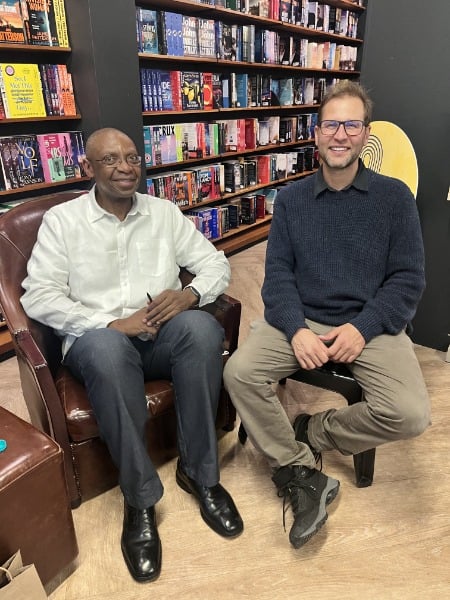
Andile Xaba and Alwyn Roux (Photo: Graeme Wilkinson)
Title: Soweto’s theatre of resistance, 1984-1994: Gibson Kente, Matsemela Manaka and Maishe Maponya
Author: Andile Xaba
ISBN: 978-0-7969-2704-0
Ebook ISBN: 978-0-7969-2715-6
Introduction
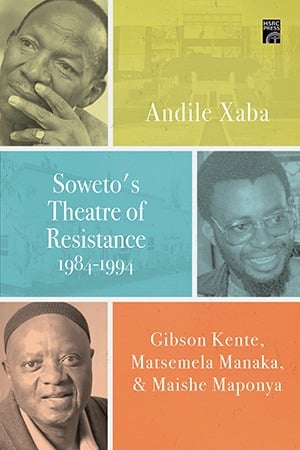 The book Soweto’s theatre of resistance, 1984-1994: Gibson Kente, Matsemela Manaka and Maishe Maponya was recently published by the Human Sciences Research Council (HSRC) Press. It is written by Andile Xaba, a senior lecturer at the University of South Africa (Unisa). Its publishing follows a research study in which Andile interviewed 14 colleagues of Kente, Manaka and Maponya, who produced community theatre in the 1980s and 1990s. The book aims to address a lacuna in the knowledge about Soweto-based community theatre playwrights and their contributions to South African theatre. The three playwrights provide a narrative arc for the history of community theatre, covering mainly the decade under discussion, but also anticipating and exceeding the 1980s and 1990s. The book was double-blind peer reviewed and incorporates the theoretical concepts of memory studies and the Black Consciousness Movement in telling the story of Sowetan theatre.
This article is an edited conversation between Alwyn Roux from Unisa and Andile at the launch of the book in Pretoria.
Good evening, everyone, and welcome. It’s a real pleasure to be with you tonight to launch Dr Andile Xaba’s important new book, published by HSRC Press. My name is Alwyn, and I have been a colleague of Andile’s since 2015, in the Theory of Literature section at Unisa. Perhaps it’s fitting to introduce him as part of our work situation.
I have known him since he was registered for his MA dissertation under the supervision of Professor Andries Oliphant. And then later we worked together with Professor Marisa Keuris, with whom Andile was part of the Drama and Heritage project based at Unisa. So, that was also the starting point of the journey that led to this book – to literature, theatre, memory and the lives and work of these remarkable playwrights. Andile completed this project in 2021. Firstly, this is a celebration. We will discuss this book in depth and look into the research growing out of chapters on Gibson Kente, Matsemela Manaka and Maishe Maponya, which form the core of the book.
Also, I want to welcome our Unisa colleagues. I see that Professor Puleng Segalo from the Department of Psychology is here – welcome, Professor Segalo. Professor Saal, our previous head of department, is here, as is Professor Alan Northover, the current head of the Department of Afrikaans and Theory of Literature. Another welcome to all our other colleagues as well. It’s wonderful having you here.
Andile, congratulations on this beautiful and necessary book.
Before we turn to the book itself, on page 44 you mentioned almost in passing that you grew up in Soweto and have vivid memories of Gibson Kente’s plays. Before you were a scholar writing this book, you were one of the audience members. I want to take you back there. What do you remember? And if you can, please tell us what you remember also about your background, and what first piqued your interest in drama and theatre.
My interest stems from my home. I was lucky enough to grow up in an artistic family; although we did not have a lot of money, we had an appreciation for the arts. My father was an actor. He was in two of Athol Fugard’s plays. Athol Fugard wrote and directed a play called Nongogo, and my dad was in that play in 1959. And then Athol Fugard directed Samuel Beckett’s play, Waiting for Godot, in 1962.
It was the first time that Waiting for Godot was performed on the African continent. And in order for them to get permission for the play to be performed in South Africa, they had to have an all-black cast. This was an important play, and my dad was one of the first people to perform the play in South Africa. But I didn’t know this until recently. This is part of my residual memory. Through the book, I’m also trying to explain why my dad was so into theatre – why he insisted that we go to the theatre whenever Gibson Kente’s plays were performed in Soweto.
Gibson Kente was a huge figure in Soweto. He invented the idea of having a theatre company run by a black man based in Soweto, employing a regular company of actors. Before Gibson Kente, there was no theatre tradition as such in the township. Whenever he put on his plays, it became a huge occasion on Thursday nights, Friday nights, Saturday nights and Sunday nights. We’d go to community halls, and we would queue. Long, long queues, reminiscent of – but not quite – the queues to vote in the first democratic elections.
This is a bit of a hyperbole, but that was the kind of impact he had in the township. There would be small-scale business whenever his plays were being performed. Before the play started, people would be outside the venue queuing, and there’d be people selling food. It was just a whole big atmosphere. It really made an impression on me, because it involved all parts of the community. Whether you were 80 years old or you were six years old, you went to see the theatre of Gibson Kente.
And the performances themselves were quite striking and memorable. Thank you.
One sentence in your first chapter stayed with me. We’re talking about Gibson Kente now. He wrote 35 plays, and after a fire at his home, only one script survived. So, almost everything we know about him has come from memory, from press reviews or from our own first-hand experience of plays like Too late.
But how could Manaka and Maponya, by contrast, publish their works? How did that uneven evidence shape the book? What could you write about Kente that you couldn’t write about the other two?
I think it was trial and error. I didn’t start off with the idea that I was going to write about Soweto theatre in this way. When I started my research, my inspiration was, in part, sparked by students. I was a second examiner at a university for drama students, and I remember speaking to students about Soweto theatre. I could hear during the discussions that so much information was distorted, and so much was lost. There was a bit of confusion about what happened when. And that got me a little bit concerned. How could we bring this story to life?
It was a personal motivation. When it came to Kente’s plays, there was a kind of intimacy, because I had gone to his plays as a child; I knew him, and there was an emotional connection. He was a very popular figure in Soweto, and he was larger than life, as his plays were. But with Matsemela Manaka and Maishe Maponya, they were a bit distant from me, because they were a generation younger than Gibson Kente, and they were preoccupied with publishing their plays and did not have such high visibility in the township. I didn’t have such an immediate connection with them. But I felt that to tell a longitudinal story about Soweto, I had to include both parts, that is, Black Consciousness and Kente, whose works were not so much about overthrowing the system. Kente believed in working within the apartheid system and changing it from within, whereas Black Consciousness was about rejecting the system altogether and focusing on black identity and self-actualisation.
Could you tell us a little bit more about the locations where the community theatre plays were performed? You know, like the Eyethu Cinema. How many people could fit in the venue? Could you also talk about Kente’s style of theatre or drama? You also mention the concept of poor theatre in the book.
Well, poor theatre is not about commercial or financial abilities. It’s about stripping theatre to its bare minimum. It’s about using the resources that you have around you and making the best of them.
These plays were performed in community halls, and community halls were not designed as artistic spaces. They were designed for something else. And Eyethu Cinema was a cinema, so it was also not designed as a theatre space. Artists – Kente, Manaka and Maponya – used the resources at hand to stage their plays. They used the expressive bodies of the actors, and found objects and domestic furniture to use as stage props and to convey realism. In the book, I also write about 20 other theatre companies that were operating in the township. In the book, I just used Kente, Manaka and Maponya as a thread to tell the story of Soweto theatre. These places were just bare halls with minimal electrical equipment; there was no sound to amplify the actors on stage, and there were no lights to create different moods on stage. These were just halls that people came to and appropriated for artistic expression.
You touch on why you selected these three playwrights, but they were not the only playwrights working at that time. You mention Stan Mhlongo, Peter Ngwenya, Butiza Ndlela, Sabata Sesui, Willie “General” Tshaka and Lucky Shao, among others. And on the women’s side, only two names come up: Doreen Mazibuko and Nomazizi Williams.
The choices you make in the book are an argument in themselves. And you refer to the older playwright, Gibson Kente, as working within apartheid to change the system from within, in contrast with the Black Consciousness Movement. But you also show that women were involved in Kente’s productions, not only as actors, but also behind the scenes. This seems like an ambiguous picture, where there was less visibility of women as playwrights in their own right – and in the book, you mention that you did not find much information on a playwright like Nomazizi Williams. Could you speak about that?
Yes, firstly, the idea of theatre in Soweto was primarily a very masculine construction. It was mostly men who were the playwrights, and women who were on stage performing.
The women were the majority in terms of the acting, but in terms of being playwrights themselves and running companies, it really happened very rarely because of social circumstances, and because of the systematic exclusion of women from certain roles in society. But I think what we see in Kente – and this surprised me when I did the research – was that even though the women were the stars of the show, within Kente’s company there was a group of women who were helping him to manage the company. They would audition people who came in and be in charge of the finances.
And another role that women occupied was that women volunteers would host Kente and his cast when the company went on tour. Kente’s plays toured most of the townships in South Africa and in southern Africa. It was nurses, teachers and women who were just working in the kitchen – ordinary members of the black community.
That’s what I discovered: that, actually, the role of women was quite substantial, but it’s not prominent in scholarship. We just know of these three playwrights as writers, producers, actors, choreographers and things like that, but they had a support system, and women provided that support system for Kente. Manaka and Maponya belonged to a younger and more radical generation, coming of age at the time of the 1976 uprisings, with Black Consciousness as the imperative.
Could you say something about Maponya’s notion of experimental theatre as revolutionary theatre? This is a phrase, as I understand it, for which he was interrogated by the security police.
When I spoke to Maishe and did the research, he was the only playwright still living. Both Kente and Manaka had passed away. I said to him: Why did you start protest theatre? He said to me: No, no, no, kanti (because) I’m not doing protest theatre. I’m resisting; I’m doing resistance theatre. He wanted to find a voice that spoke not only to his audience, but also to the powers that be, and to pass on and craft a message that was unequivocally anti-apartheid and pro-revolution and about throwing out the state.
There was a lot of censorship during the ‘80s; theatre was also a form of telling that story. There were things like church sermons that were also a way of subverting the censorship that was prevalent at that time. And Matsemela Manaka and Maponya were in some ways also at odds with Gibson Kente, as I have said, because Gibson Kente wanted to work within the system of apartheid and change it from within.
They criticised him a lot. They criticised him and said that his plays were just entertainment and we, the audience, shouldn’t see them; people shouldn’t go to them. And this was reflective of the politics in the township at that time. There were people who were aligned with the Black Consciousness Movement, and there were people who were aligned to a more kind of – how we understand it today as, you know, with the ANC – multiculturalism or multiracialism. There was also a socially and politically conservative group of people in Soweto, but they were mostly mineworkers living in hostels.
Therefore, there were tensions in the township, and these tensions are also reflected in the plays. At the same time, the plays by Sowetan playwrights also reflect places of meeting and coming together, because it was not just one thing all the time. Sometimes politics united the playwrights, but at other times theatre showed their different ideological sympathies. I must also point out that none of the playwrights advocated for a political party.
You draw a clear line between mainstream theatre – the Market Theatre, the Windybrow Theatre – and the community theatre of Soweto. Clearly, the difference was not talent, but apartheid law. Since there was no theatre building in Soweto, theatre happened in places like the community hall, in Gibson Kente’s garage and in churches. This was despite the fact that there was also incredible violence in the township during the mid-1980s. You give a working definition of what community theatre is, and I would actually love to read a part of it. On page 13, it says:
Community theatre is the presentation of a narrative by actors on stage. These plays often include elements of drama, comedy, poetry, music, mime and dance. The plays are typically, at least initially, presented in venues with minimal stage lighting technology, an absence of voice amplification for the actors and no terraced seating. These circumstances demand a performative style of acting evident in exaggerated body movements and voice projection to convey the dramatic intent of the characters.
At this stage, I want to ask: How big were the venues used for those performances?
Well, Eyethu Cinema would sit around, I think, 300 people. It was a huge space, but at times Kente had to turn audiences away because the plays were just so popular.
Think about it: Thursday night, Friday night, Saturday night and Sunday. There were two shows, morning and night – that’s quite a lot of people. And Soweto is divided into many areas, for example, Mofolo, Tshiawelo, Phefeni, Dobsonville and other areas – there was quite a big audience for community plays.
Theatre groups were performing at Eyethu, which was in Mofolo, where I lived, and there was another community home – smaller – in Kliptown, another one in Diepkloof, and another one in Phefeni, which is called Uncle Tom’s Hall. Actually, theatre groups could do a tour within the township, and every venue would be full, so that groups would perform in front of thousands of people. The function of the director was a special one. The director was also the playwright. He often took on multiple responsibilities, for example, training the actors, writing the script, music composition and choreography, as well as designing the stage sets.
Community theatre plays are self-financed, and the playwrights/directors are also the producers of these plays. They’re therefore responsible for booking venues, organising transportation for actors and scheduling performances. You include these aspects when you define community theatre in the book. You also write about the social and political context, and you break it down into transport, schooling, infrastructure and so on. Could you shed more light on the sociopolitical context?
Soweto has been a place of immigrants. Especially during the 1980s and in previous generations, residents would identify themselves by referring to their rural roots. Some people would say they were from the Transkei or Ciskei in Natal, as it was called then. Others in Soweto at that time were from elsewhere (within South Africa). They had different languages and ethnic affiliations, and they existed within this one geographical space, although apartheid authorities attempted to settle the community according to their so-called “ethnic identity”, and with schools designated to specific language groups. But in reality, people moved around among and between these artificial boundaries. It was a whole conglomeration of people, and I think that over time, people who lived in Soweto just overcame all of these imposed sectarian boundaries which were in the service of undermining the social cohesion of the community.
Through research, I was trying to write the history of Soweto from the perspective of the people who lived there, and it was a multidimensional place. Most of the history that’s been written about Soweto is from the perspective of looking at it as a part of Johannesburg or as a part of South Africa. But I wanted to ground my social analysis in the perspective of the people who had lived in Soweto. And when I was just paging through thousands and thousands of pages of the Sowetan newspaper, these themes sort of came up.
For example, there were problems with transportation, crime and the crisis in schooling. Schools were a place for young people to meet, congregate and share ideas. It was in schools that Black Consciousness came to be mainstream within the confines of Soweto.
It was also a place of strife. The school was a place of police action against young people. These kinds of ideas about schooling, about transport and about the development or lack of development of infrastructure in Soweto presented a way for me to frame my narrative about the sociopolitical aspects of Soweto.
Memory is a thread that runs throughout the book. It’s one of the theoretical concepts that you use substantially. You sat down with 14 people – 14 actors – and asked them to remember things that happened 40 years ago. To make sense of it, you turned to Maurice Halbwachs, who argued that memory is never really just rules. It is shaped by the group you belong to as a person. But you were always talking to one person at a time. How did you work those things together? Maybe you can explain a little bit more about the theoretical side of your work.
The theory has been tempered quite a bit in the book, but your assessment is spot on; memory studies is still important in the book. Maurice Halbwachs’s idea was that, as people, we exist within a community and we operate within social frameworks. We have living relatives and families, then we have schools, churches and other aspects of broader society. But, as individuals, we also embody the history of past generations, which we have internalised by interacting with members of our social community. For example, I come from a history of my – you know – the previous generations, and this idea of generational knowledge is in concert with the African way of organising society. I have a name that was given to me by my father, but I also have several clan names: Mashwabada, owa Shabadela inkomo nempondo zwayo. When I am talking about myself, I’m also talking about my ancestors. I’m also talking about how I exist in relation to other members of the community. Social relations are about finding areas of convergence and collaboration.
When I was interviewing the actors, it was not an “I” story. It was not “I did this”. It was always “we did this”. It was a “we” story. It was very much a case of, “This is what we did at that time. This is what we did as a company.”
Interviewees would also say, “This is what happened at home.” People would recall their neighbours or relatives who had “skipped the country” (gone into exile). There were many disappearances during the mid-1980s. Young people would disappear overnight, leaving their township to join revolutionary movements in exile. It was always a “we” story. And if you belonged to a theatre company, you also belonged to a family. You also belonged to a church; you had relatives in school. You also knew of someone who had been arrested by the police. You couldn’t just tell the story from your own perspective as one person. Telling that story involves how you’re involved within the community.
These notions of personal memory and collective memory are interesting. Where there are memories – personal memory, collective memory – there is the notion of history, which may be part of an archive. In the book, you write about living memory. How do you go about differentiating between these proposals, which are a way of writing about the past? You concentrated on a period of ten years, 1984 to 1994. You were looking at theatre reviews and the arrests of township activists and playwrights – in short, what was happening in Soweto week by week. Where is this archive actually situated physically, and what was the process working through it?
When I started my research, there was no archive at all. All documentation that was kept by the Soweto municipal council vanished, and I could not find it anywhere. Not even the provincial and national archives, which are state bodies, could explain this absence of records or suggest where to find them. After a bit of trial and error, I had the idea of looking through the Sowetan newspapers, because they had substantial arts coverage during the 1980s and 1990s. I still had a problem in that the owners of the newspaper did not have a usable archive of their own newspaper.
To cut a long story short, I discovered that the Johannesburg Library had an excellent collection of newspapers at the time. The absence of an archive forced me to be a “detective” of sorts. I also went about tracing the actors who had appeared in Kente’s, Manaka’s and Maponya’s plays. And once I had found one person, they then referred me to other people, and it was a snowball effect. It was through the interviewees that I was able to get hold of theatre programmes, letters, photographs and other material that was held privately.
In terms of the theoretical aspect, memory studies makes a distinction between history and memory. History is the type of material that is written in books; it is “set” in print and verifiable. Memory studies allowed me to prioritise the recollections of the “people who are still living” as a valid source for my scholarship. Therefore, I could try to build what I call a more comprehensive narrative incorporating the interviewees, the theatre programmes and the Sowetan newspaper.
Written history can be about great events in history, you know. It could be the history of how the uprising of 1976 unfolded, or it could be the written history about great men in South Africa. For example, a written history could be about how Nelson Mandela grew up. But memory studies prioritises the way in which people within a society have related to each other. Memory is about how we – as people who are still living – relate to each other.
Memories are also related to geographical space – not seeing space as a repository of memories. As an example in history, we can look at the site of the killing of Hector Pieterson in this way. But in memory, we prioritise how people use or have used this space. I think that memories help to tell a more personal story. It is also about being alive, and it’s about looking at your heritage and your future at the same time, and acknowledging that life is ephemeral.
It’s really not fixed; it’s something that is constantly changing and evolving all the time. This is also a significant concept to consider when analysing theatre.
How did you construct a narrative informed by collective memory when you were speaking to or interviewing the actors?
There were points of convergence in their individual stories. I would always pick up on who said what, when; and then I would build a story around these points of convergence and difference, and incorporate theatre reviews and stories from the Sowetan newspaper. I see the latter as written memories of the Sowetan journalists Elliot Makhaya and Victor Metsoamere. They always wrote from their personal point of view. Memory studies allows for harmonising subjective aspects of our recollections, and this worked quite well in the book.
Also, there was a lot of labour involved. I bought surgical gloves, because I had to page through all these printed newspapers. My hands would get very dirty. There was an element of not just intellectualising the material, but undergoing the physical toll of travelling – taking a train from Pretoria to Park Station in Johannesburg. Sometimes I would miss the Gautrain bus from the station to the city centre, where the library is located. I remember nearly being mugged while walking to the library. You name it, I went through it!
I worked in the library basement, arriving in the morning and working till the library closed. And there was many a time, near the library closing time, that they nearly locked me in because I was so engrossed in the work. I would be in the basement and suddenly realise, oh, my God, it’s 4:30 – and then I would just sprint up to the ground floor, where the entrance and exit were. I would say to the guard, “Please, please, don’t lock me in. I don’t want to stay in the library for the whole weekend.”
I must say, it was trial and error. I didn’t know how I was going to write a narrative of the past, going back ten years. I came to this idea of collective memory by paging through the Sowetan newspapers. The starting point for the research project was my own memories; it was recollecting how I – how we as a family – lived for the theatre when Kente’s plays came to Eyethu Cinema: what it meant to us, and what it meant to the part of that communal experience. And then, because there were no records, I thought, let me interview the people who were part of this space. And then one person led me to another person, and it just felt like a domino effect from there.
Similarly, I found that, in essence, Elliot Makhaya and Victor Metsoamere were writing about their memories of a play they may have seen the night before, or a few days before writing done their recollections. They wrote in a very descriptive style, which was helpful, especially for the plays that I had not seen. They were writing down how they remembered the plays, and giving their impressions of the plays, because they were not working with scripts. In considering these aspects, I could join up all these memories and see them as a collective – how they shaped and interconnected with aspects of our lives, within the environment of Soweto.
I also notice that in the book, you write “Black” with a capital B throughout. You call this part of decolonising the academy. One alphabet letter, but a significant position. Did you have to defend it?
Yes. Their style guide was to use the small “b” when referring to black persons. I am aware that in terms of poststructuralism, essentialism has fallen out of favour. But black studies also advocates strategic essentialism. I think it’s important to foreground qualities affirming the humanity of black people, especially because of the colonial and apartheid tendency to dehumanise being black, in discourse as well as in the lived experience of women, men, children – everyone.
This is a way of highlighting the importance of their creativity and thoughts, and claiming part of history – for a person who has lived in Soweto and wants to relate to the world from a specific philosophical and ideological position. Using the capital B was very important to me. The publishers welcomed my ideas. In my subsequent writing for academic journals, I have continued with the capital B. And the editors of the journals also do accept the capital B now.
It is positive that things are changing and improving. You framed the book between 1984 and 1994, from the state of emergency to the first democratic election. But much of the story starts earlier. Gibson Kente’s play How long was performed in 1973/1974. Maishe Maponya’s The hungry earth was in 1979. And you also write about the whole Black Consciousness Movement of the ‘70s. What did you have to leave out in the book?
The original book was 400 pages. We really had to hone the story. I had to leave out quite a lot of information about the other playwrights in Soweto. I had to resort to just naming them, giving minimal information on their plays and where they performed. I also had to trim information on the impact of the state security apparatus in the township. In the 1980s, you had the army, the police, the special branch and the local municipal police, who were colloquially called “Blackjacks”.
There were nuances about the relationship between people who worked for the apartheid state, versus the community, who despised the authorities. I didn’t elaborate on these aspects. There was also a much bigger connection between the struggle of everyday life and theatre. Then there were plays about capital punishment for young male activists. There were reports from survivors of how prisoners would sing political songs as they were being led to the gallows. Some of the most heart-rending occurrences are captured in a play called Survival by a theatre company called Workshop ‘71.
Not all is lost. I think that these omissions present an opportunity for younger scholars to continue the story where it has left off. As I say, I’ve got about 200 more pages still to sort out. Incidentally, the set of Sowetan newspapers I was working on at the Johannesburg Library are no longer complete. When I went back to the library recently, I saw that it was no longer complete. In the space of the seven years from starting my research to publishing, some of my sources have disappeared.
That’s a really big challenge. This brings me to my second-last question. You put forward four proposals: a research project on playwrights, a heritage route, a revival programme and a theatre museum. I want to press you on these. Which of the four feels most urgent, and why? What stands in the way of funding? Is it a lack of political will? Do there need to be partnerships between arts institutions?
And who needs to lead such a project? Can scholarship like yours, in collaboration with institutions like Unisa or HSRC, realistically play a role in improving the situation for South African theatre in general and township theatre specifically?
I think that, in general, money could be better managed and spent. We need to keep up with the research, but involve the community in making decisions on an ongoing basis. We need to get township dramatists involved in planning how programmes can be designed in such a way that they can access funding and technical assistance. I no longer live in Soweto, and so my preference would be to work with dramatists who live in Soweto, and see how we can devise meaningful interventions that will revitalise theatre in the township. For the last two years, I have been going to the township on and off. I’ve been trying to get a theatre project off the ground, but establishing a structure on the ground takes time. A number of administrative processes need to be put in place, so that there is a framework for collaboration between township artists and even academic institutions like Unisa.
One policy gap that I have noticed is that the orientation of government policy is not toward community theatre or building things from the ground up. It’s more about supporting institutions in a top-down kind of situation. That’s an impediment to building capacity for township arts as a sector. And the other thing is that after democracy in 1994, there was an exodus of people who lived in Soweto. Soweto theatre makers and other artists left the township to take administrative and artistic positions in theatres in the cities (Johannesburg, Pretoria, Durban and Bloemfontein), because there was this urgent rush for the state’s Performing Arts Councils to integrate and become multiracial and multicultural.
This left Soweto poor in terms of people who were growing up in Soweto and making art in Soweto; they were no longer making art and living in Soweto within their communities. There’s a huge skills gap. I’m hoping that, following this book, dramatists, researchers, policymakers and other interested parties will approach me and we can work to build a project to revitalise township theatre. Not so much to revive the past glory of community theatre – you could never do that – but to find something new that is meaningful that we can contribute to South African theatre more generally.
You are heading to Australia later this year to attend the International Federation of Theatre Research Conference, where the question on the table is one of the most important for your discipline: What does theatre do? You can answer it from theory, but you can also answer it from personal experience; you sat there in those community halls in Soweto as part of the audience in the 1980s. Looking back now, with the bigger picture in view, what did theatre actually do in those years to you and to the community? What would you be taking from this book into your conversation in Australia?
Theatre can beguile, theatre can inspire, and theatre has also been used to oppress people as propaganda. But ultimately, theatre was a way of humanising society. It brought people together and, in their solidarity, helped them be aware of their own humanity and their own ability to love and to create and to cry and to experience life as full human beings.
There’s a place in Soweto, in Jabulani, where there used to be gumboot dancing as well as protest theatre happening in some of the cultural events. The background to this is that the people who were into gumboot dancing were from the hostels, and as migrants mainly from Natal, they did not share the prevailing political orientation in Soweto. The people who were into protest theatre were comrades; they were the community that wanted to get rid of apartheid, and not consider working within the apartheid system to modify it. Therefore, there was quite a lot of tension between the people from the hostels and the people from the township in terms of their political beliefs. But in a space like the Jabulani Amphitheatre, both ideas could exist at once. Both ideas were tolerated, and there was room to celebrate culture, no matter who was making that culture. But it was a temporary space.
I am just emphasising that through theatre, these opposing ideas and notions about who we are and how we resist or fight apartheid – those differences were managed within that space. Theatre did that. It did bring people together. I don’t want to overstate it, but theatre did create spaces of creativity and convergence that allowed us as the Soweto community to meet at a human level.
But to go a step further than just theatre in Soweto, I would like to find a way of forming relationships between the people of the Global South. We have more than just a history of colonialism. What are our experiences with spirituality or with kinship? How do these experiences inform how we live? How does the way we live inform how we make theatre, make art and write narratives about ourselves? I am looking more at this as a conversation between theatre makers of the Global South.