


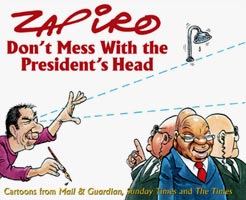
Title: Don’t Mess with the President’s Head
Author: Zapiro
ISBN: 9781770097575
When one thinks of satire, the most immediate thought is often of a figure that uses wit to criticise behaviour, ridiculing those in positions of power through irony, sarcasm and ridicule. While this is often the case, the more exceptional satirist uses keen understanding of his medium and the psychology of the masses to create a visual and verbal equivalent of holding a cracked mirror up to society: what we see is ourselves, but it is also not; it is both a distortion and representation of ourselves and others.
Controversial, award-wining cartoonist Zapiro (Jonathan Shapiro) is viewed by many as the foremost cartoonist and satirist in South Africa. Brilliant, bold, often downright brutal in his critique of society, Zapiro is an exemplary satirist and a watchdog of society in his own right, a modern-day court jester that can make us laugh out loud as easily as provoking reproach and criticism, mainly from those that feel he has no sense of boundaries in his often scathing depictions of those in high office and positions of power.
Having published thirteen volumes of commissioned cartoons, ranging from The Madiba Years in 1996 through to Take Two Veg and Call me in the Morning up until 2007, Zapiro has just released his fourteenth volume, entitled Don’t Mess with the President’s Head. What makes this volume so relevant and amusing is the fact that much controversy and fanfare has followed Zapiro in recent months. On July 23rd, Zapiro was joined at the Visual Arts Department of the University of Stellenbosch by fellow Cape Town cartoonists Brendan Reynolds (Business Day, The Weekender, Rapport, Weekend Argus), Jeremy Nell (The Times) and Stacey Stent (Noseweek) for a public debate on press freedom and the limits of editorial cartooning in South Africa entitled Defending the Jester’s Space: Pushing the Limits of Political Cartooning.
The producers of Z News, a televised, political puppet-based show, are seeking alternative distribution channels after the SABC pulled the plug on the show before the pilot even aired. They reportedly spent close to R1 million on developments before the show got canned. The most well-known of Zapiro’s recent cartoons, the “Rape of Justice”, has resulted in a pending lawsuit against the cartoonist for R7 million, R5 million for injury to Zuma’s reputation and R2 million for injury to his dignity. As of yet, Zapiro has refused to pay any damages. According to www.zapiro.com he is also convinced that if this case does go to court, freedom of expression will be upheld, and that the courts will uphold his right as a satirist and as a cartoonist to criticise public figures harshly, even when the images he produces are unpleasant to some. (Read more here.) The controversy of this volume thus comes as no surprise to the discerning reader.
Starting with the plummeting of the global economy and the rand, and the “vomit” outburst of Luke Watson about SA Rugby’s failure to transform on the 16th of October 2008, concluding with the awarding of the Nobel Prize to US President Barack Obama on the 13th of October this year, Don’t Mess with the President’s Head is, of course, centrally concerned with the actions of the newly elected president of South Africa, Jacob Zuma. It has certainly been an eventful year, and apart from the central focus on Zuma, Zapiro covers all the major events and stories of the past year. His South African focus falls primarily on the recent democratic elections; the formation of a breakaway party from the ANC, COPE, and its continuous leadership struggles; the election promises of the ANC; the emergence of the much-maligned leader of the ANC Youth League, Julius Malema; the squabbles between alliance partners SACP and COSATU; and the struggles of the ANC in dealing with corruption, nepotism, public service strikes and negative public sentiment, not to mention the recession.
Throughout the collection, Zapiro is in fine form as he ridicules, denigrates, castigates and criticises the likes of Zuma, Malema, Vavi and Mantashe, developing hilarious cartoon personas such as the infamous Zuma figure with showerhead alternately attached and detached, depending on presidential performance, and Malema as a baby in nappies, ogre from the swamp à la Shrek, or a portly, male(ma) chauvinist pig. Helen Zille is portrayed as the dinosaur Godzille, replete with botoxed features, while the leaders of COPE are often seen to be fighting over power in the form of a newborn baby, or steering a sinking ship with no captain calling the shots. In these critical cartoons, Zapiro offers the public exaggerated, pathetic representations of those in power. Using his great skill as sketch artist, he morphs and mangles the features of our political leaders to convey their limits, weaknesses and fatal flaws.
The most insightful and insistent critiques of the South African political landscape are rendered in Zapiro’s hard-hitting yet deeply comical reflections on the recent elections, the electoral processes and the figures that stand to benefit most from (re-)election. While it is hard not to laugh out loud at cartoons such as the “A-Z of elections 2009”, it is with a heavy heart that one is reminded of the broken promises, lying, scheming, cheating and in-fighting that mar true political progress, mature democracy, and a better dispensation for all. When Zapiro re-verses the ANC election bylines of “A better life for all” to “A better lie for all” and “Together we can do more” to “Together we can do more crime”, the institutional decay, wholesale corruption and fall of a once great liberation movement is patently clear. Once we have finished laughing bitterly, it is difficult not be stirred by anger, resentment and deep disappointment.
The heart of the collection, and indeed Zapiro’s critique, falls at the door of President Jacob Zuma. While acknowledging when good has been done, Zapiro is fearless in his fierce criticism of a state president tainted by charges of rape, fraud, corruption and a lack of education. Zuma becomes the target for a relentless barrage of insults and invective, often as side-splittingly hilarious as it is thoughtful and deeply troubling. For a state president to be so openly derided and mocked is deeply disturbing, funny as it may be.
The South African political landscape, and Zapiro’s searing salvos towards Zuma, are complemented and contrasted by Zapiro’s deep admiration for the celebrated and widely popular figures of Nelson Mandela and Barack Obama. Zapiro reserves his most gracious and understated sketches for our former president, praising his humanity, goodwill and the endless inspiration he generates, culminating in the 64 minutes spent on 18 July in service of others, and the first ever Mandela Day, which coincides with the first ever manned visit to the Moon forty years ago. Barack Obama, in contrast to the clearly derided figures of Sarah Palin and John McCain, is represented as a man celebrated both for his inclusive vision for the contemporary world and future generations and for being tremendously burdened by the issues of the day, in one cartoon appropriately seen carrying the weight of the world on his very human shoulders. Acutely aware of the challenges faced by both Obama and Zuma, it becomes clear throughout the course of Don’t Mess with the President’s Head that Zapiro believes that Obama will rise to the challenge and leave the American and global landscape a better place than he found it. On the other hand, he has severe reservations about the moral fibre of Zuma and our current administrators, and their service to the people of this country.
Apart from the chief newsmakers, Obama and Zuma, the year 2009 was filled with occasion, and Don’t Mess with the President’s Head is a collection filled with cartoons ranging from the uproarious to the unyieldingly critical, from the sensationally savage to the sensitive and compelling. 2009 has been a year of tremendous conflict and loss in many areas, resulting in the death of many innocent lives through among others the Mumbai and Sri Lankan cricket team bus attacks, the death of scores of Palestinians and many Israelis in cross-border attacks from Israel after rocket attacks from Hamas in Gaza, and the deaths of celebrities Miriam Makeba and Michael Jackson and of the wife of Zimbabwean Prime Minister Susan Tsvangirai. In his cartoons on these emotive topics, Zapiro pushes the boundaries of satire to new heights. It is of little doubt that his cartoons on the deaths of Jackson and Tsvangirai and the attacks on Gaza will linger in the memory and continue to provoke heated responses to the vexed questions surrounding, life, death and their representation in the media.
The title of this volume is extremely fitting as Zapiro toys with the many meanings of the word mess and head. Not only does he play around with the idea of playing intellectual games and a playfulness of the mind, but he self-reflexively pokes fun at his own popularisation of the shower head when drawing the cartoon figure of Zuma. Zapiro also slyly suggests that the president has made a constant mess of things, hence the need for the consistent presence of a shower head to clean things up.
In Don’t Mess with the President’s Head, Zapiro has affirmed his status as an unrivalled satirist, cartoonist and social commentator. Far more than looking behind the dirty windows of glass houses, he shatters any notion of fear or favour, delivering a brave, belligerent, incredibly stimulating collection of cartoons that pave the way for intelligent debate, heated conversation, and real social action. Controversy is what defines the successful modern satirist and cartoonist, and this collection is vintage Zapiro in that regard. In Don’t Mess with the President’s Head, the reader can expect to encounter a range of diverse cartoons that cover the biggest stories and events of the year of 2009 and the people that defined them. Without being too lavish in recognising the standout events and corresponding cartoon treatment in this volume: the cartoons representing the controversies around asylum seeker Brandon Huntley, gold medallist Caster Semenya, the head of Cape judges John Hlophe, new police chief Bheki Cele, George Bush having an Iraqi journalist’s shoes thrown at him, and the leadership battle for the presidency of SAFA, alongside Zapiro’s inimitable take on President Zuma and Julius Malema, make this volume a highly recommended Christmas gift and general read for all those with a sharp wit and appreciation of a truly fine sense of humour.
After fourteen volumes, Zapiro is as sharp and cutting as ever.