

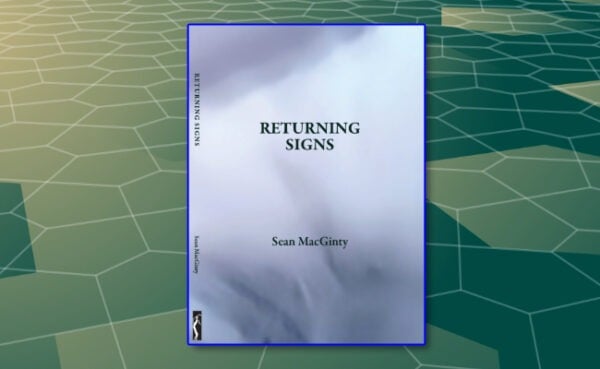
This reader’s impression was written and sent to LitNet on the writer's own initiative.
Title: Returning signs
Author: Sean MacGinty
Publisher: Botsobo
ISBN: 9780639886718
...
In observing entropy, there is sufficient chance for acceptance, for continuation, and that is enough.
...
This first collection of poems by Sean MacGinty was published by Botsotso and was launched in Cape Town at the end of 2025. The collection contains 50 poems ranging over a number of topics and observing various geographic locations, mainly in South Africa and South America. The poems come with the consistent voice of the poet, with characteristic rhythms and a sense of place. Invariably they address the key questions of how people live their lives, the decisions they make and the reactions they have to the events and places around them, all with solid descriptive comments.
Sean enjoys working with words, exploring their depths and resonances. He uses a number of non-standard English words, as well as local borrowings from other South African languages. The poem which illustrates his interest in language is called “Terralanguaging”:
The ground lost the harshness in its throat:
lost the fricative of its grond,
lost the oe in its groen and the ui of its huis.
And in their place, the spark and clap, sharp and wet
of the x of its xola, the hl of umhlaha
grew out of the soil, like sounds of rocks. (20)
This device also occurs in the South American poems, where borrowings from Spanish fit comfortably with the English words of the poem.
Sean uses descriptions of people, places and events mainly as a launch pad for light philosophical observations. The descriptions are very well done and create easy visual responses, and the poems’ conclusions never get tedious. Rather, they emerge seamlessly from the events described in the poems, and this sort of movement within the poems – from observation and description to philosophical conclusion – becomes a strong distinguishing feature of his writing. (See “After the fire”, “Sea Point” and “Newlands Forest”.)
A number of the poems are examinations of situations from the speaker’s own experiences, and the probing questions after the description of the events is often awkward and uncomfortable (“Blank season”). In the poem “Sunday outing”, in which a family is driving down De Waal Drive, a father corrects his daughter when she uses a term of disrespect for a vagrant by slapping her; yet, as he later reflects on his action, he doesn’t know how to react to what he did.
What did he think about as he went back home, hand still red from how hard he hit her,
back to his garden, and to running his newspaper, which meandered between stories
winding and curving far from the truth when the country burned with skin all around him? (10)
The speaker always finds value in the discarded objects, the debris of the world cast aside. In the poem “IKA Torino”, the speaker addresses the rusting shell of an IKA Torino caught in the silt of the riverside, waiting for final decay. But he also sees the life story of the car, the people who enjoyed it and the value the car’s experiences had for the family, even though the decay will continue as the water rises around the wreck, “filling memory with sweet water” (61). In the poem “Still life: Great white”, the speaker reflects on the decaying carcass of a beached white shark, seen as refuse, thrown out by the sea, being reduced to nothing but a spine; but out of this, the speaker composes a poem which immortalises the shark.
Death as unmysterious as accident,
which brought a poet to a carcass
and the reader to a poem. (39)
The South American poems form a distinct and powerful section of the collection. Sean lived there for several years, and the experiences obviously had a strong effect on him. He shows his awareness of the differences as well as the similarities of the people and the life they lived on that continent, as compared with his own experiences. His ability to catch the sense of place and how to value it make strong comments on what he learned there. In the poem “Segundo Corral, Chile”, the speaker describes an encounter with the current occupants of Segundo Corral as he follows them, travelling on horseback to their game of soccer, and in the process becomes united with them in time.
We broke free of the straight, passing line of seconds, itself fading;
gravity reformed and resettled around us, time changed all around us,
and we became citizens of its new world. (54)
The poems overall seem to reflect an unease, a sense of discomfort, with what the speaker sees of the world around him. He is always aware of decay, of matter falling apart. Sometimes he sees through and beyond this, and can engage with the possibilities of renewal and of seeing the world through different lenses; other times, he is left with incomplete business, which he accepts as part of the deal of living. Despite this, the poems are not pessimistic. In observing entropy, there is sufficient chance for acceptance, for continuation, and that is enough. In “La Zona Oeste, Buenos Aires”, the speaker finds himself accommodating to the different world of BA, and he reaches a regenerating conclusion:
The sounds remind you you’re chasing a nostalgia that was never yours,
that you are becoming what you had wanted to be,
now have no other choice but to become. (62)