

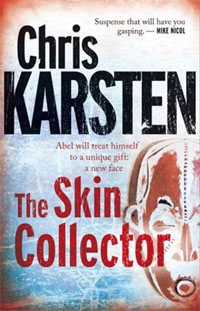
Title: The Skin Collector
Author: Chris Karsten
Publisher: NB Publishers
ISBN: 9780798157087
Buy The Skin Collector on Kalahari
The translation of Deon Meyer’s crime thrillers and translated works by other authors such as Carel van der Merwe have opened up the market to further translation from the original Afrikaans into English. A particularly well-handled, sharp addition to this growing corpus is the translation of Karsten’s first instalment of the Abel Lotz-trilogy, Abel se Ontwaking, into The Skin Collector.
Karsten is a journalist with many true crime works to his name; he is clearly interested in the thoughts and motivations of the criminal mind, and betrays a remarkable aptitude for such an examination. Having read the trilogy in Afrikaans some time ago, I found the translation immediately resonant, faithful to the original text and highly calibrated, creating the impression that the surfaces and depths of the original text have been maintained and augmented in English as far as possible.
The firm foundation of a trilogy that explores how twisted societies also produce traumatised, deeply wounded individuals, eventually turning to various forms of violent behaviour, The Skin Collector establishes the central dynamic between the deranged yet sympathetic Abel Lotz and rookie police investigator Ella Neser, resilient, fit and focused. On the eve of his fiftieth birthday the pudgy, unattractive Abel – a dealer in antiques and African masks and shrunken heads in Johannesburg, resident of a decrepit and disintegrating smallholding that he shares with his overbearing mother – decides that it’s time for a new face: he is to harvest a face from an unsuspecting victim, preferably female and beautiful, as his mother always wanted a daughter.
Also on the agenda is the completion of various cosmic volumes telling the story of the cosmos from his perspective as a lover of all things nebulous. Lotz is clearly no ordinary villain (based on the real-life serial killer Ed Gein, who inspired such luminaries as Leatherface and Hannibal Lecter), and Neser, with the possible exception of Meyer’s Mbali Kaleni, is one of the few female police officers in local crime fiction.
With a heightened sense of the reader’s involvement, the novel’s expansive focus – threading together various storylines, characters, histories personal and national, and forms of death – is matched by the beautifully rounded, timbrous, operatic quality of the language on offer. Silke and Karsten make a formidable pair in translation as they mould the gritty yet sonorous Afrikaans of the original into razor-sharp shards of cutting observation. Like a forensic pathologist, Karsten carefully extracts the vitality and vivacity of highly diverse interests, suturing obsession, sin, psychological and physical injury, detective work, cosmic exploration, African culture, capitalism and commodification, the thin line between love and hate, matriarchy, deformity, police politics, the rich symbolism of masks and tattoos, and the debate between nature and nurture into a thrilling and elaborate whole.
The novel, here, in this form, is akin to a highly polished and entertaining illusionist act: Karsten weaves thread after thread of the horrific, the baroque and the beautiful into a tapestry as textured and finely woven as it is unusual. Comparisons between the Abel Lotz texts and Thomas Harris’s Hannibal would certainly prove fruitful.
As is the case with the other Abel Lotz works, Karsten sees war (in this case, the bloody Anglo-Boer War) as a conduit for displacement and dissolution and death, haunting generations to come, warping family dynamics and self-narratives. The motif of skin – simultaneously both surface and depth, covering all of the body while acting as the membrane between self and world – is wonderfully utilised as the basis for an investigation into the ways in which we see ourselves, the way we are perceived by others, and the ways in which our skins become a platform for our experiences of sensation and wonder. The skin is a blank canvas, after all, and the novel shows just how many different kinds of art, communication, relationships and exploration the skin makes possible.
The novel offers stark contrasts, most notably between light and dark, good and evil, body and mind, destruction and preservation, kindness and cruelty, hope and despair, urban and rural, the cosmic and the cosmetic, kinship and alienation, past and present, fear and courage. The Skin Collector succeeds in creating an unforced, organic sense of inevitable showdown between the various forms of righteousness on offer between the killer Lotz and the law-abiding cop Neser, involved in her first major murder investigation. Just as Lotz is revealed to be a deeply psychotic individual, far removed mentally from the real world, he is acutely intelligent, focused, determined to see out his cunning plan to create his masterpiece.
The family history of Lotz is such that it leaves the reader with little choice but to withhold condemnation, and to view his deeds with as much empathy as utter revulsion. Similarly, Neser is such a likeable, relatable figure, so dogged and yet dear, that we cannot help but fall in love with her character. Together, Lotz and Neser are the not-so-archetypal arch enemies that ground the reader amid an ever-expanding cast of characters and locations to come.
Karsten is almost obsessive about telling a multiplicity of stories that eventually interconnect. As the novel progresses, hurtling towards a bloody satisfying climax, we get a tantalising glimpse of just how enthralling the game of cat and mouse in the successive instalments will be. Far more than a generic or genre novel, The Skin Collector is a worthy translation, and it succeeds admirably in introducing English-speaking readers to the convoluted, captivating world of Abel Lotz.
Teken in op LitNet se gratis weeklikse nuusbrief. | Sign up for LitNet’s free weekly newsletter.