


This paper was read at Olive Schreiner’s grave.
Etienne van Heerden Veldsoirée
Cradock
25 September 2022
Olive Schreiner was a woman of very many parts. A century before social media and the frenetic intercontinental correspondence that hallmarks it, Schreiner was a keen letter writer, often staying in close touch and usually sustained contact with friends and letter friends – what we might today call Facebook friends – scattered across the globe.
Many of her most notable correspondents were based in the metropolitan centre. She, on the other hand, wrote from the periphery of the colonial project, the then already fraying fringe.
Born in 1855 at the Wittebergen Mission Station in what is today Lesotho, Schreiner spent the lion’s share of her youth in the Karoo. In the 1880s, she was abroad in England and Europe for eight years, before returning to South Africa in 1889 and settling in Matjiesfontein. In 1894, she married Samuel Cronwright, a Cradock farmer. They resided on the farm Krans Plaats.
The Cronwright-Schreiners would move to Kimberley, thereupon to Johannesburg and then to Hanover. In 1908, they settled in the newly established hamlet of De Aar, where her husband had taken up the cudgels as the first town clerk. This was until her second period in England.
It is from dusty De Aar that most of the letters that I consider here were dispatched. The material-culture aspect of it all – where all the paper and ink came from, for example – would make a fascinating study for a student in socio-economic history. Last night, the Afrikaans novelist Kirby van der Merwe told me that when Richard Rive, who did a DPhil on Schreiner at Magdalen in Oxford, was compiling his volume of letters of Schreiner, he was one of several transcribers. He said every bit of paper surface was used – certainly both sides – all of which rendered the task of transcription particularly arduous.
Indeed, today we have the benefit of a marvellous online repository of her letters, Olive Schreiner Letters Online, which collects at one virtual address all the letters from her that have been located. It is truly nothing short of a treasure trove – with several footnotes (I didn’t tell Kirby) criticising Rive’s transcriptions.
Some letters are personal and intimate. In others, Schreiner pursues the many causes to which she was avowed. In many, there is a surprising and refreshing coalescence of the private and the public – a transgression that Schreiner committed repeatedly and seamlessly. Indeed, often her focus changes, even mid-letter, from matters playing out on the world stage to cameos of domesticity amid the dust of the Karoo – the interminable and omnipresent dust.
I home in on 1912 and 1913. One of the central themes on Schreiner’s mind at that time is the advancement in the world of the professions of two of her nieces, both children of her brother Will and his wife, Fan Schreiner, namely Frances Lyndall – known fondly to the family as Dot – and Ursula.
On 24 April 1912, from De Aar Olive wrote to the English poet, reformer, socialist, utopian and gay rights activist Edward Carpenter. Like so many carrying one or more of those epithets, Carpenter started out as an Anglican priest, before atheism set in.
Carpenter was one of Schreiner’s longest-standing correspondents – one sees letters of minute and affectionate intimacy as early as the 1890s. He was himself a friend of Rabindranath Tagore and Walt Whitman and supposedly the spur for EM Forster’s novel Maurice. He was 11 years older than Schreiner, and, between 1870 and 1925, shortly before his death in 1927, he wrote and published prodigiously.
In April 1912, then, Schreiner writes to him: “Dear Edward,” she starts. And then comes what might be a reproach for a less-than-diligent correspondent, but what was more likely simply a commonplace in a time when communication was far from immediate, the more so where those writing to one another were at a significant geographic remove. Yet, what it speaks of most is the network – the webbed strands of which stretched as far as De Aar – to which Schreiner belonged: “I now & then hear a word of you from someone who has seen you & they say all seems going well.”
Schreiner proceeds to speak of her immediate environment, something she rarely omits from her letters to those farther afield: “We are having a real old De Aar sand storm at this moment. Great clouds of sand marching across the veld like armies & sweeping over us. It is the afternoon, but the sand makes it so dark one can hardly see to write. My cat & two dogs have rushed in from the garden to take refuge in the house. Animals are still as much joy to me as ever, & reading.”
And so Schreiner segues from the natural forces with which those in De Aar are enjoined to contend, through the intimately binnekamerlike – pets – to books, the last two her twin solaces.
But then she comes to the true theme of her letter: “But perhaps the thing that gives me most pleasure in life is the thought of the new young girls growing up like my niece Lyndall so beautiful & free & strong; knowing nothing of all we have lived through. My niece is studying law for which she has a great liking. She may never practice as a barrister if she marries or finds her work in politics; but she will, I hope, break the way through for other women to gain the freedom to practice if they will.”
Schreiner then speaks of her sister Ettie’s profound health travails, before commenting on a news story that must have had the whole world agog – even De Aar, once the news had reached it: “We have just got the full news of the loss of the Titanic, & dear old Stead’s passing. You know I’ve never loved the sea as I have the land & the sky, the dear, wonderful sky.” This last comment gives an ironic twist to the earlier description of the De Aar sandstorm.
And then, in a masterfully brisk sweep over themes, Schreiner concludes thus: “Things are going very badly in our political world; the one little bit of brightness I see is that the natives are slowly awakening. But the white men are determined on a great native war.”
She closes off with forceful affection: “Good bye. I love you dear old Edward.”
There is as much to comment upon in that letter to Carpenter as there is in Schreiner’s other letters to him. On this occasion, it serves, though, as an introduction to the theme of Dot, Schreiner’s fledgling-lawyer niece.
In a letter to Isie Smuts, of 19 October 1912, in which Schreiner did nothing as much as to sing the comparative praises of Muizenberg over St James as a holiday destination, she observed: “Did I tell you my little niece Ursula Schreiner has just begun her medical studies in England? Lyndall the elder sister is going on with her law. Her first exam takes place in December. Even if she doesn’t pass it will be good for her to have studied it, & I hope she will pass. I think she would make a good Barrister.”
There is the same reservation that marked her discussion of Dot’s academic endeavours in the letter to Carpenter. She may marry. She may go into politics – interestingly, in Schreiner’s view a more readily open door. Or, indeed, she may not pass, a realistic prospect surely for any student, however diligent. The more so in 1912, when a female student would not know what exactly was expected of her, and would be entering a world into which few women before her would have ventured.
Schreiner then returns to her immediate surroundings: “Dear, the heat & drought are fearful here now. If it goes on a little longer many of the farmers will have to trek.” Before – in a dramatic change of tone – adding: “I am going to board myself when I am at Muizenberg. Have a little parafine stove & cook for myself … Do come to Muizenberg!”
The next letters upon which my eye fell are directed to Aletta Henriëtte Jacobs. Born a year before Schreiner, in 1854, Jacobs was a Dutch physician and activist for women’s suffrage and rights more generally. She was by all accounts the first woman officially to attend a Dutch university. She was one of the first female physicians in the Netherlands. In 1882, she set up the world’s first birth control clinic. She was a pioneering figure in both the Dutch and the international women’s movements.
In 1910, she travelled to South Africa, having been invited by local activists. She toured from Cape Town to Johannesburg, making speeches on suffrage and on hygiene, sanitation, prostitution and what were then still known as venereal diseases.
In 1911-12, Jacobs and Carrie Chapman Catt undertook a 16-month tour to evaluate the legal and social position of women and to urge women to struggle for pertinent improvements. That tour took them to South Africa, the Middle East, India, Ceylon, the Dutch East Indies, Burma, the Philippines, China and Japan.
In 1913, Jacobs published a collection of travel essays called Reisbrieven uit Afrika en Azië, on which, among others, Ena Jansen has written. Indeed, from 1900 onwards, Jacobs had also published translations of works of feminist theory. One of those works was Schreiner’s Woman and labour, which appeared in 1911; the original title of a much longer version of that book had been Musings on woman and labour. The original text was lost when Schreiner’s Johannesburg home was sacked during the 1899-1902 South African War.
In the introduction, Schreiner writes: “In my early youth I began a book on Woman. I continued the work till ten years ago. It necessarily touched on most matters in which sex has a part, however incompletely ….”
She continues:
In 1899 I was living in Johannesburg, when, owing to ill-health, I was ordered suddenly to spend some time at a lower level. At the end of two months the Boer War broke out. Two days after war was proclaimed I arrived at De Aar on my way back to the Transvaal; but Martial Law had already been proclaimed there, and the military authorities refused to allow my return to my home in Johannesburg and sent me to the Colony; nor was I allowed to send any communication through, to any person, who might have extended some care over my possessions. Some eight months after, when the British troops had taken and entered Johannesburg; a friend, who, being on the British side, had been allowed to go up, wrote me that he had visited my house and found it looted, that all that was of value had been taken or destroyed; that my desk had been forced open and broken up, and its contents set on fire in the centre of the room, so that the roof was blackened over the pile of burnt papers. He added that there was little in the remnants of paper of which I could make any use, but that he had gathered and stored the fragments till such time as I might be allowed to come and see them. I thus knew my book had been destroyed.
Near the end of the introduction, she observes:
One word more I should like to add, as I may not again speak or write on this subject. I should like to say to the men and women of the generations which will come after us [that must surely include us gathered here today] – ‘You will look back at us with astonishment! You will wonder at passionate struggles that accomplished so little; at the, to you, obvious paths to attain our ends which we did not take; at the intolerable evils before which it will seem to you we sat down passive; at the great truths staring us in the face, which we failed to see; at the truths we grasped at, but could never quite get our fingers round. You will marvel at the labour that ended in so little – but, what you will never know is how it was thinking of you and for you, that we struggled as we did and accomplished the little which we have done; that it was in the thought of your larger realisation and fuller life, that we found consolation for the futilities of our own.’
On 21 January 1913, some seven or eight months after she had written to Carpenter, while she was still living in De Aar, but temporarily away, she wrote to Dr Jacobs, who had visited her while touring South Africa:
It was a great pleasure to me to get your letter. I have been too ill all the last year to do any real letter writing. Now I have come down to the coast to see what the lower level will do for me.
She continues (and this commentary would be as true today as it was then):
I do hope you will in [sic] getting in a more liberal ministry in Holland. Do let me know how it goes. Colonial papers give us so little news of what is going on in Europe that is of real interest.
Yet, we are no longer as isolated from the international news media as those in her position were. Quite the contrary.
Then, Schreiner turns to the theme of her studious nieces. Once again, they become “loci”, as it were, where the private and the public coalesce, intersect, justify one another:
You will I know be glad to hear that my little niece Lyndall whom you saw with me, has passed successfully her first law exam to become a barrister. She is the first woman in Africa to take up law, but I hope many will follow. In the mean time we have a big fight before us.
Schreiner proceeds:
The University here gives women the same degrees as men, & makes no distinction of sex. But the law society composed of Barristers &c is opposed to women’s being allowed to practice, & will not admit them into the courts. So we shall have to get an act of parliament passed allowing them to practise. We are getting up petitions now. I have a hope that by the time she passes her final in two years the bar may be open to her.
The public acquires a personal urgency. When Dot will emerge as a fully fledged lawyer, the world, Schreiner hopes, will be receptive to her using those skills productively.
Then, she turns to her other niece, Ursula, and seeks to put her connection with the addressee, Dr Jacobs, to good use:
I have also a favour to ask of you. My second niece, Lyndall’s younger sister is now studying medicine in England. This is her first year. She sometimes visits Holland. If she does so might I give her a letter of introduction to you, & would you let her call on you. I feel it would not only be a great pleasure to her to have a talk with you, but it would be an inspiration & a help to her. She is very much in earnest about her work.
If anything should take you to England at any time I would be so glad if you would let her come to see you. Her address is Miss Ursula Schreiner, Newnham College, Cambridge, England. You cannot I’m sure understand what a bright memory is that day you spent at De Aar. You would have to understand how lonely life in South Africa is mentally to understand it.
She closes off in a way that foreshadows at once wryly and amusingly the social media practices and etiquette of today:
I would much value a photograph of yourself if ever you have one you could give me. I will send you mine if ever I am taken.
And, then, on 19 May 1913, she again writes to Dr Jacobs. By this time, she is back in De Aar. After some observations about her ill-heath and, interestingly, the comment that she might be “coming home to Europe at the end of the year to try & find some medical treatment”, Schreiner turns to her nieces:
My little niece Ursula is coming out here for her long vac but I hope she will be able to see you next year when she goes to Holland.
I think I told you Lyndall passed her first exam very successfully, at the end of next year she passes her final.
She then returns to the idea of the big fight she and those of a like mind would have on their hands:
Then we shall have a big fight to get the parliament to pass a law allowing women to practice here as Lawyers. The law courts have given it against us basing their judgement on an old Roman-Dutch law passed in Holland some three hundred years or more ago. I wonder if I should be asking too much of you to ask you to write & tell me just what the law is now in Holland.
Can women now practice in Holland as both barristers & attorneys? Can they become judges? When was the old Roman Dutch law done away with in Holland. It is curious that we here should be bound by a law passed in which the Dutch themselves are too enlightened to up hold! I want to write a short letter to the Cape paper’s on the matter but should like to be quite sure of my facts.
Are all medical posts open to women, or all they only allowed to practice privately. How many women doctors are there in Holland now, & about how many women lawyers. I know how busy you are; but it would be a great help if I could get the exact facts from you.
Here, Schreiner’s use of her being part of a network of international intellectuals becomes plain. She needs certain information, which is not readily available to her – certainly not in De Aar – in order to assist her niece Dot. Dot’s readiness to step onto the world stage is becoming pressingly imminent.
And Schreiner had clearly been apprised of legal developments on this front. When she received the information she sought, she’d deploy it in a strategic, activist way.
Indeed, the first woman of whom we know who sought admission as an attorney was Sonya Schlesin (Schlesin v Incorporated Law Society 1909 TS 363). She had been articled to one Mr Gandhi. The Transvaal Supreme Court held that, since the word attorney had always denoted people “of that class who have always been capable of being attorneys” (in other words: men), Bristowe J reasoned that the admission of women as attorneys could also lead to them being admitted as advocates, “a change which would mean an enormous difference in the practice of the courts in this country”. He had in mind that that would be a harmful change. Ms Schlesin’s application failed.
Thereupon, in the equivalent Cape court, Madeline Wookey sought an order directing the Incorporated Law Society to register her articles of clerkship with an attorney and notary in Vryburg (Wookey v Incorporated Law Society 1912 CPD 263).
She was received more generously. Since there was no positive law disqualifying women from admission as attorneys, the court (per Maasdorp JP) granted her application. Upon proof of the requisite qualifications, women were as entitled as men to be admitted as attorneys. Upon such proof, the court held, a candidate had to be admitted – except if good cause were shown to the contrary.
Yet, as is common with such important questions (this was an early example of a type of human rights litigation, before human rights had become entrenched in a Constitution like our present one), the matter was taken on appeal by the Law Society. Three judges of the Appellate Division (Incorporated Law Society v Wookey 1912 AD 623), including the hallowed Innes ACJ, did not clothe themselves in jurisprudential glory.
Innes undertook a minute enquiry into Roman, Roman-Dutch, foreign and South African law before reaching the conclusion that, where the law referred to “persons” being admitted as attorneys, it referred only to male persons. While he voiced “real regret”, he found that the “question is not whether this lady is likely, adequately, and satisfactorily to discharge the duties of a legal practitioner”. She was “simply” not a “person” contemplated in the Cape Charter of Justice of 1883.
The court held:
If it was rightly answered in the court below, the result will be materially to widen the area of women’s economic activities, though that be done by opening to a host of new competitors the doors of an already congested profession. If it was wrongly answered, then the law of the country will be denying to one-half of its citizens, on the mere ground of sex, the right of employing their natural abilities in the pursuit of an honourable calling.
With similarly performative reluctance, Solomon J held that “the central fact which we have to bear in mind, in approaching the consideration of these enactments, is that from time immemorial men only had been admitted and enrolled as attorneys of the Court”.
De Villiers JP observed that a woman was not a “person” for the purposes of the Charter:
Accordingly [he opined] we find that, inter alios, boys under 17 years of age were excluded from the profession of attorneys or advocates, as also women, the deaf, and the blind. The later Christian Emperors introduced further restrictions, which were also adopted into Dutch practice: Pagans, Jews, pronounced heretics, persons, for example who deny the Trinity. … Some of these restrictions are undoubtedly obsolete. It would be difficult to maintain that a blind person duly qualified in other respects cannot be admitted as an attorney on the ground that he cannot see and, therefore, cannot pay the proper respect to the Magistrate. The prohibitions, too, based on race or religion are notoriously obsolete. Can the same be said of the prohibition based on sex? I am of the opinion that the answer must be negative.
It was precisely this legal status quo that Schreiner had in mind in writing to Jacobs, as she did in the letter of 19 May 1913. I have not managed to locate the response of Jacobs, but the situation in the Netherlands was somewhat advanced.
On 20 April 1903, Adolphine Kok had been admitted as an advocate in Rotterdam, as the first female advocate. On 1 July 1903, the newspaper Belang en Recht wrote:
[D]e kalme wijze waarop in ons land aan de vrouw de toegang tot de balie is geopend; wat in Frankrijk niet ging zonder tusschenkomst van den wetgever, geschiedde hier zonder eenig verzet. Over het eerste optreden van Mejuffrouw Kok wordt met waardeering gesproken. De daarmee geleverde proefneming wordt als geslaagd beschouwd en er schijnt, zoo wordt gezegd, geen enkele reden te zijn, waarom onze bekwame juriste niet de gewichtigste strafzaken met succes zou kunnen behandelen. Bij den wensch, dat zij menigmaal in de gelegenheid moge zijn zulks te doen, sluiten wij ons gaarne aan.
In South Africa, too, it required – as Schreiner had correctly observed to Jacobs – the intervention of parliament.
On 10 April 1923, the Women Legal Practitioners Act was promulgated. It provides:
Women shall be entitled to be admitted to practise and to be enrolled as advocates, attorneys, notaries public or conveyancers in any province of the Union, subject to the same terms and conditions as apply to men, and any law in force in any province of the Union regulating the admission or enrolment of persons as advocates, attorneys, notaries public or conveyancers shall henceforth be interpreted accordingly.
Frances Lyndall – Dot – Schreiner (born between 1887 and 1889) took a law degree from Cambridge. Upon her return to South Africa, she passed the examinations required to become a barrister, but was not permitted to practise – until the statutory amendment of 1923.
The appellate decision in Wookey remains a blemish on otherwise excellent judicial records, especially those of Innes CJ.
Dot married Tommy Gregg. She would become a nurse. In Hospital sketches (1918), she wrote about her experiences as a nurse in the First World War. In 1957 appeared Memories of Olive Schreiner.
For present purposes, what stands out is Schreiner’s modernity; not only was hers a mind untroubled by the prejudices of her time and place. Edward Carpenter and Aletta Jacobs were both at the vanguard of progressive thinking and activism around what would today be called sex, gender and sexual orientation. To them, Schreiner, residing in dusty De Aar, was an equal, a comrade in arms, a thinker in her own right on matters that even in the metropolitan centre still elicited considerable opposition.
Her central tool? Maintaining an engaged and engaging correspondence, in the period in question, through the office of the surely unwitting Postmaster of De Aar.
What Schreiner would today, even in the face of loadshedding – can one imagine her response to this very contemporary natural disaster? – probably have done so much more easefully over the various social media platforms we take so for granted.
But with exactly the same haphazard changes of focus, segues from matters of the day to quotidian intimacies. And if not with pictures of, at least with verbal cameos of, pets, books to be read – and petulant sandstorms!

- Editorial note: Schreiner’s letters were published as she had written them. There are inconsistencies in the spelling.
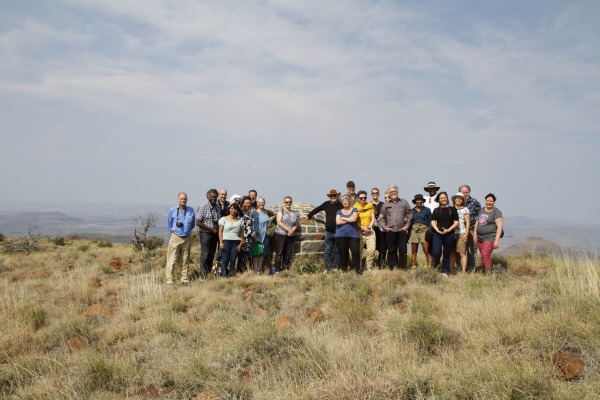
This paper was read at Olive Schreiner’s grave on the final day of the Etienne van Heerden Veldsoirée.

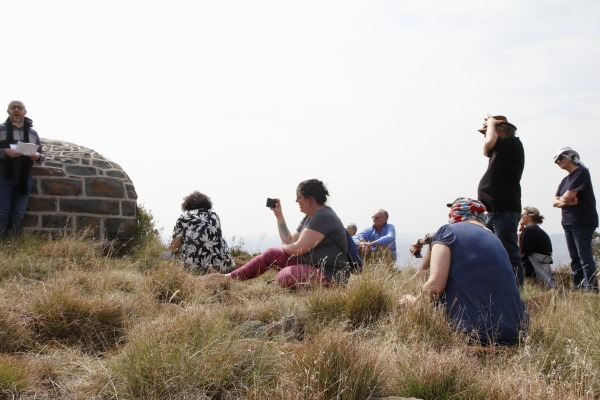
Jean Meiring addressed an audience seated on rocks or grass.
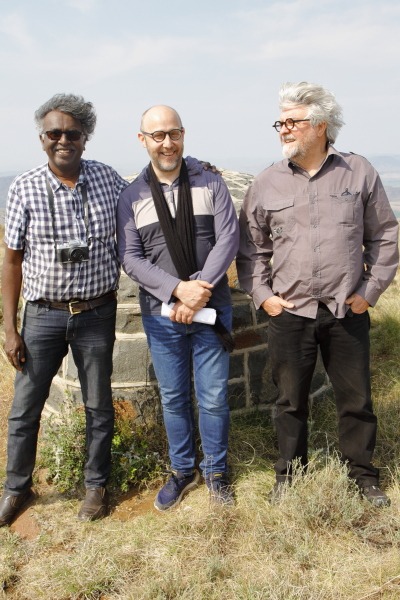
Festival director Darryl David, Jean Meiring and Etienne van Heerden
Sponsors:

Die Tuishuise & Victoria Manor

Buffelshoek Dirosie Lodge
 NB-Uitgewers

Amazwi South African Museum of Literature

Montego Pet Nutrition
See also:
Kommentaar
Insiggewend, soos al jou skrywes.