

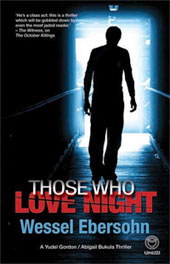
Title: Those Who Love Night
Author: Wessel Ebersohn
Publisher: Umuzi
Date of publication: August 2010
Genre: Crime fiction
Pages: 272
ISBN: 9781415201190
In a tremendously fertile literary climate, authors such as Mike Nicol, Margie Orford, Deon Meyer and Chris Marnewick have released high-calibre works of crime fiction that present engaging, dynamic plots and vivid characterisations, as well as some harsh but all too necessary social commentary on a South Africa of the present and the past. As somewhat of a veteran of the genre, Wessel Ebersohn has published most of his nine works, which include The October Killings (2009), to an overseas audience, and both said novel and the work under discussion, Those Who Love Night, are available locally and distributed in the US.
Those Who Love Night can be classified as a work of crime fiction and also as a political thriller. Ebersohn presents a basic premise that most readers will be familiar with – a group of anti-government activists, the Harare Seven, have disappeared from custody in Zimbabwe’s Chikurubi prison. Enter a smart and seductive young lawyer, Abigail Bukula, to investigate their disappearance, add a familial resonance to the search in the form of one of the missing group, Bukula’s cousin, the brilliant dissident writer Tony Makumbe, and include difficult relationships from the past, which include Bukula’s kinship with unconventional psychologist Yudel Gordon, and the stage is set for a hard-hitting and often unbearably tense search for the missing activists amid the frightening hardship and political terror emblematised by modern-day Zimbabwe.
It would be a sin to divulge more of the novel’s plot, for reasons twofold. The first is that Ebersohn’s narrative is powered along by a variety of other characters, like Bukula’s husband Robert and the powerful government operative Jonas Chunga, and that the novel’s particular strength is the way it uses the mechanics of plot and narrative progression to move beyond mere expositions of torture, grisly violence and chase sequences (although all of the above are present nonetheless) towards meaningful insights into the ways that corruption, greed and moral decay are both present in Zimbabwe and fought by those brave enough to make their voices heard.
The second reason that I balk at divulging more of the novel’s plot here is because of Ebersohn’s propulsive, tightly knit prose, his carefully judged and haunting descriptions of humanity at its worst and best that confronts the reader with a reality we would like to shy away from, even at the best of times. It is with such portents of recognition and respect for human life that Ebersohn paints a riveting and raw picture of a Zimbabwe in ruin.
Those Who Love Night makes no bones about its desire to shock, startle, and eventually strangle its readers into submission, forcing us into recognition of the horror of a diseased and dis-eased society, a parallel universe that sits uncomfortably close to our own. Ebersohn’s relentlessly grim, occasionally humorous descent into the “night” of a country at war with itself will not be appreciated fully be those that seek to momentarily be transported into an alien landscape only to return to their lives with fleeting appreciation of the novel’s value as entertainment. Rather, Those Who Love Night begs to be read as a significant indictment of man’s will to power, as a sensitive tribute to the ordinary men and women that fight daily against oppression in its many forms, and as a lamentation of the many men, women and children born as “ghosts”, invisible to the outside world. As such, the novel is recommended to all that seek an intelligent and immersive reading experience, and a visit to a literary world where the boundary between night and day and character and reader is constantly unsettled.