

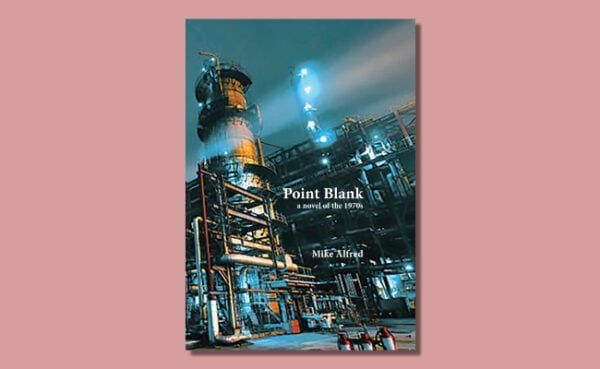
This reader’s impression was written and sent to LitNet on the writer’s own initiative.
Title: Point blank
Author: Mike Alfred
Release: May 2026
Publisher: Botsotso
Mike Alfred’s novel is set in a large, corporate, industrial production environment – a Johannesburg-based explosives plant. Having served as a human resources manager in such a plant in the 1970s, he clearly draws on his own experiences and provides us with an authoritative account of the mindset of white middle-class men in middle and senior management, as well as their interactions with their white secretaries. As this takes place in the divided black-white world of 1970s South Africa, we also see the beginnings of the powerful black worker movement of the future.
In avoiding stereotyping, the author takes us by surprise. He allows searing truths to unfold unexpectedly. As such, there is a thick plaiting of the personal, organisational and political, and in this vintage setting he reveals events as conforming to his mentor Schumacher’s dictum that “life is fired at you point-blank”.
Set in an environment having an ever-present danger of fatal work accidents, the novel is educational, capturing the anomalies of a system where, among white people, everything was not as controlled and in equilibrium as it appeared to be. There were many pushes and pulls, as political and social interests influenced the system and individual interests pressured performance. Stresses and tensions caused by working conditions, with little capacity to articulate the many arduous and personal challenges, are expressed in the thoughts of the main character, Harry Westlake: “What secrets we all carry – what desperations and desires for escape.”
Those who lived through the ’60s, ’70s and ’80s will recognise the stoniness and lack of awareness among white staff and management, whose cosseted physical comfort existed in parallel to the untold suffering and emotional deprivation of black workers. As such, the book brings alive the everyday shadow world of the apartheid system, how mindsets and racial beliefs lived within people, and how they were evidenced and played out in an “us and them” dynamic that produced supercilious superiority on the one side and enforced inferiority on the other.
Apart from descriptions of the unsafe and harsh working and living conditions of black workers, a key issue is the emergence of a trade union and the overcoming of repression. This is a time of “black will stirring”, as put by the author in the words of a factory manager. We witness the high impact of the first sit-in and strike, which completely halts production. White management are shocked by the frightening power sitting silently and resolutely in 1 200 bodies.
In a world where production is far more important than people, there are no frilly or deep mood descriptions, just action endorsing the impression that positions are taken, held and entrenched. With the environment visceral, pragmatic and testosterone-driven, there is little softness and no accommodation of dissent, with no diversions being tolerated other than in secret. A world of dualities: white or black, clever or stupid, with me or against me, master or servant – with all complexities well hidden.
However, the character Arthur Blake, an enlightened human resources manager, offers an alternative by showing empathy and respect, qualities appreciated by black workers but declared naive and unrealistic by whites. Stevens Baloyi, a worker in the plant, is another who breaks the mould. He courageously starts the undertaking of challenging the status quo, and progresses to the position of being the first recognised trade union official. These two characters give us glimpses into the power dynamics of the future.
Threaded through the book is the representation of women in such a confined corporate environment. This is achieved by tracing the awakening and insight of two female characters, who come to see and reject the limitations of their assigned roles.
In summary, Point blank captures dramatic moments with textured description, as turning points are reached and South Africa moves into a new dispensation.