

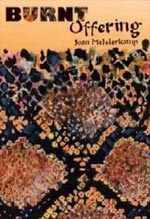
Title: Burnt Offering
Author: Joan Metelerkamp
Publisher: Modjaji Books
ISBN: 9780980272949
Price: R117
Pages: 96
Written in a tight three-part structure, Joan Metelerkamp’s latest collection of poetry, Burnt Offering (Modjaji Books, 2009), is a questing and questioning meditation on the transformative process of alchemy. The collection searches for, and seeks to effect, alchemical transformation and metamorphosis, not only within the poems themselves, but also within the lives of the women, marriage and family which they depict.
The first unnamed, three-poem section of Burnt Offering focuses most explicitly on poetry itself. The opening poem, in this titularly alliterative section: “Prologue”, “Points on Poems” and “Penelope”, gives the reader a "prologue”, not only to Metelerkamp’s “obsession with narrative”, “symbol and analysis” in her poetry, but also to her most dominant poetic themes: her family life, her mother’s death, the everyday (11). Importantly, as the last stanza echoes the Christian communion liturgy (“take, break”) and thus invokes one of the most prominent Western alchemical transformations (that of a loaf of basic bread into the golden glory of Christ’s body), this prologue already implicates the theme of alchemy which is threaded through the collection (11).
“Points on Poems” is both a thorough and thoughtful reflection of her own poetic practice and a lesson in the writing, and reading, of poetry. Dealing with such issues as “[w]ho speaks when the speaker is ‘I’” (“a poem is not a confession,/ it is not a profession …/ … it’s a puzzle”), and the fact that “all poems are illegitimate” because “[l]anguage itself is the transgressor”, this poem is illuminating and instructive (13, 15, 16). “Penelope” evokes Metelerkamp’s oft-used needlework-as-writing analogy, intricately and poignantly weaving together mythic and everyday narratives about women’s work and family lives.
The second section of Burnt Offering is thematically and physically at the centre of this book. Entitled “Alchemical Incantations”, it explores (and performs) the alchemical nature of poetry, and searches for similar metamorphoses within the poet’s depicted familial life. The epigraph to “Alchemical Incantations” emphasises that the “alchemist thought of himself as committed to a sacred work – a search for the supreme and ultimate value” (Edinger in Metelerkamp 29). In the poem “Body of Work” Metelerkamp expresses her identification with the alchemists, who, like poets, must have got
sick of it sick of that vocation that exhaustion that compulsion
to make something of something as nothing
as love making matter what mattered
so little to anyone else if at all –…
… what they were
working on
their material, their metal, to make
come like the mysterious bodythey didn’t want to end up with
the same stuff they started with
the residue of the time beforeall they knew they were
burning thickening melting
into air finding wanting
all they could ever hope for (54).
As an alchemical poet, Metelerkamp submits her work to “burning thickening melting” processes, seeking to transform it. She “burn[s]” her “unfinished stories, letters, journals” (33) and even “[her] book”: “carrying the fire” (her previous, 2005, collection of poetry) (31) all the while hoping that, like a “slow salamander”, it will “get up and shake [itself] free” (31–2). She melts her words with her tears (“sit in the chair and cry/ sit down to write –/ the words seep, leak” [37]), “[d]issolving [them] in [their] own water”, reducing them to “ink in puddles pooling on the paper” (36). She wants to “peel away the thick husk of the voice/ the thick skin of the fifty year old/ sinews of someone else’s values/ bark surrounding the core” (43). Poetic and personal (and here specifically, marital) transformation is interwoven in Metelerkamp’s work, as the poem “Come together” implies, in which Metelerkamp tries to
make it all come together –
all, you know, meaning
married to metaphor,
the alchemical conjunction;the institution of marriage
the enduring union
soft and compliant insidelike hands held
under the bedclothes (50, italics in original).
The next poem performs a metaphorical, alchemical transformation in the “[i]ntact” marriage: “I am the wind you are/ the grass blown back the grass I am/ the grass you are the wind blown back the wind” (51, italics in original). The eponymous poem of the collection demonstrates most profoundly the alchemy at work in Metelerkamp’s poetry. It ends with the directive to “take this day, here, take it/ all its clarity, all its gold” (35, italics in original). Using a simple “metaphor/ the alchemical conjunction”, Metelerkamp thus transforms the quotidian sunlit day into “gold”.
The third (again unnamed, three-poem) section is unified through the topic of travel – of journeys undertaken, with family members, in search of transformation. The concluding poem, “Crossing the Crocodile”, gives an explicit statement of Metelerkamp’s aim in taking these trips:
What did I hope for? Hopelessly I hoped
for something transforming, letting
hopelessly, contradictorily, be, I hopedto bring something back – way to be –
(frankly, simply, I wanted to sleep
and to learn how to sleep again without chemicals helping me,and to come home again and be able to sleep, I wanted normality/ to come home and feel normal, I can tell you, I know now this is/ impossible, normality, normally, I don’t even know what to think.) (83)
In this poem describing a car journey to Mpumalanga, accompanied by her daughter, she depicts the Crocodile River as “wait[ing] for no-one [:]/ ruthlessly it follows its happiness over the stones/ it survives” (72). It is in the pursuit of happiness and determined survival that Metelerkamp not only physically journeys here, but also makes this journey in her poetry. She wishes to write a “work [which can] take [her] across the great water” and thus enable her, like the Crocodile, to survive (78).
The need for this survival is explored in the previous poem, “Twee Rivieren”. Here, Metelerkamp describes a trip to the Kalahari with her husband, during which they “continue [their] conflict” and she “weep[s]” about their “various despairs” (67, 65). Like the two dry rivers of the title, the Auob and Nossob, their “pushed-together beds rift” apart and she fears that they “are finished, dry,/ dead as two river beds” (65, 69).
As the first poem in this section indicates, Metelerkamp is “travel[ing] and travel[ing] looking/ for inspiration”, both poetic and personal (64). But even if that inspiration is found (“suddenly I see it, here, in the workshop in Komati,/ every day we are being dipped in the mystery –/ daily how we are dipped remains the mystery” [85]), one “can’t do the whole journey in one day” and thus complete one’s “metamorphosis” and be able to immediately “come home and feel normal” (72; 83).
As her seventh collection of poetry in eighteen years, Burnt Offering confirms yet again that Joan Metelerkamp is a South African poet to be taken seriously. Her poetry is skilfully, sensitively and subtly wrought; it thrums with vibrancy and passion. She is a poet wholly committed to poetry – not slyly playing word-games, but earnestly practising alchemy.