

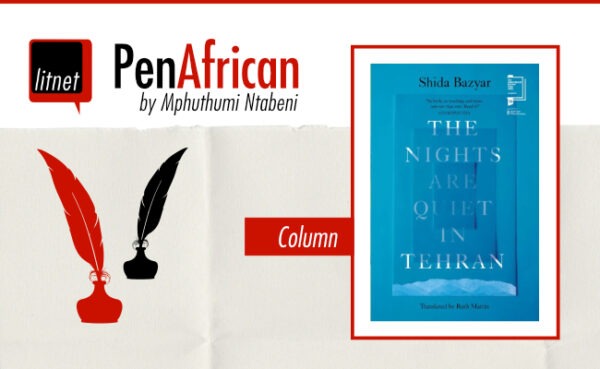
Book cover: Scribe UK
- Mphuthumi Ntabeni writes regular book columns for LitNet.
The nights are quiet in Tehran
Shida Bazyar, translated by Ruth Martin
Scribe UK
ISBN: 9781964992105
........
The book is a brilliant, pertinent read for our troubled times.
........
I
Like a growing number of readers, I have come to regard the International Booker Prize as a reliable index of serious, quality literature of variety. Each year, it carries, for me, something of the anticipatory pleasure of Christmas morning for the careful unwrapping of unfamiliar worlds. Of this year’s longlist, the only title I knew in advance was The director by Daniel Kehlmann, which I hope to talk about before the winner of the prize is announced. I hope to do three reviews of my favourite reads on the longlist before the judges announce the winner on Tuesday, 19 May 2026. The nights are quiet in Tehran by Shida Bazyar is the one that compels my first attention, for the obvious resonance with the present global political moment.
The novel opens in the shadow of Reza Shah and his son Mohammad Reza Pahlavi, whose rule from 1941 to 1979 ended with the seismic events that brought to power Ayatollah Ruhollah Khomeini, who was recently assassinated by the Israeli and USA missile attacks in Tehran. What began as a broad-based revolt, one in which Marxist-socialist secular forces played a decisive role in dethroning the imperial Shah regime, culminated in the establishment of the Islamic Republic and its own Islamic Shia totalitarian regime.
At first glance, Bazyar’s novel concerns this revolution and its aftermath. More precisely, it is an anatomy of the slow disintegration of national political certainties, a phenomenon not unfamiliar to South African readers who have lived through the degradations of apartheid, the moral clarity of the Mandela years, and the subsequent disillusionments of ANC postcolonial governance.
What interests Bazyar is not revolution as spectacle, but the interior life of belief in those who mistake the velocity of history for that of moral clarity and individual freedoms, gradually discovering that such convictions offer no political immunity against the growing violence of a totalitarian state. This is evident from the opening pages, which are calibrated by tonal precision rather than political rapture. The failures of the Revolution arrive first by a linguistic shift, a change in what can be said aloud rather than an eruption of violence. “We read Long live the Shah and thought, Death to the Shah” (4). The line is deceptively simple, yet captures the emergence of a counter-language of dissent, one that precedes action and, in many respects, determines it. For Bazyar, politics begins in syntax.
Her narrator, Behzad, belongs to a generation for whom ideology is rebellion against imperialism, including that of the West, which siphoned oil from Iran through the corrupt Shah regime. The early sections of the book are suffused with a collective voice – we read, we smuggle, we learn – suggesting a solidarity that feels, if not naïve, as yet untested. The Revolution is imagined as a totalising moral correction: “we’re at the beginning of a new age, a new system, a new freedom” (4). Yet, even here, a faint dissonance intrudes. The ironic tone is already seeping in through the emphatic insistence and the ridiculously too-assured future.
What distinguishes Bazyar from many chroniclers of revolutionary fervour is her attention to the domestic counterpoint. The political never eclipses the quotidian. In one of the novel’s most memorable early scenes, women gather around a sofreh preparing dolmeh, their conversation drifting between gossip and survival. Behzad notes that “the women talked about real people and real problems” (6). This is a quiet rebuke of the abstractions of male political discourse. The Revolution, in this register, is less an event than an intrusion, something that unsettles, rather than replaces, the rhythms of ordinary life.
This tension between the grand narrative of history and the granular texture of lived experience runs throughout the novel. Bazyar is particularly adept at showing how ideological commitment reshapes perception. Everything becomes confirmation; doubt is recoded as weakness. “Restlessness is uncertainty, and future leaders must not show any uncertainty” (6). The sentence is chilling in its casual authoritarianism, anticipating in miniature the structures that will later harden into power. It is something one can imagine coming out the mouth of the current ANC Secretary General, Fikile Mbalula, in the not so distant future.
The friendship between Behzad, Sohrab and Peyman provides the novel’s emotional axis. Each embodies a different orientation toward revolution: zeal, discipline and scepticism. Peyman, in particular, emerges as a figure of quiet resistance to the totalising logic of the Revolution. His insistence on the ordinary – “We need to make sure there is food, there is water, and that the children are going to school” (12) – reads, in retrospect, as a moral anchor. He is less interested in history than in its consequences.
Bazyar’s portrayal of revolutionary consciousness is unsparing. Solidarity quickly calcifies into dogma; inquiry becomes suspect. “We don’t ask questions anymore … the Revolution was our answer” (18). The novel’s central insight lies in how she exposes the fact that revolutions, at the helm of their triumph, often recreate the very conditions that made them necessary. They quickly lose their capacity to tolerate dissent.
The protest scenes in the book are rendered with a kinetic intensity that resists romanticisation. The crowd is both exhilarating and annihilating: “in a revolution, the crowd takes over your thinking, the crowd replaces your judgement” (13). Bazyar here approaches a phenomenology of mass politics, in which the individual dissolves into the collective, gaining in momentum what it loses in responsibility.
This is nowhere more evident than in the moment when Sohrab is shot during a demonstration. The scene is stripped of heroism and rendered instead as disorientation: “How small a person is when they fall to the ground in a crowd” (15). The mythology of martyrdom collapses here; death is treated not as sublime sacrifice, but as an abrupt, almost banal, cessation. There is, paradoxically, a kind of moral clarity in this refusal of grandeur.
As the narrative progresses, the unity of the revolutionary moment fractures. Competing ideologies – Marxist, Islamic – vie for dominance. Comrades become rivals, then enemies. “Suddenly you can’t remember when the shared fight … turned into a fight among ourselves” (39). This loss of temporal clarity, of not knowing when things changed, is one of the novel’s most unsettling effects. History, Bazyar suggests, does not announce its nodal turning points.
She is equally incisive in showing how revolutionary movements reproduce the structures they seek to dismantle. Clandestine operations, coded messages, hierarchical decision-making – all these mirror the apparatus of the state they oppose. The protagonist, Behzad, who once imagined himself a liberator, finds himself participating in a new regime of discipline in which even language is militarised against opponents. The future is no longer imagined, but planned, strategised and enforced by violence if need be.
.........
And yet, the novel resists cynicism. There are moments, brief and fragile, when another life seems possible, like in Behzad’s encounter with Tara, the child in the car.
.........
And yet, the novel resists cynicism. There are moments, brief and fragile, when another life seems possible, like in Behzad’s encounter with Tara, the child in the car. Their talk during this moment leaves him nostalgic for normalcy. The child’s insistence on a moral logic outside ideological binaries is what catches him, introducing back to his life a different mode of reasoning – neither revolutionary nor reactionary, just human: “The pelican isn’t evil, the girl says eventually. I’ve just told her a story in which the hero and his comrades are swallowed by a pelican, but Tara still says, The pelican isn’t evil, the pelican gives his children food, and if there’s no more food he bites off his own flesh so no one will starve. I smile and say Ah and Oh, and I didn’t know that, the kind of thing you say to strangers’ clever children” (36). For a moment, Behzad glimpses an alternative: “It would be lovely just to stay sitting in this car forever … in another time and another life” (36). The poignancy lies in knowing that such a life is incompatible with the one he has chosen.
The title, The nights are quiet in Tehran, is deeply ironic. There is little quiet in the book – only the suppression of noise, the silencing of dissent, the enforced calm of a society under transformation. What Bazyar captures with remarkable precision is the psychological cost of that quiet in the erosion of doubt, the narrowing of possibility and the substitution of belief for thought.
The first part of the novel is less about the failure of a particular revolution than about the structure of revolutionary desire itself. It asks whether any movement that seeks to remake the world can avoid reproducing the very forms of domination it opposes – while still persuading itself of its liberatory mission. Bazyar offers no resolution. She leaves us instead with questions her characters can no longer ask.
II
If the Tehran sections chart the intoxication of revolutionary belief, the European sections register its afterlife, what remains when history has moved on. Narrated through Nahid, Laleh and the younger generation, these sections are quieter but, in many ways, more devastating. They describe slow drift like collapse, as compared with the abruptness of things in the first part.
The parallel with contemporary South Africa is difficult to ignore here also. One hears, in the fading rhetoric of former liberators, echoes of a language that once mobilised masses but now dissipates into the air, uttered with conviction and received with indifference. It is the moment when the wheels have already come off, yet the cart continues forward on residual momentum from the past.
Formally, Bazyar marks this transition by fracturing the collective we into a series of intimate, often contradictory first-person voices. The Revolution, once totalising, becomes memory, then burden, then inheritance. What replaces it is not clarity, but dispersion across geography (Iran to Germany), time (1979 to the present) and psyche (certainty to ambivalence).
Nahid’s sections in West Germany are among the most quietly devastating. Where Behzad experienced history as acceleration, Nahid experiences exile as suspension. “Every perfectly shaped but tasteless peach fitted under the bell jar of exile” (100). The metaphor is exact, for exile preserves life in a manner that drains it of vitality. Alienation extends beyond place to language and self. German is not merely foreign; it is estranging: “I heard myself say every German word as though it had been frozen, to be thawed out in later times” (100). Language, once an instrument of action, becomes a medium of barren delay.
Here, the Revolution mutates into bureaucracy. Its lexicon shifts from ideology to administration: “residence permit and lawyer and school board and appeal process” (100). The revolutionary subject becomes the migrant subject – regulated, documented and processed. Behzad tries to resist this transformation. “Khomeini will die and everyone will wake up” (101), he says, but the statement is less prediction than psychological necessity. To abandon it would be to concede not only defeat, but irrelevance. Nahid recognises what he cannot. Her question – “when are we going back?” (101) – is existential rather than logistical. Return becomes impossible. They have already “hammered nails into the walls”. Exile, like revolution, has become irreversible.
From the vantage point of the present, the reader is placed in a position of retrospective clarity. The hope that the death of a single figure might restore freedom appears now as wishful misreading of the structural power that history rarely yields so easily.
Bazyar’s depiction of Europe is equally subtle. For the revolutionaries, the West was an abstraction – capitalism, decadence, inequality. In reality, it appears disarmingly ordinary: “No one here looks very rich or very poor” (64). The ideological binary collapses under observation. What replaces it is not revelation but disorientation. Even privilege appears muted, almost banal. Students look “like they’ve always had a lie-in” (64), their lives marked by ease rather than urgency. What unsettles Nahid is not their wealth, but their lack of necessity. Exile thus produces not only loss, but a crisis of meaning. One no longer knows what constitutes a serious life anymore.
With Laleh and later Tara, the novel shifts from exile as experience to exile as inheritance. These narrators do not remember the Revolution; they inherit its residues. Laleh exists in a state of cultural doubling: neither fully German nor Iranian. “I stand facing a five-year-old … and feel like she is the older one here” (167). Identity becomes contingent, performed and unstable.
What she inherits most powerfully is narrative. Her parents’ past confers a borrowed significance – they are “revolutionaries in our midst” (218). Yet, because this significance depends on storytelling, on selective disclosure, it is, in effect, a myth that produces second-order politics. Laleh participates in protests – against neo-Nazis, against nuclear waste – not purely from conviction, but from a desire for legitimacy. “At her side, I always felt a bit more justified in being there” (218). In part, activism becomes an attempt to align oneself with a moral tradition only partially understood and misunderstood.
There are resonances here with movements of the Fallists (Rhodes Must Fall), where a second generation inherits not only the language of struggle, but also its expectations, often seeking to exceed the radicalism of their parents or predecessors. Yet, what is missing is the original certainty, the unambiguous moral horizon that once made such language effective.
In the present-day sections, particularly those centred on Tara, the novel enters a different epistemic register altogether of digital mediation, global protest and psychic fragmentation. Tara’s voice is jagged, interior, almost claustrophobic: “everything is one-dimensional … I really want to grasp things” (245). The complaint is not political but ontological. Reality appears flattened and mediated through screens.
Where the Revolution replaced thought with action, the present replaces action with representation. The subject is no longer absorbed into the crowd, but dispersed across media. And yet, the desire for immediacy persists. Tara longs “to shout … and throw myself at policemen” (245). The body retains what history has lost.
The Hamburg demonstration crystallises this tension. It is both continuation and parody. When Tara shouts, “Long! Live! International solidarity!” (250), the phrase carries historical weight, but also a trace of irony. It is unclear whether it is believed, performed or merely inherited. Bazyar leaves the ambiguity unresolved.
What emerges across these sections is a profound meditation on aftermath. The Revolution does not simply end; it disperses – across generations, geographies and forms of life. The first generation lives in its shadow, unable to relinquish it. The second reshapes it into identity. The third encounters it as mediated history.
And yet, certain structures endure: the longing for solidarity, the suspicion of authority, the impulse toward collective action. Even in fragmentation, the past exerts a gravitational pull. Bazyar’s achievement is to show that this pull is neither purely nostalgic nor tragic, but constitutive. To live after a revolution is to inhabit its unresolved questions.
At one point, the language of exile disappears: “we stopped using that word long ago” (p 105). What replaces it is not resolution but adaptation. Life continues, though altered. The nights may be quiet in Tehran, but in Bazyar’s novel, quiet is not peace. It is the residue of noise, the echo of chants, arguments and hopes that have yet to settle into silence. The book is a brilliant, pertinent read for our troubled times.
Also read:
Haunted selves and colonial shadows: Nadia Davids’s Cape fever – a book review