

.........
Those familiar with these pages know that every year I choose one literary prize to read from its list. This is why I am continuing with my reading from the International Booker Prize 2026.
.........
- Mphuthumi Ntabeni writes a regular book column for LitNet.
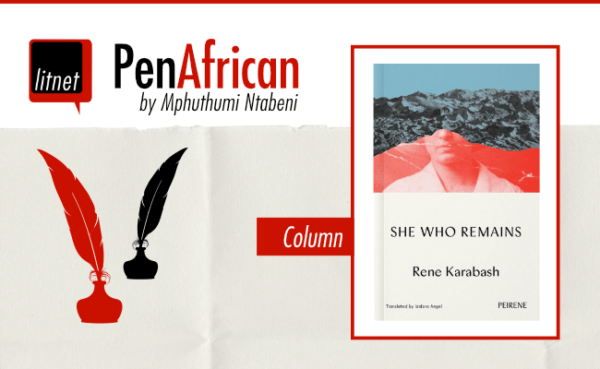
Title: She who remains
Author: Rene Karabash, translated by Izidora Angel
Publisher: Peirene Press (2026)
ISBN: 9781916806184
Those familiar with these pages know that every year I choose one literary prize to read from its list. This is why I am continuing with my reading from the International Booker Prize 2026. I have already spoken about two books from it: The nights are quiet in Tehran and The remembered soldier by Anjet Daanje, translated by David McKay. I had hoped that The remembered soldier would at least make the shortlist, if not win the prize. I was very disappointed when it didn't.
My last read on the list is She who remains, by the Bulgarian writer Rene Karabash and translated by Izidora Angel. Karabash is the pen name for the popular Bulgarian actress Irene Ivanova.
The most creative moment of Karabash’s novel – its watershed hinge, if you like – occurs early when a child, still in the womb, hears her father wishing for a son. It’s the kind of detail that, in another book, might feel like a piece of symbolism planted a little too deliberately. Here, it lands differently, because it happens when Karabash has already established a world where language and fate and the body are all tangled up together in ways that don’t come apart. It doesn’t feel like superficial symbolism as much as a surgical scar of the diagnosis the book is doing. Something has already gone culturally and historically wrong before the child is even born.
In Bulgarian, she tells us, the word for “son” is also the word for “blue”. From that point on, blue bleeds through the novel like a bruise of masculinity, longing, absence and expectation – something both desired and imposed. The whole symbolic universe is set up through this single word, and Karabash keeps worrying at it, returning to it, turning it slightly each time so it catches the light differently. It’s one of those small linguistic coincidences that the book turns into fate.
The novel follows Bekija, who becomes Matija, a “sworn virgin” under the Kanun, the old customary law of the northern Albanian highlands. Under the Kanun, a woman could renounce her gender, take an oath of celibacy and live as a man. Karabash isn’t particularly interested in the anthropological novelty of this. What she wants to know is what it actually feels like to inhabit a body you’ve formally given up, to be re-authored through an oath and to become someone who exists only because the law said you could. Not just socially, but internally – what happens to memory, to desire, to the private sense of self when it has to re-organise itself around an oath like that. That question drives everything, and the strength of the novel is that it never really settles it.
The prose is built to match it. It flickers. It moves between first-person confession, direct address to some unnamed journalist, and something closer to choral lament – myth and memory and hallucination overlapping until you lose track of where one ends and the next begins. Sentences pile up without punctuation, then suddenly contract into something stark and declarative. Images and phrases repeat with small, disorienting variations, like the mind circling something it can’t quite process. Time doesn’t move forward; it circles, stalls and doubles back. You get a vertigo-like feeling and the sense that nothing is ever over, only replayed and replayed to dizzying heights.
.........
This is not a novel that wants you to feel comfortable, and its structure won’t let you, either.
.........
This is not a novel that wants you to feel comfortable, and its structure won’t let you, either. The chapters are short, titled like this: “The heralds of death”, “The black armband” or “The milk-white bride”. And they read almost like recital fragments, returning over and over to the same cluster of concerns: blood feud, sexual violence, familial duty. The Kanun looms over everything like mist or environmental weather. The law in this book is described as something that “reaches everywhere … returns as rain”. That feels exactly right. It’s not enforced as much as absorbed.
Ismail Kadare’s book Broken April is explicitly invoked, and the comparison makes sense. Where Kadare tends to observe the Kanun from a certain remove, Karabash puts you inside it. You don’t study it; you breathe it in. You start to understand how people begin to think through it without even noticing.
One of the things the book does very well, and very quietly, is show how early all of this begins – the expectations, the gendering, the hierarchy of value between boys and girls, and the way even affection is filtered through that preference. It’s a kind of slow conditioning from very early, so that by the time the more overt violence arrives, it doesn’t feel strange. It feels like an inevitable extension of normal life.
The most brutal section involves Bekija’s rape in the dairy, and the way Karabash handles it is worth noting. There’s no sentimental outrage, no redemptive arc waiting on the other side, and no rhetorical signalling telling you how to feel. The scene is disorienting, almost dreamlike in places, and then suddenly very concrete. What’s unsettling is how seamlessly it fits into the novel’s broader logic of inevitability, treated not as an exception but as part of the same system that will later demand proof of purity, enforce marriage and eventually push Bekija to take the oath. When she becomes Matija, that transformation is both a kind of freedom and a surrender at the same time. She gains access to public space, to male privilege, to movement and to speech, but she also inherits the male obligations of honour, violence and the blood feud. It’s not an escape, but a reassignment.
There’s another scene where she’s forced to choose which male relative – father or brother – must be sacrificed to settle a debt of honour. This reduction of kinship to the random arithmetic of survival is one of the most chilling things in the book. It’s done without melodrama, almost procedurally, which makes it worse. The decision isn’t depicted as tragic in the way we might expect; it’s framed as necessary. This is where the book is most unsettling – in how it normalises what should be unthinkable in our modern sensibilities.
The men in the novel aren’t drawn as simple villains, either, which complicates things further. They’re often trapped in the same system, performing roles that precede them. The father, in particular, is both affectionate and terrifying, capable of tenderness and brutality in the same breath. His desire for a son doesn’t read as personal cruelty as much as inherited expectation, which doesn’t make its consequences any less devastating, but does shift how you read him. The book resists easy moral sorting.
There are also strange, almost tender counterpoints: moments with the pigeons, with the landscape and with small domestic rituals. These briefly open the world up, only to close it again. The mountains, the fog and the animals are not just a backdrop; they feel complicit, somehow, or at least indifferent. The environment carries the same sense of enclosure as the law.
Izidora Angel’s translation does the prose real justice. It keeps the oscillation between minimalism and something more ornate by the breathless accumulation of clauses and the incantatory repetition. None of it feels flattened or over-smoothed. The rhythm survives, which is half the achievement in a book like this. If there’s a reservation, it’s that the intensity rarely lets up. The novel doesn’t offer much modulation – air for the reader to breathe. That can become numbing after a while, even if the material doesn’t lose its force, because it doesn’t vary its pressure. I suspect that’s part of the point. Demanding relief from a book like this is to misread what it’s trying to do. It’s not interested in pacing itself for the reader’s comfort. It wants to take you within the delirium of the reality it delineates.
.........
What the novel offers the South African reader is a kind of echo that replicates our realities, too, bringing them to sharp awareness in reminding us how easily a brutal system can become naturalised and how injustice can be mistaken for destiny.
.........
What the novel offers the South African reader is a kind of echo that replicates our realities, too, bringing them to sharp awareness in reminding us how easily a brutal system can become naturalised and how injustice can be mistaken for destiny. And, in doing so, it leaves you with a discomfort that feels oddly recognisable in the end – about the structures, visible and invisible, that shape life much closer to home.
Even the title, She who remains, is doing quiet, complicated work. Bekija/Matija survives, but survival here carries no triumph and no sense of resolution. To remain is simply to persist inside a structure that has already fatally decided the terms of your survival, and the price you pay for going on despite your fundamental objections to it. There’s something bleak about that, but also something stubborn. The book doesn’t offer a way out of the structure, just a means of survival for the witness who stays with it long enough to see how it works. Naming is the only means of surviving it.