

https://www.penguinrandomhouse.com/books/678944/land-by-maggie-ofarrell/
- Mphuthumi Ntabeni writes regular book columns for LitNet.
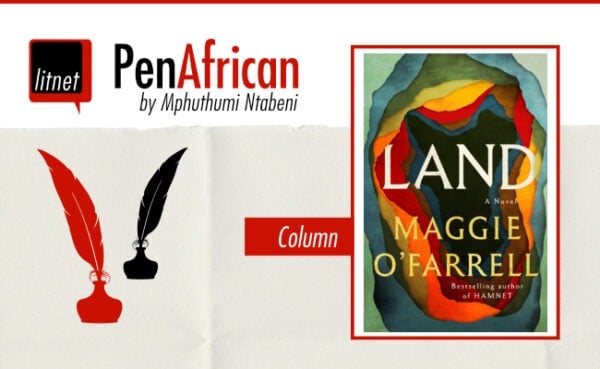
Land
Maggie O’Farrell
Penguin Random House
ISBN: 9780593320648
Maggie O’Farrell’s Land is an astonishing family and national (Ireland) novel of dispossession and inheritance, and a meditation on land as an archive of history, grief, resistance and belonging. That should immediately resonate with black South Africans in particular. It extends the historical imagination that animated Hamnet and The marriage portrait into something broader, more elemental and closer to our era (nineteenth century).
The novel opens in 1865 on a remote, unnamed Irish peninsula still haunted by the aftermath of the Great Hunger. We encounter the mapmaker Tomás and his young son Liam, employed by the military in the imperial project of surveying Ireland. Tomás occupies a deeply ironic position. He is both servant and critic of empire, a gifted cartographer whose work helps produce official maps while simultaneously preserving local memory against colonial erasure. Though his task is ostensibly scientific, he gradually comes to realise that every map is also an argument about ownership, power and history as he surveys a landscape emptied by famine and eviction. He is confronted by the impossible task of translating human suffering into discernible lines and symbols, for future generations if nothing else. He becomes haunted by the ruins of cottages, the vanished families, the abandoned villages, experiencing something approaching political consciousness.
Entering a mysterious woodland with a sacred spring, Tomás undergoes a mystical, psychological and political transformation. The rational surveyor becomes possessed by an alternative vision of land, history and memory, and begins speaking of hidden layers of reality – of maps that must record not merely property boundaries, but ancestral claims, folklore, myths, losses and buried truths: “I see it all now. I see that maps cannot be made with theodolites and poles and compasses alone. These are but playthings,” he insists (27). The statement becomes a manifesto for the novel. His family – his son in particular – is not always happy with the gruelling work. We get hints that his life among the native Irish was difficult, because he was regarded as part of the hand the oppressor used.
One of the great achievements of Land is its exploration of cartography as both knowledge and domination. O’Farrell understands that maps are never neutral. They determine who belongs, who owns, who remembers and who disappears. Tomás spends his days translating long Irish place names into abbreviated English forms for imperial records, reflecting on how local histories are compressed into bureaucratic convenience for the rulers, generations of memory vanishing beneath administrative manipulations.
Readers familiar with colonial histories elsewhere – in India, Australia, Canada or South Africa – will immediately recognise the significance of this theme of making artificial borders into imperial national markings. They know that the renaming of places is never merely linguistic, but an act of possession. And this is why the process of changing town names, in the Eastern Cape in particular, has become such a fraught affair.
O’Farrell’s insight recalls the work of historians such as Edward Said and Patrick Wolfe, who argued how colonial powers operate through representation. Tomás has woken up to the deeper realisation that to map a place is to claim authority over its meaning. Hence he eventually arrives at the startling conclusion that history needs to be remapped, because official records have failed by prioritising ownership and ignoring loss.
Many novels about the Irish Famine treat it as historical background. O’Farrell, who understands the sentiments of the dispossessed from within, knows that treating dispossession as mere extant residue of history constitutes double betrayal and a second dispossession, in a way. For the dispossessed, in particular, history exists as an active force of the status quo, haunting entire landscapes with the absence of native presence through empty cottages, abandoned roads, ruined estates, tribes and overgrown fields that testify to human lives erased from current official memory.
The widow who shelters Tomás and his son, Liam, becomes one of the novel’s most moving voices as she recalls family after family lost through starvation, eviction, emigration and neglect. Her memories transform a map into a cemetery for memories that refuses the rest and peace of the dead.
Rather than dramatise famine directly, O’Farrell allows memory to become part of the narrative to remind us that historical tragedies rarely survive through official historical archives, but persist through the lived peripheries of oral testimony, folklore, family stories and the almost sentient quality of the landscape of the former colonised. And the land always remembers what institutions do not, or what they try to erase. The past traces are everywhere, discoverable perhaps through archaeology, land and language maps, etc.
The novel’s Irish setting is highly specific with universal implications. Readers from South Africa will recognise echoes of forced removals, land dispossession and the struggle over historical memory. The same questions arise here, too, about who owns stolen land, how to remember its previous inhabitants, and what must happen when official records erase lived experience.
If Land were merely a political novel, it would be impressive, but O’Farrell reaches for something larger by constantly shifting between historical time and geological time. Rocks, rivers, trees and coastlines participate in the narrative. Human lives appear fleeting against the immense age of the earth. Tomás’s fascination with a small stone from the sacred spring becomes emblematic of this vision. The pebble is older than any nation, dynasty or human settlement. This movement between intimate human drama and deep time gives the novel its distinctive atmosphere. O’Farrell writes as though geology possesses memory.
The influence of Irish folklore is equally important in the book. Although sacred wells, shapeshifting landscapes, hidden worlds and ancestral presences run throughout the book’s narrative, O’Farrell does not treat folklore as quaint superstition. Instead, myth becomes an alternative archive, a way of preserving truths inaccessible to official history. In this respect, Land belongs to a tradition extending from WB Yeats to John Berger and Seamus Heaney, writers who understood that landscape contains cultural memory. You find such writers aplenty in African lore. You just have to read SEK Mqhayi to understand how, like in the Celtic poetic tradition invoked by the likes of Yeats, an imbongi, in his true nature, is a keeper of a nation’s memory: history, traditions, culture and spirituality.
Few contemporary novelists write physical landscapes as beautifully as O’Farrell. Her descriptions possess expansive precision and lyricism. The Irish peninsula emerges as both scenery and a living organism, as wind, rain, moss, stone, streams and cliffs become active presences. To appreciate the full blast of this, you have to read contemporary Celtic literature. Particularly striking is how this renders perception as a moral act. Liam’s fearful journey into the woodland is written with extraordinary psychological acuity. The forest becomes simultaneously real and imagined, external and internal. Childhood fears transform moss-covered mounds into possible graves, and shadows into spirits. This passage demonstrates O’Farrell’s rare gift for inhabiting consciousness without sacrificing narrative momentum. Her prose is lush without becoming indulgent. Unlike many historical novelists, she trusts imagery more than exposition, without neglecting or betraying historical fact. I doubt there’s any person capable of reading part two of the book without shedding a tear or two.
O’Farrell is not merely telling a family story, but narrating the relationship between people and place across generations. The crucial question of the novel is whether land can be understood as a historical actor. South Africans will instinctively understand this question, even if they differ in the answers they give. Too much contemporary fiction confines itself to private experience to avoid dealing with the moral questions of history. O’Farrell moves in the opposite direction. She seeks connections between personal memory, family inheritance, national history, folklore, ecology and geology. This is why Land is such a profound and deeply moving novel around the contested meanings of place. It asks questions that feel increasingly urgent in the twenty-first century, about how to remember and make right historical injustices. What stories are embedded in our landscapes? Who has the authority to name, map and possess the earth?
The novel tries to persuade us that land is never merely land. Every field, hill, river and shoreline contains accumulated layers of human experience – love, labour, conquest, exile, grief and hope. To walk across a landscape is to walk across history. Like the sacred spring at the centre of its opening chapters, O’Farrell’s novel invites readers to look beneath the visible surface of things. What lies there is not simply the past, but an invitation to a deeper understanding of how memory survives.
Land is among the finest historical novels of recent years: intellectually ambitious, emotionally resonant, politically alert and written with extraordinary grace. It confirms Maggie O’Farrell as one of the most accomplished novelists writing in English today.
The use of the present tense is often an effective means of sharpening narrative focus, drawing the reader into the immediacy of events and narrowing the distance between story and experience. Used with restraint, it can create remarkable intimacy. Yet when sustained without relief, it produces the opposite effect of estranging the reader, making the narrative feel constricted, even claustrophobic, as though neither the characters nor the reader are ever allowed the reflective space that the past tense naturally affords. This is perhaps my principal reservation about O’Farrell’s Land.