

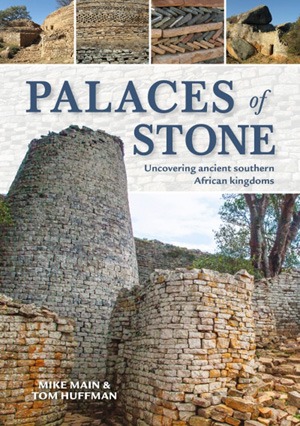
Palaces of stone: Uncovering ancient southern African kingdoms
Mike Main & Tom Huffman
Penguin Random House South Africa
ISBN: 9781775846147
This reader impression was written and sent to LitNet on the writer's own initiative.
.......
Palaces of stone covers some of the political history from AD 900 to the year 1850. It is a time in the history of Africa that is not very well documented, due to the fact that the society was dominated by oral tradition rather than writing.
........
Palaces of stone covers some of the political history from AD 900 to the year 1850. It is a time in the history of Africa that is not very well documented, due to the fact that the society was dominated by oral tradition rather than writing. Geographically, the book focuses on the area of what is today known as southern Africa, and encompasses the modern states of South Africa, Zimbabwe, Mozambique and Botswana. Traditionally, the history of these countries has been interpreted with a strong colonial emphasis. Over the past three decades, in particular, these narratives have been changing, with particularly the history of the First Nations being introduced, with some references to African kingdoms such as Mapungubwe, of which not much is generally known. One can particularly think of the recent publication of The lie of 1652, which attempted to challenge the colonial perspectives.
Much of the work that historians have done has also been largely based on the written record. These records, although critical for our understanding of past societies, were written from a colonial perspective, and the evidence found in the archaeological record has clearly not been properly integrated into what is being presented as history. While sites such as Mapungubwe and Great Zimbabwe are at least known to the general public, what is not well known is that there is evidence of at least 566 of these “stone palaces”, the ruins of which can be found across southern Africa. These ruins not only serve as evidence of societies long past, but they also raise many more questions as to who these people were, who their leaders were and what sort of lives they led.
The science of archaeology has developed in leaps and bounds since the first amateur archaeologists started to study evidence from historical societies. Much in the same manner that historians stereotyped societies and did a great deal of damage, the early amateur archaeologists also did not know nearly as much about conservation as they do today, and in conducting their business, a lot of damage was done to historical sites due to a lack of knowledge. The book details, for example, how early European explorers concluded that the Great Zimbabwe structures could only have been built by foreigners from the Middle East, or perhaps Asia. These conclusions were based on the discovery of ceramics and other items on the site that linked the site to Arabia and China, but which were later established to be the result of a complex trade network.
........
The “stone palaces” are extraordinary sites. They provide evidence and testify to the fact that South Africa has been continually inhabited for centuries.
........
The “stone palaces” are extraordinary sites. They provide evidence and testify to the fact that South Africa has been continually inhabited for centuries. While many of the 566 sites that have been identified have been largely damaged by the ravages of time, there are others that are still well preserved. Apart from showing evidence of trade, the sites also provide evidence of mining and agriculture. It is important for us to learn as much as we can of these long-forgotten societies – how they were organised and what happened to them before Africa was divided up by colonial powers into its present form. There remains a lot of research that still needs to be conducted, and hopefully upcoming historians and archaeologists will be able to rewrite the history of Africa by utilising the archaeological record in better ways than in the past.
