

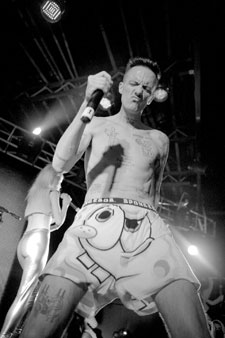
 It is difficult to write anything meaningful about the zef-rap phenomenon now, when it has ceased to be interesting. This is a pity, since Die Antwoord and Jack Parow are the first remotely relevant white South African pop acts in over twenty years. For a while, it seemed as if these two acts possessed the one element most lacking in pop music: the potential to be subversive. Unfortunately (and leaving Jack Parow aside for the present), Die Antwoord have reached what will no doubt be the peak of their popularity at the very moment that they have become boring.
The main problem is with the music itself, or at least what they are currently releasing and performing. When I first heard Die Antwoord a year ago, it sounded genuinely exciting, and it was. The big, sloppy, vuil sound of "Doosdronk", coupled with its brilliant lyrics – subverting its own status as a party track by incorporating domestic violence, and thus being even more appealing as a party track for that – makes it the best satirical pop song since Johannes Kerkorrel’s “BMW”. What appealed about this song, and others like “Wat pomp” and “Wie maak die jol vol”, was precisely that it didn’t seem to be ironic, at least not in the prissy and exhausted sense which we have become used to in white South African art. There was invigorating, confused rage there, and it was genuinely funny.
However, this was not to last. Their subsequent songs are uniformly dull parodies, with lyrics that offer nothing except the occasional snigger at the (increasingly less inventive) use of the word poes. The central appeal of Die Antwoord’s adoption of zef was that they were, very amusingly, embracing and identifying with minute aspects of a very specific subculture, and this appeal is wholly negated by treating it ironically. The group now seems nothing more than another Waddy Jones vanity project. Coupled with this, the new songs are musically boring. Although the adoption of a uniformly blank and banal aesthetic can be a powerful artistic provocation, it does not make for interesting listening.
A major factor is the genre they work in. Hip hop is one of the forms of pop music which is entirely devoid of emotion (except anger) or lasting meaning. This is the best thing about it, since its vital importance is precisely its novelty – when done well, it is able to speak about topical issues in a highly engaged, concrete and direct way. To make good hip hop, you need to move fast, and Die Antwoord have slowed down. After an initial spurt of creativity and surprise they have settled into a dreary rehearsal of the same worn-out songs and jokes. Show after show, Waddy beats up his wife, and delivers exactly the same “freestyle” raps, and the same graphics flash in the background. Granted, as a new group they are obviously concentrating on building a brand, and some continuity is necessary. However, the highly formulaic performances, coupled with the bland music, make their act look tired already.
Die Antwoord are as much a media phenomenon as a musical group, and they have also been severely diluted in this sphere. In South Africa they have been effortlessly absorbed into the boring and pointless “debates” on “identity politics”. They are seen as a challenge to fixed notions of Afrikaner identity, as an expression of cultural “hybridity”, or as a clever and disturbing appropriation of Cape Flats coloured style. These arguments miss the point in so far as they argue for Die Antwoord’s broader significance, for two reasons: firstly, they suppose that zef (both the Afrikaner and the coloured variety) is an exciting and complex cultural phenomenon to be analysed. It isn’t. It is a joke that is at its most funny when it is absolutely vulgar and one-dimensional. At its best, the popularity of zef is a superficial interest in amusing bad taste; at its worst, it is a way for rich white people to laugh at the South African working class. This irreverence is exactly what makes it fun. Try to analyse zef seriously, and the object of analysis disappears. Secondly, these discourses of identity politics assume that hybrid and “postmodern” personas are culturally subversive, which is certainly not the case, especially in pop music. On the contrary, the global pop music industry depends on such hybrids, since it is constantly in search of increasingly diminishing sources of novelty to satisfy the demand of its diverse niche markets. As no new or even exciting pop artists or movements have appeared in decades, acts which blend already existing elements in seemingly new ways, like Die Antwoord, are an already-assimilated commodity, about as radical as Lady Gaga.
 As such, I am probably making a big mistake by assuming that Die Antwoord was meant to be subversive in the first place. Even so, hope remains that they might offer some light amusement in the future. The single American interview they gave was very funny and uncompromisingly acted in character; perhaps, with an international audience, they will take a fresh direction. Furthermore, Waddy’s projects tend to implode after two or three years. They are usually quite fun at the start, and then descend into banality after a few months. This one is less sustainable than the rest (you can milk a single joke for only so long), so we may get something new soon.
This brings us, finally, to Jack Parow, who is much more interesting than Die Antwoord, precisely for the reasons given above. He does not treat his material or his persona ironically, and his music is consistently fun and funny, excepting his over-reliance on the fokken ou nuus Fokofpolisiekar crowd. His transparent and culturally literate engagement with an authentic subculture makes him an Afrikaans rapper first and a zef fokker second, which means that his relevance stretches far beyond the current fad. He seems to be serious about actually becoming a romantiese Afrikaanse superster rapper, as popular as Kurt Darren. While this does not make him in the least subversive, it thankfully means that he has been entirely exempted from talk about the deeper significance of shifts in South African identity.
Perhaps the best thing about zef-rap is that it is not a movement, and that it will birth no new acts. The concept is so one-dimensional, and has been explored so well by Die Antwoord and Jack Parow, that anyone else attempting to exploit it will seem a lame imitation. And as the other pieces in this mini-seminar show, the hip value of zef has already been significantly lowered – it is now just another cute South African phenomenon, something we can all celebrate as part of our vibrant and diverse culture.
So, if you are just getting into the whole zef thing, don’t bother: you’re too late, as usual.