

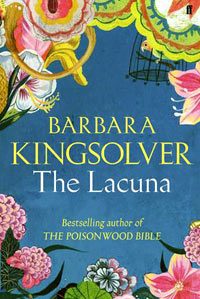
Title: The Lacuna
Author: Barbara Kingsolver
Publisher: Faber and Faber
Publication date: 2009
Pages: 532
Harrison Shepherd is split between two countries, the USA and Mexico, and caught between competing existences and philosophies throughout his life, much like the novel The Lacuna, which tells the story of this life.
The Lacuna opens in his boyhood, as his Mexican mother careens from one love affair to another, after deserting his dour American civil servant father. As a young man, Harrison finds himself a servant in the household of Diego Riviera and Frida Kahlo, and from there, becomes one of Lev Trotsky’s trusted inner circle during the Bolshevik leader’s last exile in Mexico, the period that dominates his memories later on. The combination of the fanciful with historical record makes The Lacuna compelling, but ultimately, this is a novel that is as much about ideas and history as it is about any individual psychology, and in this lies both its strength and its weakness.
Like her 1998 masterpiece, The Poisonwood Bible, Kingsolver is clearly concerned with capturing histories that our present day has conveniently swept under the carpet. The Poisonwood Bible engages with postcolonial Africa, particularly the morality of any attempts at a “civilising mission” and memorably, the role of the US in African conflicts. The Lacuna in turn offers fascinating insight into, amongst other themes, US trade unionism, pre-colonial Mexican history, and most devastatingly, the impact of the blindly anti-communist McCarthy years on individual American lives. But unlike The Poisonwood Bible, Kingsolver’s attempt at integrating social history with deeply personal narrative in The Lacuna feels somewhat heavy-handed at times, making this an undoubtedly instructive but also rather bleak read.
However, if literature must be didactic, one can certainly do much worse than Kingsolver: Her gifts of creation are still prodigious. In the end, The Lacuna tells of the power of words and art, particularly literature, to entrance and also ensnare, as the most private of lives are overtaken by history and the maniacal force of public opinion.