

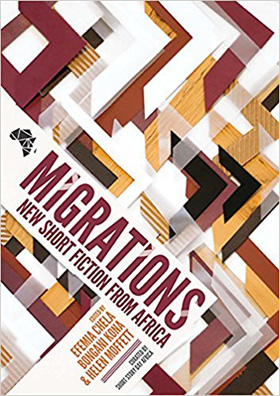
 Migrations: New short fiction from Africa
Edited by Efemia Chela, Bongani Kona and Helen Moffett
Publisher: Short Story Day Africa
ISBN: 9780620745406
In small literary circles like ours in South Africa, it is seldom that one gets to review a publication by a complete stranger. I often end up discussing books written, compiled or edited by people I know. Inevitably, conflicts of interest arise, but with enough self-awareness and openness, one can hopefully uphold critical integrity. So, let me put all my cards on the table, and there are quite a few in the case of the latest Short Story Day Africa (SSDA) anthology, Migrations: New short fiction from Africa, edited by Efemia Chela, Bongani Kona and Helen Moffett: I have been a board member of SSDA, founded and run by Rachel Zadok, for nearly three years, and thus have been involved in the reading and preliminary selection of the stories submitted for the annual SSDA Prize. Nick Mulgrew and I co-edited the previous SSDA anthology, Water: New short fiction from Africa. I am friends with all of these remarkable writers, including the editors of Migrations. Together with Catherine Shepherd, I also co-edited the YA companion anthology to Migrations. Entitled Misplaced and other stories, it includes stories by six of the promising young writers who entered the SSDA Prize competition last year. In short, it’s complicated.
However, it has now been more than a year since I first read the stories in the original submission pile for Migrations, and the ones selected for the anthology had undergone a rigorous editing process, so it feels as if I am encountering them with entirely fresh eyes and, more importantly, with my literary reviewer’s hat firmly in place.
Migrations is the fourth SSDA anthology after Feast, famine and potluck: African short stories, Terra incognita: New short speculative stories from Africa and the abovementioned Water. The idea behind the SSDA project is to offer a platform for writers across the African continent and the African diaspora to write about our experience on our own terms, and to support African writers in our endeavours through the SSDA Prize, anthologies and writing workshops. Last year, the project was expanded by a new mentoring element. The acclaimed South African editor Helen Moffett was tasked with mentoring two young editors, Efemia Chela (Zambian-born, based in South Africa) and Bongani Kona (Zimbabwean-born, based in South Africa), both excellent short-story writers in their own right, shortlisted for the Caine Prize.
There are few current topics as pressing as the worldwide migrations taking place, displacing millions, offering as much hope as despair for those who seek new homes for whatever reasons: whether war, starvation, economic opportunities or dreams.
The collection opens with a piece by the Egyptian writer Mirette Bahgat Eskaros. Her “Exodus” is told from an unusual perspective, that of a seagull. “It was about time to change my regular route,” the avian narrator tells us, and embarks on a journey north, where the seagull encounters a boat precariously full of refugees heading towards Italy. The adventurous bird befriends one of the passengers, a young boy hoping for a new lease on life. The fantastical storyteller is the only part of the story that, otherwise, quite literally, drowns in reality. “My sister’s husband” is also told by an unconventional narrator, the ghost of a woman observing the complex dynamics of her family unable to deal with her tragic death. The author, Nyarsipi Odeph, hails from Kenya and is a content creator, feature writer and magazine editor based in Nairobi.
Mary Ononokpono’s haunting writing has featured in SSDA anthologies before. In “Anyanti”, the Nigerian-British storyteller narrates the horrors of slavery as seen through the eyes of children playing in a fortress they construct in the forest beyond their compound. Slavery also features in Arja Salafranca’s delicate “The castle”. Set across the centuries, two parallel stories record the choices available to gay women coming either to settle in or to visit Cape Town in the 1830s and 2011 respectively.
Military conflict displaces the Nigerian family in Okafor Tochukwu’s “Leaving”, but it is a different kind of war that the protagonist, Obioma, has to fight for the right to live his sexual preferences. Another family is thrown into turmoil when one of the children dies from an overdose and his sister returns from Australia to Zimbabwe to confront her guilt about his demise. In “Naming”, Umar Turaki from Nigeria takes us on a transgenerational journey of trauma. One of the characters in a line of violated lives “fears that his life is a palindrome patiently unfolding, that the same pain that burned him as a youth will return to finish him off as an old man”. Trauma is also at the centre of Ethiopian writer Mignotte Mekuria’s “Of fire”, in which a woman tries to find peace for herself and her niece after tragedy strikes their home: “But here they were, back at the place that painted Isatay’s nightmares with blood and flame, scented it with smoke and charred flesh, drowning her in sorrow.”
“I was thirteen and didn’t know better, and in our house, you either hid or ran, or you gave into his [the father’s] rage,” writes Nigerian Edwin Okolo in “The fates”, a tale of abuse, secrets and betrayal. In “Things we found north of the sunset”, Ghanaian Aba Asibon tells the story of Eden, “a place of abundance” where you “sometimes had too much choice”. When Saaku runs away to find a better life, her friend stays behind to keep her secret, hoping that Saaku will return for her one day. Fred Khumalo’s “This bus is full” is set in the States, where Vusi is hoping to become famous and dreams of returning home to Joburg as a social media sensation. There are no true winners in Francis Aubee’s “Teii mom, win rekk lah” (As for today, winning is the only thing that matters), as horror stories about their former team members attempting to seek asylum in Europe are recalled by friends who had once played soccer together in Gambia.
South African Stacy Hardy’s “Involution” is a brilliant piece that might leave you squirming as she describes the “tiny lonely Frankenstein creature” that the protagonist discovers in her body: “She resolves to keep her thing secret. […] The thing grows taut under her touch. She feels its warm mouth open, the liquid excretion saliva, not blood. […] She hopes her thing never becomes like that. Docile and dependent. She likes its wildness, its skittishness.” Every SSDA anthology includes a few stories that are so innovative and sparkle with such exquisite writing that they will stay with you for years to come. The unforgettably freaky “Involution” is one of these. The stunning sci-fi story “Diaspora Electronica” by Hardy’s compatriot Blaize Kaye also belongs to this category. In the world he creates, people are no longer migrating between countries or continents, but between states of being. “The Institute for the Future of Humanity was the result of unlimited computing power meeting exponential population growth. It was a joint initiative between some of the biggest names in technology. They approached the problem of human overpopulation the same way they approach everything, as another scaling problem to be solved with better algorithms and faster hardware.” Migrating from this life into a different state of being is also the theme of Anne Moraa’s beautiful “Lymph”. An affluent man buys specially chosen human vessels to attempt a journey to a better world: “It was desperation, not belief, that led him to his first vessel … His second vessel failed because he was weak … He had both vessels painted, eyes closed, after their wasted deaths, and hung them in this very room.” The third wants to believe that “this isn’t yet another time when stupid men thought they had found a way to outsmart the gods, where sacrifices are made out of their lies”.
Another of my favourites is the shattering “Movement in the key of love” by Lauri Kubuitsile. It portrays a migration – a movement – of a purely personal nature, that of a woman towards herself and away from the norms society imposes on her. “Am I disappearing?” the narrator asks, questioning the very essence of her existence, doubting how to continue: “Don’t pick at it, it will only bleed, I tell her.” It is a story of love and betrayal, and how to pick up the pieces when your world falls apart. That quintessential question of “Where do I go? Me, the me-part, where’s that?”
Megan Ross’s mesmerising “Farang”, the second runner-up for the 2016 SSDA Prize, tells the story of a young South African who travels to Thailand, where she encounters a local who will change her life: “I quit my job, left my wretched digs in Woodstock, and decided to explore the world. It was a big dream with a small budget, and I never knew it would involve love.” The journey also involves a painful loss. The story includes a gorgeous passage about love and language: “From this swelled all the stories you would never tell, translated from unspoken flesh, into the hands with which you always spoke. Your hands. Hands with songs. Beautiful as rain. Slender fingers, deep coloured and soft as baby’s skin. The things you taught me with them, the things I showed you in return. Whole worlds, constellations. And in your palms, something eternal as planets orbiting the earth.” The word “farang” has two meanings in Thai: guava and foreigner.
Two strangers’ lives collide in TJ Benson’s “Tea”, the first runner-up for the 2016 SSDA Prize. A Nigerian woman and a German man escape human trafficking, and discover a bond and the possibility of making a home in a completely foreign country under extremely dire circumstances.
The winning story has one of the most shocking opening lines I have ever encountered: “She grabbed the wailing infant and threw it against the wall.” Sibongile Fisher’s “A door ajar” also deals with the transgenerational trauma of “those who survive the wall” and violence, but through the lens of the South African traditions of healing and calling.
Migrations closes with two remarkable stories: “Keeping” from Karen Jennings (South African, living in Brazil), whose writing has enthralled me before, and “The impossibility of home” from Izda Luhumyo (Kenya), whose work I hope to read much more of in the future. Jennings’s protagonist is a lighthouse keeper on an island where bodies wash up, “all of them nameless, unclaimed”: “In the beginning, when the government was new, crisp with promises, when all was still chaos and the dead and missing of the twenty years under dictatorial rule were being sought, Samuel had reported the bodies that washed up.” The new authorities of the nation understood that for healing to begin, those who had suffered had to be found. But, then, different priorities take over, and Samuel has to find other ways of disposing of the dead. Luhumyo writes about Nairobi, “the city of restlessness”, where Santa and Sofia meet and truly see each other: “It is easy to look; it is not easy to see.” Santa is searching for her long-lost father, only to discover that he “wasn’t even hiding”. She loses herself in that most daunting of spaces, where you are “unable to leave and unable to stay”.
The 21 stories showcased in Migrations: New short fiction from Africa offer insight into the multifarious possibilities of storytelling from some of the continent’s finest emerging and established writers.