

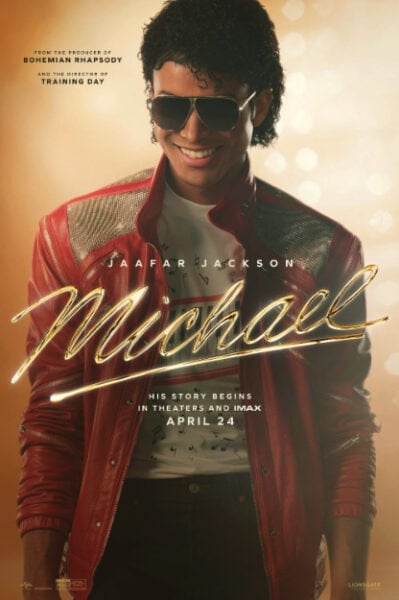
For almost a year, my daughter has been counting down the days to the Michael Jackson biopic. Unlike most people, I am not ashamed to admit that she inherited her love for Michael Jackson from her parents. And so it was with great anticipation that we attended the opening night of the biopic Michael.
I would like to think that I’m a very objective person when it comes to movies. While my family detested the Bruce Springsteen biopic, I could see the artist in Springsteen shining through – although it was a bit underwhelming if you had come to hear his music.
Michael was more in keeping with conventional biopics of musicians. And I must add it was wonderful to watch this movie in an Imax theatre. The music coursed through your very body. And I have to admit that not even a third of the way through the movie, I started crying. Not because of any memory. But the music. As I was a singer in my youth, the music touched my soul. And when the movie ended, tears were rolling down my cheeks. Both my cheeks. My daughter was most amused at my tears, especially since I had banned her from playing Michael Jackson in my car. Hearing a single Michael Jackson CD repeatedly on a 10-hour journey will do that to the most ardent Michael Jackson supporter.
But it was the song “I’ll be there” that opened the floodgates for me. To hear that angelic voice sing this song, especially if you know a thing or two about singing – you have to have not a musical bone in your body not to marvel at this song.
After the movie, the excitement in the air was palpable. One boy, no more than six years old, and his father were dressed up as if they were attending an opera. The MJ fans came out of the closet and were in their glitterati apparel, doing the trademark Michael Jackson kick.
I told my wife and daughter that it was one of the greatest musical biopics I had ever seen. Imagine my surprise, then, when I got home and checked up what the reaction had been to the movie:
Why the Michael Jackson movie is flopping.
Michael is a not-so-regal biopic.
Michael Jackson biopic is bad, is bad, you know it.
Michael opened to a 27% critic score on Rotten Tomatoes.
My first reaction was: Is the name Rotten Tomatoes a reflection of the movie or the reviewer? After a performance like that by Jaafar Jackson, and you can score it at only 27%, you’ve never sung in your life, my friend. Or should I say enemy!
We all knew what the criticism would be. That the movie was a whitewash. That the movie was a hagiography of Michael Jackson and never addressed his child molestation charges.
And so, I decided for the first time in my life to investigate why people think Michael Jackson was guilty when no court of law ever found him guilty. I must admit that a part of me feared he was guilty, and for years I had stayed away from all the allegations.
But on this day, 24 April, I decided to go out in search of the evidence. And what I found shocked me to my core. It is so unbelievable that I feel I must preface my views by giving a bit of background of the journalist whose article I am using to assess whether Michael Jackson was a paedophile. Because there are just too many untruths told about Michael Jackson, even by his fans.
Charles Thomson investigates crime and corruption for Newsquest. He is a four-time Weekly Reporter of the Year and two-time Crime and Investigative Reporter of the Year at the Regional Press Awards.
His years-long investigation into an Essex paedophile ring exposed a notorious child abuser as a secret police informant. Along the way, he became the first UK journalist to obtain deceased offenders’ criminal records under Freedom of Information. The stories won the Ray Fitzwalter Award and were shortlisted for the Paul Foot Award.
His investigation into Jason Moore’s murder conviction unearthed new evidence, now the basis of an appeal bid.
In an article titled “One of the most shameful episodes in journalistic history”, the following is what Charles Thomson had to say. And because it is so beautifully written, and written by such a highly regarded investigative journalist, I am going to rely almost exclusively on his article – so that you do not think I am making this all up. In his introduction, Thomson states the following:
It was five years ago today that 12 jurors unanimously acquitted Michael Jackson on various charges of child molestation, conspiracy and providing alcohol to a minor. It is difficult to know how history will remember the Michael Jackson trial. Perhaps as the epitome of Western celebrity obsession. Perhaps as a 21st century lynching. Personally, I think it will be remembered as one of the most shameful episodes in journalistic history.
Naturally, my interest was piqued, and what I uncovered will shock the world and shame everyone who calls themselves a journalist.
Looking back on the Michael Jackson trial, I see a media out of control. The sheer amount of propaganda, bias, distortion and misinformation is almost beyond comprehension. Reading the court transcripts and comparing them with the newspaper cuttings, the trial that was relayed to us didn’t even resemble the trial that was going on inside the courtroom.
In the following article, I will highlight some of the most damning evidence against world media. Let it be stated from the outset: Thomson’s statements have never been refuted. Thomson has never been sued by these powerful media houses who don’t need an excuse to litigate. Everything he says comes from court transcripts:
The transcripts show an endless parade of seedy prosecution witnesses perjuring themselves on an almost hourly basis and crumbling under cross-examination. But the newspaper cuttings and the TV news clips simply detail day after day of heinous accusations and lurid innuendo.
Fear not, all you doubters. I will speak the truth and shame the devil, albeit as a ventriloquist for Charles Thomson, who deserves to be heard by a wider audience.
All three major networks immediately set about producing hour-long specials on the Jackson case, apparently undeterred by the fact that nothing was yet known about the allegations and prosecutors weren’t answering questions. CBS dedicated an episode of 48 Hours to the arrest, while NBC’s Dateline and ABC’s 20/20 also rushed out Jackson specials. Within two days of the Neverland raid, and before Jackson had even been arrested, VH1 announced a half-hour documentary called Michael Jackson sex scandal.
Thomson quotes Daily Variety, describing the Jackson story as a “godsend for … media outlets … looking to pump up Nielsen numbers”. Within days, viewership figures had shot up by 8-10% for all the major broadcasters like Entertainment Tonight, Celebrity Justice and Access Hollywood.
Newspapers reacted just as hysterically, according to Thomson. The New York Daily Times ran with the headline “Sicko”. This, even before Michael Jackson had been charged. The Sun, one of Britain’s newspapers, tried to outsmart their American counterparts and ran the heading “He’s bad, he’s dangerous, he’s history”. Clearly, these were not journalists who had watched the ending of Beauty and the Beast or read JM Coetzee’s Foe. “The piece branded Jackson an ‘ex-black ex-superstar’, a ‘freak’ and a ‘twisted individual’ and called for his children to be taken into care.”
But let’s get to the actual court case. This is what Thomson has to say. Twelve years later, none of the people Thomson lambasts has ever asked him to retract his statements. The following pertains to district attorney Tom Sneddon:
- For instance, when the DA found out about two taped interviews in which the entire Arvizo family sang Jackson’s praises and denied any abuse, he suddenly introduced a conspiracy charge and claimed they’d been kidnapped, held at Jackson’s ranch and forced to lie against their will.
- In a similar incident, Jackson’s lawyer Mark Geragos appeared on NBC in January 2004 and announced that the singer had a “concrete, iron-clad alibi” for the dates on the charge sheet. By the time Jackson was re-arraigned in April, on an indictment that now included the conspiracy charge, the dates on all the previous charges had been shifted by almost two weeks. Jackson’s alibi was no more.
- Further egregious conduct came to light when Sneddon was later caught seemingly trying to plant fingerprint evidence against Jackson during the grand jury proceedings. Defence documents accused Sneddon of allowing accuser Gavin Arvizo to handle adult magazines during his grand jury questioning – before they were bagged up and sent away for fingerprint analysis.
However, this behaviour was not limited to a district attorney, who was also the man who had failed to prove sexual allegations charges in the first such case in 1993. Thomson tells of the despicable behaviour of a court reporter:
- For example, CourtTV reporter Diane Dimond appeared on Larry King Live days after Jackson’s arrest and spoke repeatedly about a “stack of love letters” the star had supposedly written to Gavin Arvizo.
“Does anyone here … know of the existence of these letters?” asked King.
“Absolutely,” Dimond replied. “I do. I absolutely know of their existence!”
“Diane, have you read them?” asked King.
“No, I have not read them,” she replied.
Dimond admitted that she’d never even seen the letters, let alone read them, but said she knew about them from “high law enforcement sources”.
But those love letters never materialised. When Dimond said she “absolutely knew” of their existence, she was basing her comments solely on the words of police sources. At best, the police sources had been parroting the Arvizos’ allegations in good faith. At worst, they’d concocted the story themselves to sully Jackson’s name. Either way, the story went around the world with not a shred of evidence to support it.
Thomson goes on to say that an entire year lapsed from the time the story broke till the court case began. He makes the interesting and valid point that the sheer volume and frequency of stories connecting Jackson to ugly sexual abuse, coupled with his inability to refute them, had a devastating effect on the star’s public image.
What does Thomson mean by Jackson’s “inability to refute them”? What most people don’t know is that there was a “gag order” on Michael Jackson, and so he could not speak up to refute these allegations. The gag order came from the presiding judge and applied to the defence as well as the prosecution. However, Thomson details in his article how the prosecution would surreptitiously leak information to the press, with Michael Jackson powerless to counter these allegations.
- As the trial kicked into gear, it quickly became apparent that the case was full of holes. The prosecution’s only physical “evidence” was a stack of heterosexual porn magazines – whose existence was explained by claiming he must have owned them for the purpose of showing them to children – and a couple of normal, legal art books, still on sale in shops all over the country, featuring homoerotic images or nude portraits.
Thomas Mesereau – who had replaced Geragos as lead defence attorney not long after the alibi incident – wrote in a court motion: “The effort to try Mr Jackson for having one of the largest private libraries in the world is alarming. Not since the dark day of almost three quarters of a century ago has anyone witnessed a prosecution which claimed that the possession of books by well-known artists was evidence of a crime against the state.”
- During cross-examination, Mesereau showed the boy (Star Arvizo, brother of Gavin Arvizo) a copy of Barely legal and repeatedly asked if it was the specific edition Jackson had shown him and his brother. The boy insisted again and again that it was, only for Mesereau to reveal that it had been published in August 2003, five months after the Arvizo family had left Neverland.
- When Gavin Arvizo took the stand, he claimed that Jackson had instigated the first act of molestation by telling him that all boys had to masturbate or else they would turn into rapists. But Mesereau showed under cross-examination that the boy had previously admitted his grandmother made that comment, not Jackson, meaning that the whole “grooming” story was predicated on a lie.
- In an April 2005 interview with Matt Drudge, Fox columnist Roger Friedman explained, “What’s not reported is that the cross-examination of these witnesses is usually fatal to them.”
He added that whenever anybody said anything salacious or dramatic about Jackson, the media “went running outside to report on it” and missed the subsequent cross-examination.
Drudge agreed, adding, “You’re not hearing how witness after witness is disintegrating on the stand. There is not one witness, at least lately, that hasn’t admitted to perjuring themselves in previous proceedings either in this case or in some other case.”
This alarming trend of ignoring cross-examination was perhaps most apparent in the media’s coverage of Kiki Fournier’s testimony. The Neverland housekeeper testified that when at Neverland children often became unruly, and she had sometimes seen children so hyperactive that, yes, they could theoretically, she supposed – when the specific word was put to her by prosecutors – have been “intoxicated”.
Journalists scurried outside to report this apparent bombshell and missed some of the most significant testimony of the entire trial.
Under cross-examination by Mesereau, Fournier said that during the Arvizo family’s final weeks at Neverland – the period during which the molestation supposedly happened – the two boys’ guest room had been constantly messy, leading her to believe they’d been sleeping in their own quarters all along – not Michael Jackson’s bedroom.
According to Charles Thomson, in what I consider to be one of the most truthful summaries of the Michael Jackson 2005 trial:
But this information went almost entirely unreported, the media focusing on the boy’s allegations rather than the cross-examination which undermined them. Allegations make good soundbites. Complex cross-examination does not.
- The case of Jason Francia, son of Michael Jackson’s maid, is another important matter showing media bias. The media reported that this molestation predated the Jordy Chandler case, thus planting the seed in the minds of the public that Jackson was a serial paedophile. What Charles Thomson shows is that these allegations were actually made after the Chandler case. And that his mother Blanca Francia promptly then sold her story of the alleged molestation for $20 000 to Hard copy for an interview with Diane Dimond, whom we met earlier in the case of making up stories about “love letters” on the Larry King show.
This is what Thomson says about Jason Francia’s testimony:
The fourth “victim”, Jason Francia, took the stand and claimed that when he was a child, Jackson had molested him on three separate occasions. Pushed for details of the “molestation”, he said Jackson had tickled him three times outside his clothes and he’d needed years of therapy to get over it. Jurors were seen rolling their eyes …. Transcripts from police interviews showed Francia had repeatedly changed his story and had originally insisted that he’d never been molested. They also showed that he only said he was molested after police officers repeatedly overstepped the mark during interviews.
Officers repeatedly referred to Jackson as a “molester”. On one occasion, they told the boy that Jackson was molesting Macauley Culkin as they spoke, claiming that the only way they could rescue Culkin was if Francia told them he’d been sexually abused by the star.
Transcripts also showed that Francia had previously said of the police, “They made me come up with stuff. They kept pushing. I wanted to hit them in the head.”
How shocking is this? And yet, it is most common. How many times have police tortured victims, physically and mentally, to get a “confession” out of them?
Commenting on the media bias after both sides had rested, this is what Charles Thomson had to say:
When both sides rested, jurors were told that if they found reasonable doubt, they had to acquit. Anybody who had been paying attention to proceedings could see that the doubt was so far beyond reasonable it wasn’t even funny. Almost every single prosecution witness either perjured themselves or wound up helping the defence. There wasn’t a shred of evidence connecting Jackson to any crime, and there wasn’t a single credible witness connecting him to a crime either.
But that didn’t stop journalists and pundits from predicting guilty verdicts. Defence attorney Robert Shapiro, who had once represented the Chandler family, stated with certainty on CNN, “He’s going to be convicted.” Ex-prosecutor Wendy Murphy told Fox News, “There is no question we will see convictions here.” When the jury delivered 14 unanimous not-guilty verdicts, the media was “humiliated”, Mesereau (Jackson’s lawyer) said in a subsequent interview.
Media analyst Tim Rutten later commented, “So, what happened when Jackson was acquitted on all counts? Red faces? Second thoughts? A little soul-searching, perhaps? Maybe one expression of regret for the rush to judgment? Naaawww. The reaction, instead, was rage liberally laced with contempt and the odd puzzled expression. Its targets were the jurors. … Hell hath no fury like a cable anchor held up for scorn.”
Despite the all-round unreliable testimony of the witnesses, the media believed that the jurors had been seduced by Michael Jackson’s fame. Thomson summarises how the media continued to round on an innocent Michael Jackson like a pack of hounds. It is worth quoting Thomson in totality, where he summarises all the major media houses’ responses:
Grace (of CourtTV) later stated that Jackson was “not guilty by reason of celebrity” and was seen attempting to hound jury foreman Paul Rodriguez into saying he believed Jackson had molested children. One of Grace’s guests, psychoanalyst Bethany Marshall, levelled personal attacks towards one female juror, saying, “This is a woman who has no life.”
Over on Fox News, Wendy Murphy branded Jackson “the Teflon molester” and said that the jurors needed IQ tests.
She later added, “I really think it’s the celebrity factor, not the evidence. I don’t think the jurors even understand how influenced they were by who Michael Jackson is. … They basically put targets on the backs of all, especially highly vulnerable, kids that will now come into Michael Jackson’s life.”
Legal analyst Jeffrey Toobin claimed on CNN that the “prior bad acts” testimony had been “effective evidence”. He also claimed that the defence had won because “they could tell a story, and juries, you know, always understand stories rather than, sort of, individual facts”.
The following day on Good Morning America, Diane Sawyer reinforced the notion that the verdict had been influenced by Jackson’s celebrity status:
“Are you sure?” she pleaded with the jurors in an interview. “Are you sure that this gigantically renowned guy walking into the room had no influence at all?”
The Washington Post commented, “An acquittal doesn’t clear his name; it only muddies the water.” Both the New York Post and the New York Daily News ran with the snide headline “Boy, oh, boy!”
In her final New York Post article about the trial, Diane Dimond bemoaned the not-guilty verdict, saying that it left Michael Jackson untouchable.
She wrote, “He walked out of court a free man, not guilty on all counts. But Michael Jackson is so much more than free. He now has carte blanche to live his life any way he wants, with whomever he wants, because who would ever try to prosecute Michael Jackson now?”
Thomson goes on to draw the links between this trial by public opinion with the mainstream media acting for the prosecution and ultimately Michael Jackson’s death:
The story was over. There were no apologies and no retractions. There was no scrutiny – no inquiries or investigations. Nobody was held to account for what was done to Michael Jackson. The media was content to let people go on believing its heavily skewed and borderline fictitious account of the trial. That was that.
When Michael Jackson died, the media went into overdrive again. What drug had killed him? How long had he been using it? Who had prescribed it? What else was in his system? How much did he weigh?
But there was one question nobody seemed to want to ask: Why?
Why was Michael Jackson so stressed and so paranoid that he couldn’t even get a decent night’s sleep unless somebody stuck a tube full of anaesthetic into his arm? Perhaps the answer can be found in the results of various polls conducted in the wake of his trial.
A poll conducted by Gallup in the hours after the verdict showed that 54% of white Americans and 48% of the overall population disagreed with the jury’s decision of “not guilty”. The poll also found that 62% of people felt Jackson’s celebrity status was instrumental in the verdicts. 34% said they were “saddened” by the verdict and 24% said they were “outraged”. In a Fox News poll, 37% of voters said the verdict was “wrong”, while an additional 25% said “celebrities buy justice”. A poll by People Weekly found that a staggering 88% of readers disagreed with the jury’s decision.
The media did a number on its audience, and it did a number on Jackson. After battling his way through an exhausting and horrifying trial, Jackson should have felt vindicated. He was legally entitled to feel vindicated.
But the media’s irresponsible coverage made it impossible for Jackson ever to feel truly vindicated. The legal system may have declared him innocent, but the public, on the whole, still thought otherwise. Allegations disproven in court went unchallenged in the press. Shaky testimony was presented as fact. The defence’s case was all but ignored.
When asked about those who doubted the verdicts, the jury replied, “They didn’t see what we saw.”
They’re right. We didn’t. But we should have. And those who refused to tell us remain in their jobs unchecked, unpunished and free to do exactly the same thing to somebody else.
Now, that’s what I call injustice.
Based on the above, I have no doubt that I will be attacked from all sides. I will be labelled an apologist for Michael Jackson. For condoning the rape of young boys. But when faced with evidence that the media refuses to comment on? For example, in a prior lawsuit for $152 000, which Janet Arvizo received from a certain JC Penney Store, in which the father was accused of theft of school uniforms, Janet Arvizo claimed that their entire family was assaulted by security guards at the store. She later added a charge that she had also been sexually assaulted by the guards. However, a paralegal in the law firm who represented Janet Arvizo testified that Janet admitted that the bruises shown in court photos were actually caused by her own husband, David, and not the security guards. There are only two conclusions that can be drawn: that her husband beat her a day or two after the theft, or that she got him to beat her so that her body would be bruised, so that she could extort money from the store. If you think I am being harsh, note that mugshots taken at her arrest showed no bruising.
Most damning was the testimony that the Arvizo boys – the same boys who accused Michael Jackson of sexual molestation – had, in this case, been enrolled in acting classes prior to the settlement. This, the defence argued, had been to help them and coach them “to get their story straight”.
Furthermore, after Jackson’s death, the FBI was forced to disclose what information they had on Michael Jackson over nearly two decades. In a report of over 330 pages, they found not an iota of proof that suggested that Michael Jackson was a paedophile. However, the last word must go to Charles Thomson.
So, every single person who accuses Michael Jackson subsequently goes straight to a civil lawyer and tries to sue him. There is never an accuser who simply walks into a police station and says, “Michael Jackson molested me; what are you going to do about it?” They always go to a lawyer and say, “Let’s get rich!”
The day you start making that excuse for victims and saying, well, we have to believe them anyway because it’s probably just trauma – we have to believe them anyway; well, that is the death of justice! Justice does not exist anymore! The day you start saying it doesn’t matter if an accuser has all their facts wrong and is proven to be telling a story that can’t be true, we should just convict the person anyway because it’s just trauma – that basically means that no innocent person can ever be acquitted again!
After poring through pages and pages of viewpoints and evidence, I am of the firm conviction that we have wronged the greatest artist to have ever walked this earth.
If the media is baying for a film on the sexual molestation charges, I say let’s make a film about the kangaroo court that was and still is the media of today. The same industry that no one trusts any longer because of all the fake news they spread. Yet, people are only too willing to accept the one-sided reporting in the Michael Jackson saga. I believe that the media must be put on trial alongside Michael Jackson in part two of a biopic. Michael Jackson tried to warn us all those years ago, through his music, of the dangers of the media:
Just because you read it in a magazine
Or see it on the TV screen
Don’t make it factual
Though everybody wants to read all about it
Just because you read it in a magazine
Or see it on the TV screen
Don’t make it factual, actual
They say he’s homosexual
If I were the film director, I would shine a light on cheque book journalism. Cheque book litigation. I, for one, implore filmmakers to go ahead with the part two of Michael that the critics and the public are baying for. And I have just the title: Wanna be starting somethin’.
In my heart of hearts, I pray that the words of Martin Luther King ultimately come to define the legacy of the greatest musical artist who ever walked the earth: “The arc of the moral universe is long, but it bends toward justice.”