

Photo by William Hook on Unsplash
...
In other words, more sunlight, or solar radiation, is reaching the earth’s surface. But when it attempts to leave the earth, it is prevented from doing so by the blanket of greenhouse gas emissions that we are all trying to get rid of. We are too hot in bed and need to throw off the blanket.
...
Ever wonder why thinly inhabited parts of the world, like the Karoo, for example, are so much hotter and have more sunshine than built-up industrial city areas? The answer apparently lies in the cleaner air of these remote places. And today, you can find similarly clean air across many populated areas as well – and with similar consequences.
The whole of Europe, including the UK, is currently experiencing record-breaking summer heat, with temperatures over 40 degrees in some parts. According to experts, this heatwave is the result of European countries cleaning their air, a phenomenon known as the “climate paradox”.
One might have thought the European success in having scrubbed their atmosphere over the past 50 years would be a cause for celebration. Instead, thousands of people are, or will soon be, dying prematurely as a result, unless cooler weather returns soon.
France has been worst affected, as it was in 2003, the first time such high temperatures were recorded this century. I remember it well, since we were on a family holiday in Provence at the time, and fled the heat for cooler climes in the Swiss Alps, along with many other hot weather refugees. It was a shocking wake-up call for the continent: There were over-crowded hospitals, and mortuaries were ill-equipped to receive so many bodies at the same time – refrigeration lorries were deployed to act as temporary morgues.
Why were there so many deaths? Well, one answer provided was that the normal human core temperature is 36 degrees; and placed under stress by hot weather, the body forced the heart to work much harder than it normally would. For older people, this can often prove lethal.
The success of the Europeans in cutting air pollution has ironically amplified global warming because of the accompanying reduction in aerosols, such as sulphur dioxide. Since the dawn of the Industrial Revolution, sulphates and other minute particles from factory chimneys have been reflecting sunlight back into space. These particles act like a mirror, providing a kind of cooling shield from radiation. But now, in an unintended consequence of clean air guidelines, the cooling shield has been removed.
Of course, the clean air policies were designed to save lives, and in the same way that the campaign against tobacco has largely succeeded, so have thousands of lives been saved from highly toxic aerosol emissions. But the result has also led to this unanticipated paradox: Hotter weather is negating the hoped for outcomes of global efforts to reduce greenhouse emissions at the farming and industrial level.
Greenhouse gas emissions are different. They act like a blanket in the atmosphere, made up of so-called “heat-trapping” gases. The most important of these are carbon dioxide (CO2), methane, nitrous oxide, fluorinated gases and water vapour. Carbon dioxide is the one we read about most often, and involves three quarters of all emissions. Burning any kind of fossil fuel (coal, oil and wood are good examples) releases carbon dioxide. The European-wide shutdown of most coal- and oil-fired electricity plants since 1970 has dramatically reduced carbon dioxide output.
Methane gas comes from human and animal digestion, landfills and some coal/oil production. Nitrous oxide is produced through the use of synthetic fertilisers and other industrial and agricultural activities, for example, wastewater treatment. Fluorinated gases are man-made gases used in the fields of cooling, refrigeration, manufacturing and electronics.
Water vapour is naturally occurring. It is the largest greenhouse gas which regulates temperature, but man-made warming leads to more water vapour in the atmosphere than would otherwise be the case. This magnifies the heating effect.
Aerosols (like sulphur dioxide), on the other hand, reflect sunlight back into space. By scrubbing these particles out of the sky to improve air quality, Europe has accidentally allowed much more solar radiation to reach the surface of the earth, adding an additional warming effect to that already caused by greenhouse gas emissions. In other words, more sunlight, or solar radiation, is reaching the earth’s surface. But when it attempts to leave the earth, it is prevented from doing so by the blanket of greenhouse gas emissions that we are all trying to get rid of. We are too hot in bed and need to throw off the blanket.
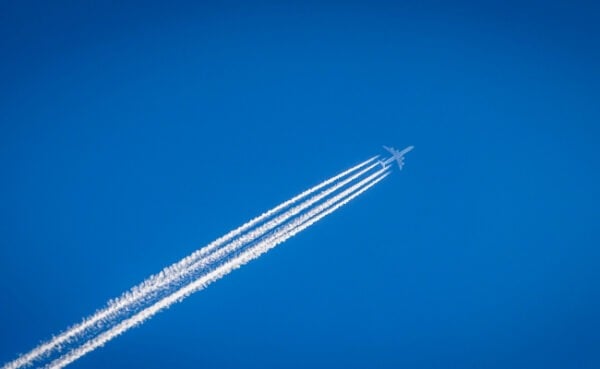
The implications of this two-pronged assault on carbon dioxide greenhouse gas reduction efforts on the one hand, and air quality improvements on the other – the one seeming to cancel out and contradict the beneficial effects of the other – will likely be far-reaching. The immediate response has been calls to curb the use of passenger jets. Global tourism has massively increased since the lockdown six years ago, and you only have to glance up at the sky to see dozens of jets and their vapour trails.
...
The aviation industry has been astonishingly free of the pressures that other industries, including agriculture, have faced to clean up their act and produce sustainable products – in other words, to reduce their carbon footprint.
...
The aviation industry has been astonishingly free of the pressures that other industries, including agriculture, have faced to clean up their act and produce sustainable products – in other words, to reduce their carbon footprint. There are now plenty of certifiable environmental standards that the soy, cotton, sugar, palm oil, beef and wine industries, among a host of others, are tested against. Steel and other manufacturing firms are likewise confined to green sustainable policies, which can be very expensive to implement. But these industries are now vocal in demanding more regulation of aviation.
Only aviation is relatively free of climate restrictions, because it’s too much of a political hot potato. But jet aircraft emit carbon dioxide in enormous quantities – about three kilograms of carbon dioxide for every one kilogram of fuel consumed. As it is released into the upper atmosphere, the warming effects are magnified.
Jets also emit water vapour in huge amounts as fuel is burned. In the upper atmosphere, water vapour’s effects are also greatly magnified compared with what they would be on the surface below. But even more dangerous is the nitrogen oxides produced by jets, interacting with sunlight at higher altitudes to produce something called tropospheric ozone (O3), a significant greenhouse gas. Finally, contrails of water vapour and exhaust gases from the jet engines act as artificial clouds, which also trap heat from the earth’s surface and prevent it from escaping into space.
If more measurable solar radiation hits the earth than is allowed out in the form of thermal radiation, then one can expect strong steps to be taken by the countries most affected. If the aviation industry is forced to cut its wings, so to speak, by the green lobby and by way of higher taxes imposed by concerned governments, then world tourism will decline as flights become fewer and much more expensive. Airports will cut back on expansion and investment, and fewer people will invest in second homes abroad, as getting there would become more difficult and expensive. There are many such parts of the world that could be affected, as the planet goes into overdrive to accelerate measures to reduce climate change-induced heatwaves. An emergency may be at hand, and taxes are a convenient bandage for the authorities, close at hand.
Cape Town is an interesting example of a city that may soon be affected. Some one third of recent Atlantic Seaboard property acquisitions in places like Camps Bay, Sea Point and Clifton were purchased by foreigners. These properties are worth billions. Many of them are also effectively second homes. The possibility is that, just as in countries like France, Italy, Spain and the UK, the South African government will impose additional empty home taxes on these properties – money that (theoretically, at least!) is ringfenced to provide services to less well-off families.
In Cape Town, this may coincide with the Constitutional Court’s ruling which has placed local government under a constitutional obligation to advance affordable housing in well-located areas, including the Atlantic Seaboard. Either way, the climate crisis and mass jet travel – which looks like it could be coming to an end – provides a straw in the wind.
Such extra taxes have already discouraged many from buying second homes in large parts of Wales, London and elsewhere in the UK. In some cases, there has been a 300% tax increase. Taxes have also been imposed on tourists, and the effect has been to discourage travel – including flying. Tourist taxes are now the norm in many countries and only add to the cost of travelling.
But there is going to be an even bigger environmental stick soon – the United Nations General Assembly recently voted to approve an environmental proposal which would mean developed countries (by definition more polluting in terms of greenhouse gas emissions) compensating developing countries for the damaging effect of high temperatures. Although unlikely to be acted on by developed countries for various legal reasons, it inevitably tightens their focus on those areas – like aviation and possibly shipping, including the running of cruise liners – whose contribution to global warming is now out of step with most other industries. The Renewable Energy Directive (RAD) of the European Union may also be revisited in order to seek greater overall compliance with the objectives of the European Environment Agency.
So, who knows – the golden era of mass air travel may soon come to an end in hopes that it will usher in a period of cooler weather. The jury is still out on this, but at least we can possibly begin to imagine the kind of climate that our forebears knew 400 years ago, before smokestacks and the internal combustion engine.
- For readers interested in exploring the climate paradox in greater detail, I can recommend Eumetsat. Just click on this link: more-sunshine-in-europe-due-to-cleaner-air
See also:
Uitdagings van die Antroposeen: onderwys in die era van ’n mensgemaakte wêreld
Kommentaar
Ek sou graag wou sien watter bronne vir die doeleindes van hierdie artikel gebruik is en wat die kwaliteit van die bronne is. Is die Karoo dalk bloot warmer weens verskeie geografiese/geomorfologiese faktore soos oa hoogte bo seespieël, relatief min plantegroei en die voorkoms van beperkte wolkvorming? Skoner lug oor die Karoo kan moontlik effens meer sonlig toelaat om die oppervlak te bereik, maar dit is waarskynlik slegs een van ń reeks oorsaaklike faktore.