

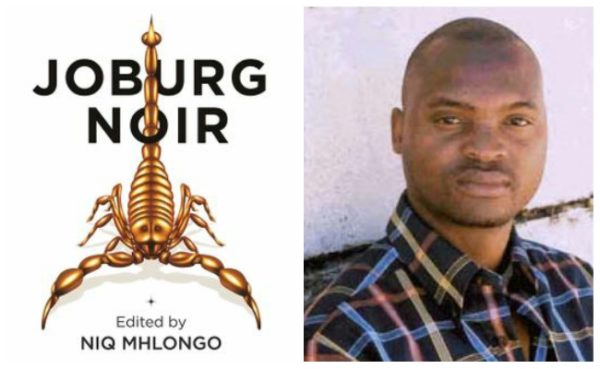
Photo of Niq Mhlongo: LitNet
Joburg noir
Edited by Niq Mhlongo (2020)
Jacana Media
https://jacana.co.za/
This reader impression was written and sent to LitNet on the writer’s own initiative.
In a world consumed by the ravages of COVID-19 and the unfolding drama of the US presidential election, Joburg noir, edited by Niq Mhlongo (2020), is a welcome relief from the overwhelming and dispiriting headlines clogging international and local media. Even more welcoming are the pleasure, treasures and insights that the short stories offer through the selection of young and established authors constituting this new collection of modern South African writing.
While neither Johannesburg nor any other African city features in The world’s most written about cities,[i] it is no conjecture that Johannesburg is the most written about city in Africa. An example is a compelling special edition of Public Culture edited by Achille Mbembe and Sarah Nuttall (2004).[ii] This special edition, according to Mbembe and Nuttall, "is, and is not, about Africa. It is, and is not, about Johannesburg".[iii] And, like Joburg noir, "[i]t is an exercise in writing the worldliness – or the being-in-the-world – of contemporary African life forms"[iv] in Johannesburg. Citing Amin and Thrift’s Cities: Reimagining the urban (2002), Mbembe and Nuttall note that "[i]ndeed, a city is not simply a string of infrastructures, technologies, and legal entities, however networked these are. It also comprises actual people, images and architectural forms, footprints and memories; the city is a place of manifold rhythms, a world of sounds, private freedom, pleasures, and sensations."[v]
Joburg noir is a collection of 20 short stories ranging between seven and twelve pages long, from native writers from immigrant parents and/or grandparents, to new African immigrants from across the northern borders of our country. These stories tell of urban legends and myths ("Feasting"), love lost and found ("The waste picker", "Nineteen questions") and wrestling with introspection, self-awareness, sensitivity, identity and the search for meaning through human contact, regardless of one’s station in life ("Obedient dog", "Joburg hustlers", "Dreams and other deceptions"). They also deal with coming of age, losing your innocence and finding yourself ("Mud", "Spit and polish", "Finda finda", "Moonlight sonata"); reckoning with hypocrisy and questionable faith ("Johustlerburg prison cell", "Jozi is calling"); corruption in the church, government and business ("Man of God", "Weep for me, Willow", "The airport project"); crime, drugs and redemption ("The unauthorised biography slow flow", "Three strangers", "Like a cocked pistol"); culture, music, cuisine and art ("A little something from the pot", "Yeoville"); and a futuristic treatment of an old notion that the reason for the city’s existence will also be its demise ("The return").
While the majority of the stories in this collection treat specific experiences and concerns about life in Joburg, "A little something from the pot" and "Yeoville" come close to rising to the challenge raised by Mbembe and Nuttall concerning writing about Africa and Johannesburg, which is to depart from the practice of reducing the legibility of the city to "an experience of the pathological and of the abnormal".[vi]
"A little something from the pot" is written by Gloria Bosman, the multi-award-winning South African jazz musician. Her contribution to Joburg noir shows her to be a literary virtuoso and master storyteller. Her abiding metaphor of a pot which she is preparing and sharing with the reader resonates deeply with the African notion of "feeding one’s soul" and the melting pot that Johannesburg is to all and sundry. It also conjures up the image of jazz, its continuous evolution through synthesis and improvisation, augmented by new, exciting, intoxicating and unexpected evocations of memory, movement, experience and sound, conjoined by a melody that keeps it all moving toward a crescendo. The tempo and energy of her synthesis of the complex metaphor, from old roots in Sophiatown, to Soweto, Berea, Hillbrow and Yeoville, allude to the jazzy headiness of the city, its landscape and the souls that wander and populate its streets, high-rises, shebeens, churches and back yards. Here is a lyrical manifestation of a city rich in tradition, trauma and triumph!
Having risen in the middle of nowhere to become one of the greatest metropolises on the African continent – imagined, entreated and canonised through music, song and dance – Joburg is now reborn lyrically through storying by Bosman in letters as well. What a magnificent encapsulation of the racy, treacherous and marvellous soul of a brilliant and deviant city. Through her music and now her word, Bosman has become a true chronicler of the soul of the City of Gold. She captures not only the glitter and charm of the city and its inhabitants – the perpetual immigrants – but also the sharp edges and dark shadows each contour offers and hides. Her exposition is a lyrical rendition of the city in words that reveal a remarkable artist born and raised in the sun, sound, rain and thunder of the city, as perhaps only an attuned musical poet can imagine and articulate.
"Yeoville" by Sam Mathe is a portrait of the brilliance which immigrants have brought to the city, enriching its diversity and vibrancy while also eroding its stability, ushering in its degeneration. It also portends the dangers lurking in unchecked and unplanned transitions that can leave a vibrant city bereft of all its wonders and plundered by fear, opportunity and insecurity.
Ordering the stories differently might have provided a better geospatial navigation of the themes and contents. The collection could have, for example, opened with Bosman’s story, which is expansive, overarching and multifarious, and concluded with "Yeoville", which focuses on a specific part of the city with extraordinary focus, detail and contextual texture.
Joburg noir is a present-day attempt to capture and reflect the people, images, architectural forms, footprints, aspirations, fears, dreams, cuisine, culture and memories of the City of Gold in contemporary times and for the modern reader. Joburg noir rages with the pulse, anxiety, uncertainties and dogged conviction characteristic of Johannesburg over the years. It is, in the final analysis, a window into the modern-day experiences of the age-old and enduring immigrant character and nature of this magnificent African metropolis. Harkening back to Max Ehrmann’s Desiderata, with all its shams, drudgery and broken dreams, "it is still a beautiful world".[vii] As Joburg noir reminds us, Joburg’s beauty, hopes and aspirations are found in its continuously evolving physical and metaphysical spaces, diverse cuisine, music and people. If you want a glimpse of modern-day Johannesburg, then – notwithstanding the regrettable lack of rigour in the editing of the text apparent in the first few stories – you would do well to read Joburg noir and hear the voices of this city’s children from all over South Africa, Africa and the world.
[i] https://www.dwh.co.uk/advice-and-inspiration/the-worlds-most-written-about-cities/
[ii] Mbembe, JA and Nuttall, S (2004). "Writing the world from an African metropolis". Public Culture. Volume 16, Number 3, Fall 2004, pp 347–72.
[iii] Mbembe, JA and Nuttall, S (2004). "Writing the world from an African metropolis". Public Culture. Volume 16, Number 3, Fall 2004, p 348.
[iv] Mbembe, JA and Nuttall, S (2004). "Writing the world from an African metropolis". Public Culture. Volume 16, Number 3, Fall 2004, p 348.
[v] Mbembe, JA and Nuttall, S (2004). "Writing the world from an African metropolis". Public Culture. Volume 16, Number 3, Fall 2004, p 360.
[vi] Mbembe, AJ and Nuttall, S (2004). "Writing the world from an African metropolis", Public Culture, Volume 16, Number 3, Fall 2004, p 354.
[vii] Ehrmann, M (1927). Desiderata. https://www.desiderata.com/max-ehrmann.html.
