

 |
|
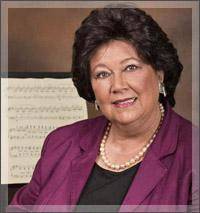
Jeanne Zaidel-Rudolph (Source: jeannezaidel-rudolph.com)
|
 |
|
Stefans Grové (Source: SA Composers)
|
My Teacher, My Mentor, My Friend! Stefans Grové’s loss to the music world is enormous. Much has been written on his prolific oeuvre by students analysing selected works from the large body of his musical output and by instrumentalists who have performed his compositions; particularly in relation to his works incorporating African elements. It is the man, his approach to composing and teaching to which I would like to pay tribute.
Grové embodied a Daliesque kind of eccentricity and charm, yet he was at the same time a very “proper” gentleman, with the emphasis on the “gentle” part. He was also a man of contradictory forces within himself and his music – on the one hand he displayed the calculated restraint in brooding and slow, dark passages in his chamber works, and on the other hand an ebullience and power that left one breathless. As a composer over many years, what was consistently evident in his works was his infallible craftsmanship – he was one of the few composers who found a rich equilibrium between technique and imagination and emotive musicality – he never sacrificed any of these qualities on the altar of the other. In addition, his sharp intellect always mediated and shaped those illusive mythological creatures and other-worldly African images that danced around in his verdant imagination. His creative fantasy knew no bounds – what he imagined in his glorious world of tantalising timbres and textures came alive in performance and seldom disappointed.
One of the least obvious elements that infused Grové’s music was his rich and very dry sense of humour. If one were able to penetrate the shyness of the man, one would be rewarded with the joy of his biting wit and sense of the macabre – aspects which were gloriously refreshing, both in his personality and in his music. He remained, however, largely refined and understated in his personality and presentation. One of his works that I heard as long as twenty-eight years ago at a concert at Wits University in the mid-’80s, programmed together with my Tempus Fugit, was the Quintet for harp, flute, clarinet, violin and viola (1986). I was immediately struck by the visionary quality of his music – a sonic world imagined way before its time, especially in a rather culturally isolated South Africa.
However, it was his symbiosis with indigenous African elements in his music that provided the deepest inspirational material for Grové. In his new hybrid style he left the European and American avant garde behind him after returning permanently to South Africa from the USA in 1972 and revelled in his musical rapprochement between the white and black cultures in South Africa. In his beautifully written scores he pushed the boundaries of new notational presentations, frequently presenting scores without bar lines and time signatures – simply supplying a unit of tempo, giving the performer free rein to interpret and express the inner essences of the works without metric restrictions. By the ’90s, the sound worlds he created in his works embodied the spirit and moods of Africa, not in any contrived or disrespectful way, but as an expression of his natural love of the African soil and the sonic environments which he was so tuned in to.
Stefans always had a story to tell – and he told it through his challenging musical narratives. Performing Grové’s music demands a commitment to deep study, as his work is complex and difficult technically and musically. Performers like Gerrit Jordaan and Ben Schoeman, who have invested their time and intense effort in mastering these virtuoso works, have been amply rewarded by deep musical satisfaction.
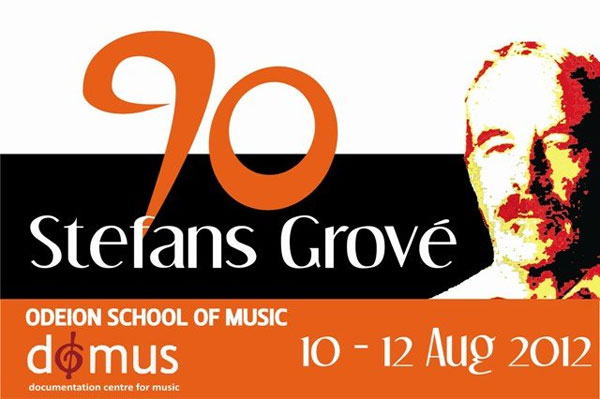
Stefans Grové did not suffer fools easily and had high expectations of his composition students. As my supervisor during my DMus studies in the mid- to late 1970s, he inspired my creativity enormously through his ability to strike exactly the right chord (pun intended) with each individual student. He taught by example – one simply had to observe his fastidious and meticulous approach to his own scores to be cognisant of the standards he expected. It was rare to receive a compliment from him – and when one did, it was like winning the lottery. He had an in-built radar to know if one had not done sufficient work, research or listening and thereby had made weak orchestration decisions which were not well enough thought out. He constantly challenged his students to use their inner ear to find balance, symmetry and optimum registers and spacing in their orchestrations. There is no doubt that as a teacher of composition he brought out the best potential in each student, but moulded each one’s craft through strict critiquing and uncompromising attention to musical detail and musical integrity – qualities which he role-modelled so well in his own work. I feel truly blessed to have been a composition student of Grové’s and I know that whatever solid composing foundation I possessed was predominantly due to his valuable investment in me.
I met the lovely Alison very soon after they had married. Going for supervisions to their erstwhile home in Hatfield (opposite the Pretoria High School for Girls, where I spent my five high school years) was always a treat – in no small measure due to Alison, who was warm and welcoming – I always enjoyed our chats. My sincerest condolences go to Alison and their children. Her dedication to Stefans, their children and his music was the catalyst to his greatness and I can unequivocally say that Alison was the very best thing that happened in his long and productive life as husband, father and much-esteemed composer!