

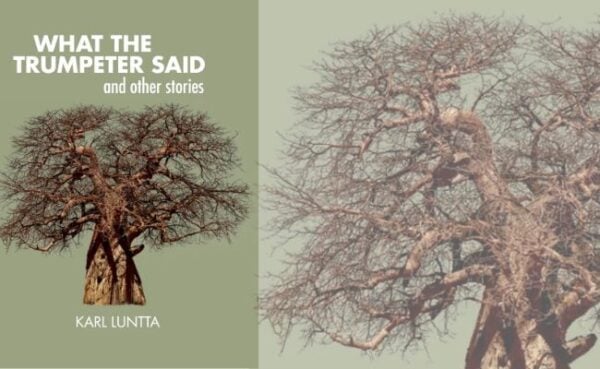
What the trumpeter said, Karl Luntta, published in South Africa by Botsotso, ISBN: ISBN: 9780639886732
- Elsibe McGuffog talks to Karl Luntta about his book What the trumpeter said and other stories.
He examined the scraped knuckles of his right hand and doused them again with hydrogen peroxide. The liquid bubbled and fizzed, raising a stinging strawberry parfait on his knuckles. He vaguely recalled that a student had snatched Mdongo’s tooth from the ground after it had left the headmaster’s mouth and arced in slow motion, tumbling through the air before it hit dust. The student no doubt still had the tooth and would later use it as a fetish – insurance against bad grades and capricious discipline. – From A virgin twice (6-25)
There is something appealing about being allowed into another country for close-up-and-personal encounters with locals, without the accompanying travel expenses. And when the visit leaves you with fascinating insights into culture and the nation’s characters, the trip was worth it. This is the benefit that I derived from reading Karl Luntta’s stories. The destination is Botswana, although there is one story set in Serbia.
There are ten tales in his collection titled What the trumpeter said and other stories (published by Botsotso in association with Catalyst Press). It’s a touching and highly readable book by the equally affable Luntta, an American who has visited Botswana and travels for work. The style of writing is standard English, the tone often humorous and hinting to British (eg, “Peter Zimunya sat next to the old man, still shaken and looking for all the world as if he were sitting on a puff adder”). Stories draw from the experiences of teachers, military men, political journalists and friends of locals. In most of the stories, the narrator (Kevin) does not share the same racial profile as his characters, and the reader benefits from this outsider-looking-in approach. The tales are beyond the everyday. These are stories you won’t glean if you are a casual tourist; you’d need to have worked there and immersed yourself in the culture. I asked Luntta a few questions.
- Could you tell me about yourself as a writer? How often do you write, and are short stories your preferred genre – or have you tried poetry, novels or others?
I have been writing for some time, having started years ago as a travel journalist and becoming author of a dozen books on travel to the Caribbean region. I was a newspaper freelancer and columnist (Cape Cod Times, Massachusetts, USA), as well as a magazine columnist (Caribbean Travel and Life). My forays into fiction started with short stories, which have been published by local and international journals.
I’ve always been a fan of short stories. They are among our oldest forms of learning and entertainment, springing from the oral storytelling traditions of the earliest humans, and I believe we (most of us, anyway) are innately predisposed to like short stories. Good stories probe the existential questions with which we’re all constantly grappling: What does it mean to be alive and to be a member of the human tribe?
I’ve also written a novel, Know it by heart (Northwestern University Press / Curbstone Press, Chicago, USA), and another collection of short stories called Swimming (SUNY Press, Albany, New York, USA).
I write daily when I’m able to – up to four hours a day, mostly in the morning. I do not write poetry – why? I admire poetry and those who write it, but I know my limits.
- I get the feeling that the stories are based on your personal experiences in Botswana. Is this so? And would you elaborate?
........
To me, all short stories start with a grain of experience and a seed of truth gleaned from something that happened to the writer. Some of the incidents and dialogue in the Trumpeter stories incorporate real(ish) events, but only to the extent that these events create a foundation on which to build a satisfying fictional world. I think fiction writers start with a question: "What if …?"
.........
To me, all short stories start with a grain of experience and a seed of truth gleaned from something that happened to the writer. Some of the incidents and dialogue in the Trumpeter stories incorporate real(ish) events, but only to the extent that these events create a foundation on which to build a satisfying fictional world. I think fiction writers start with a question: "What if …?" What if this happened, or what if such-and-such were said? You proceed to build the story by answering the questions.
- How do you think your writing about Botswana compares with that of other writers who have tried to capture the country for a foreign reader, like Alexander McCall Smith’sThe no 1 ladies’ detective agency?
I think Alexander McCall Smith is a superb writer, and I especially admire his characterisations of Botswana and the rest of southern Africa. I’m also a fan of Bessie Head, the South African writer who spent years in Botswana and wrote some of her most important works there. I wouldn’t compare my writing with theirs, but I do hope that I was more often accurate than not in my depictions of Botswana’s life and culture. Here’s the thing: A person can live in a place for years and years, even having been born there, and still not wholly understand the culture of that place. I don’t claim to capture more accuracy than anyone else, but I do look for it.
- I found it refreshing to have a man’s opinion come through in the protagonists, especially because I had respect for the characters’ views, particularly, for instance, the way the character has to navigate patriarchy in the first story. Is the worldview of the character in the first story your own worldview?
Women’s and men’s sensibilities are vastly different throughout the world, and I do think it’s an important theme to explore. What I wanted to look at in "A virgin twice" was the male dynamic in Botswana – both in men of that culture and in the American narrator, Kevin – and I would say that his worldview reflects my own. The narrator’s confusion around the incident between the female teacher and the male headmaster, and the subsequent decisions by the village kgosi, reflect my personal questions about the moral universe – what is right or wrong, and what simply is?
- If you are familiar with South Africa, what is your opinion on the difference between the two countries in terms of both settings and typical plots?
Long ago, I thought that writing fiction about South Africa would involve a heavy political component, given its history of violence, racial trauma and dissent, and a couple of stories in this collection do, in fact, involve the politics of South Africa and what was Rhodesia. Today, Botswana and the countries of southern Africa are linked by language, culture and economics, but Botswana has been and is a relatively tranquil place comparatively. So, settings and plots in Botswana and South Africa could potentially be very different, given the countries’ histories. On the other hand, what should be the same in any story from either country would be what happens at the individual level, invoking those elements of humanity that are universal – a mother’s love, longing, grief, the quest for knowledge, justice and other emotions and forces that run through every culture on the planet.
- You are resident in America. Why did you decide to publish with a South African publisher?
I chose to publish in South Africa because I felt that many of the stories would resonate, at first anyway, in that part of the world. Also, Botsotso has a relationship with Catalyst Press, located in Texas, USA, meaning that the book will be published here as well.
Karl Luntta supplied general information about this title here: https://www.youtube.com/watch?v=YT90v7ISTsc.
Also read: