

Back by popular demand, the Body Worlds exhibition returned to South Africa. Kim Harrisberg went to find out why humans can’t get enough of seeing themselves skinned.
It starts off the size of a dust ball. The tiny baby foetus lies as if fast asleep in the bottle of formaldehyde. This is where it all began. My fully developed and incredibly complex retina streams this image to my walnut-like brain. Twenty percent of my body energy is being used to process this image in my brain, which makes up only two percent of my body weight.
Retrospectively, I know this from my visit through the gorgeously grotesque Body Worlds exhibition. The exhibition showcases real human bodies and body parts that have undergone a process invented by the German anatomist Gunther von Hagens. This process is called plastination and involves dissolving parts of the bodies in acetone, impregnating the cells with silicone and then hardening it all with either gas, heat or light. This process can take over 1 500 hours for a whole body.
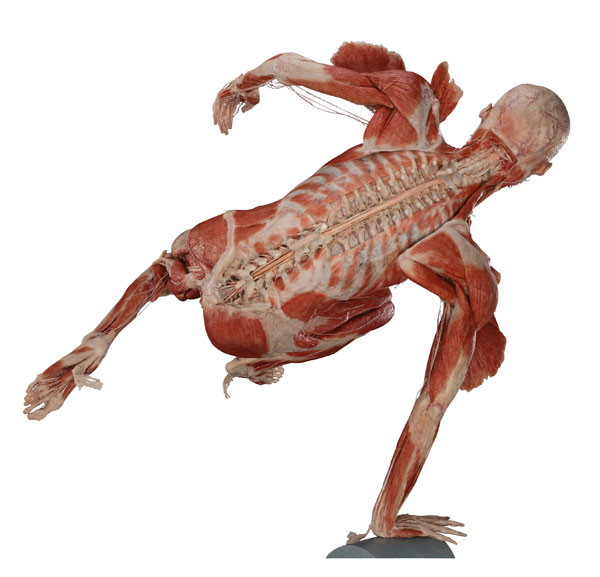
The result is an eerie yet enticing glimpse into what we all generally look like beneath our coat of skin. If you are queasy then this may leave you feeling a bit rattled. I sincerely doubt, however, whether there could be a better incentive to live a healthy lifestyle than staring at a pockmarked pair of smoker’s lungs or a clogged coronary artery of an overweight cadaver.
“This looks like biltong!” I hear my friend saying. She is staring at a cross-section of a hip joint, sliced so thinly you could eat it on a cracker bread. A close-up of this sliced flesh opens up a whole new world of internal examination. Suddenly a hip looks like a bird’s-eye view of an entire village, teeming with houses, fluffy-like trees and dotted humans.

I walk past the hardened sinews of a body holding its flesh over its shoulder like a coat, another of a skinless high-jumper and a third of a rather underdressed saxophonist. Just when I begin to feel slightly desensitised by the absurdity of it all, as well as the plastic look of all the muscles and tendons, I see a frozen fleshy display that sends chills up my arms. It is the most striking, perhaps because it seems the most human. It comprises only a shoulder, neck and head, yet the face is perfectly intact. In fact, it seems as if the person had just closed his eyes for an afternoon nap. He has stubble, bushy eyebrows, a balding scalp and even the odd stray ear hair. He is also sliced directly down the middle, exposing the inner workings of the human head.
The display next to this one is a hand made up purely of blood capillaries. It looks like a densely tangled design of red wool, and the caption beneath it is unforgettable: “The entire vascular system in the human body, if stretched length to length, could wrap twice around the earth.”
I studied biology in matric. I have seen the textbooks, the diagrams, the illustrations. Yet I do not think there is a better way of getting to know your body, as well as the transience of this fantastic working machine, than seeing it at an exhibition like this one, in the flesh.
This contribution was produced as part of a collaboration between LitNet and the University of Stellenbosch's Department of Journalism in 2013.
Also see: Body Worlds: Marvelling at the human form or macabre fascination?