

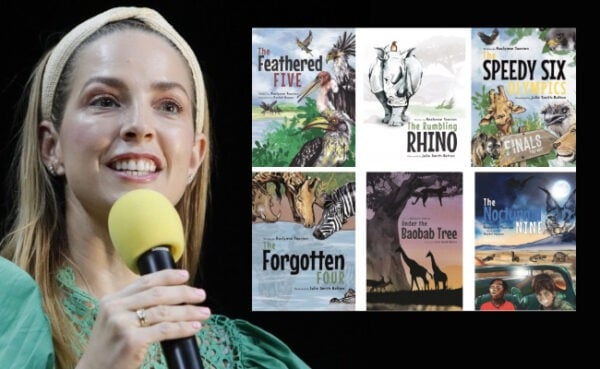
Roslynne Toerien is a prolific author. She loves sharing her knowledge of the natural world with young minds. Her works include Under the baobab tree, The speedy six Olympics, The forgotten four, The feathered five, The nocturnal nine, The rumbling rhino, The scavenging seven and The together two. Her books are being translated into Afrikaans as well. Onder die kremetartboom and Red die renoster have been published recently.
Izak de Vries sent her a few questions.
Ros, apart from being an award-wining author, you are a very good public speaker as well. You also have a background in dance. Why do you spend so much time with young readers?
I am proudly South African and passionate about uplifting education in our beautiful country. Education is key in unlocking the potential of our next generation. Raising a generation of literate readers is key in raising a generation of empowered leaders. Spending time with young readers is my passion and is the “why” behind my work.
I am the CEO and founder of the nonprofit trust, the LEARN Project, which stands for Let’s Educate A Rainbow Nation. LEARN creates sustainable libraries and classroom book corners in disadvantaged schools. I am also a mom to three young children, who inspire me to write more proudly African children’s books; and I am a teacher by profession, now full-time writing and leading the LEARN Project.
Readers make leaders, and leaders build nations. It is up to us to equip future generations.
Tell us about your love for nature. You share many facts with your little (and big) readers. Your books are fun, but jolly educational, too.
Wildlife and conservation are important to me, as is sharing this love of nature with others to create awareness around endangered animals, caring for the environment and appreciating this beautiful place we call Africa. Knowledge is power, and children love learning new information. What better way, than to weave nature facts into a fun and imaginative narrative?
Why rhyme? I seem to think your brain is one major rhythm-and-rhyme machine. How do you do that? And why?
Rhyme seems to come naturally to me. I love the power of words and the impact they can make when intentionally weaved into a story to create a rhythm and flow. This rhythmic style of writing keeps children engaged, and it is a wonderful way to remember the words on the page and retain information, especially the animal facts. Children love to guess the next word when reading in rhyme, and it makes for entertaining and expressive reading aloud. Rhyme-based stories are fun and easy to follow, and this develops reading both for meaning and for pleasure. I love writing stories that have purpose – purpose that extends beyond the words on the page and into the hearts of those reading them. I aim to ignite imaginations and create books that are fun, adventurous and engaging, yet at the same time educational and informative, sharing values and imparting newfound knowledge.
You work with some very good artists, too. How do you, as a storyteller, work with each artist to make sure both of you are scientifically accurate?
I truly do work with the best illustrators, and they are just as passionate about the books as I am. Their talent is exceptional, as they are artists at heart with an eye for detail and a heart for children. They have taken my vision for the books beyond the words on the page, and turned each page of illustrations into a true work of art, capturing the essence of the stories magnificently. Extensive research goes into the writing and illustrating of my children’s books, and facts are studied and checked by experts in wildlife, such as Grant Fowlds from Project Rhino, who proofreads all my books and gives valuable insight into the animals and their environments. The feedback and details are then shared with my illustrators, so the illustrations are realistically interpreted. It is all in the detail. Although I give some guidance into the look and feel of the story, I think it is important to give the illustrators creative freedom to bring the pages to life, trusting completely in their talent as we work simultaneously towards the vision.
Do you like reading?
I love reading; however, the honest answer is that I seem to read more children’s books than adult books. I just wish I had more hours in the day, as I do love books!
Now, some of your books are available in Afrikaans as well. I have read Nandi Venter’s translation, Onder die kremetartboom. It is so good. Are you going to perform it for kids in Afrikaans?
I absolutely love the translations by Nandi of my first two books. She somehow managed to keep the rhythm and rhyme, even in Afrikaans, and her use of words is masterful. Performing Onder die kremetartboom in Afrikaans would be a wonderful challenge; I just need to brush up on my spoken Afrikaans.
World Book Day is celebrated on 23 April. What is the importance of World Book Day for you?
World Book Day is a day to highlight and celebrate literacy, the value of a book and the joy books bring. It is a reminder to us all that books really do make the world a better place, and that through the power of a book, knowledge is gained, a love of reading is developed and confidence is built. World Book Day raises awareness about access to books, and at the LEARN Project, we welcome any preloved or new children’s book donations to help us continue our quest of educating our rainbow nation.