

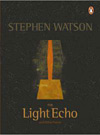
 The Light Echo and other poems
Stephen Watson
Publisher: The Penguin Group (SA) (Pty) Ltd
ISBN: 9780143025535
Format: Softcover
Publication date: 2007/8
As I am reading Stephen Watson’s sixth collection of poetry, The Light Echo, a memory comes to me of a time when, as a child, I would sit in the backseat of my father’s car as we drove to Durban from the Free State. I loved staring out of the car window as the landscape flew past my sleepy eyes. I was fascinated by the sense of speed, watching the nearest grasses and shrubs blur close to the road while in the distance the sombre stillness of the mountains contradicted the quick passage of time.
This sense of the dichotomy of time comes through in many of the poems in Watson’s collection. His detailed descriptions of events happening in the moment, passing with the inevitability of a second hand on a clock, are undercut by the profound, life-changing perceptions of those on the temporal path he describes.
For example, in "On the Great River", the first poem of this beautifully crafted volume, a party is travelling on canoes through the Orange River. As they carve their way through ancient rocks and canyons, the terrain becomes primeval in its sense of prehistory. At the same time the travellers become aware of their own frailty and perhaps even of the frailty of their relationships:
… We know only a stone against whose rind
of stone we feel the softness of our internal organs,
the soft chalk, accident of our bones. We feel only
the fabric of a sand, like rust, corroded though
by dryness – and something rising, in sand or blood,
which would cry out and cannot, choked off in the heat, in us,
who bend once more to our paddles, bending to our shadows.
The confrontation of the self which is brought into sharp relief by the harshness of the terrain leads to at least two of the travellers realising that whatever was between them is no more.
… and for a moment saw (I think you saw it too)
just how we were here: two figures in deep
empty space, each far-sunken in themselves,
knowing something harden, go separate in themselves –
This consciousness of the validity of an interior life while space and time seem so vast around us pervades many of Watson’s poems. In the second poem he describes a woman who talks about an ex-husband as if he were a “make(s) of motor car”. Watson becomes aware of that man’s existence, which has been emptied of meaning by his ex-wife, as:
… the burnt-out after burner
of some rocket now consigned
to time that owns only to disown,
to all of space, its orphanage.
The poems in this first section continue to observe the relentless passage of time through the eyes of a number of characters who people Watson’s world like characters in a play: the man who regrets having only two lovers at the end of his life; two people who realise that the possibility of love between them is finally going to remain unfulfilled; the nameless, faceless ones who perform the menial jobs without question and without whom the world would not operate; the unnoticed man desiring a woman on a beach. Once again these characters and others reach quiet but life-changing perceptions while the world continues on its unstoppable path.
In the second section, Watson observes men and women in relationships, as well as examining his own relationships, many of them under the backdrop of the landscape of Italy. In "The Light Echo" (a phenomenon of the light of a star travelling to the earth years after the star has exploded) he explores minutely the feelings of a moment of rare, intense love and compares the memory of this moment to the light echo of a dead star.
… - That even one like me
could be entered into that company; that I too, through you,
in the most secret hour of the night, in a city now years off,
could be admitted into the aureole of that one word
like a lamp – to sleep again, beloved, to wake,
and then to live on only, our lives so soon to separate,
in the echo of that light, the dust of that one moment
through which the light still travels, to reach me here
in my own vigil, another storm, another dark, tonight.
Once again, it is the sensibility of the eternal in the midst of the temporal which pervades the poetry in the third section. The poet who watches his beloved as an Old Master might watch a woman whose portrait he is about to paint; lovers in the moments after love-making; the beauty of a night of intimacy. From "Noces":
… Under a sky
that as of old is sown with planets, comets, lit by cold;in the blood of their beginnings, entwining,
that dust, their blood, their end,they lie, each transfigured in the other,
in that absolution that can be the other,while time unwinds, the night wheels
slowly past the crowns of the trees – they sleep
The fourth section of this dense volume consists of free translations of narratives in the Bleek and Lloyd Collection of 19th-century Bushman oral records. These effectively capture the Bushman’s gentle, whimsical worldview. From "The House of the Dream":
When
a Bushman dies
he becomes
a dreamThe house
of that dream
is small, a
bird’s house.It wears
a little apron
like a Bushman’s
apron; it wears
a black dress
of mouse’s
skin.
In the fifth and final section of this collection, Watson moves back into his favoured territory of examining the daily passage of life, whether at JFK Airport in America or on the terraces of Bellagio in Italy. In all these locations he finds:
Moments, yes, not to be discounted –
Illumined moments
no sooner granted than lost;
The above extract comes from "Travelogue". In another poem in this section, "Relics", Watson examines the mementoes people leave at the side of the road to mark the place where a loved one has died: “a tablet … a cross made out of box-wood, a sheath of flowers”. Watson sees “the poem that always waits in them”. Watson’s poetry reminds me of those relics left alongside travellers’ paths, reminding us always to be aware of the infinite in the midst of mundanities.
This is a dense collection and it requires some concentration to get to the heart of the poems, which are beautifully crafted. One has a sense of a perfectly constructed house, and with a bit of effort one can enter the house and find the fire burning in the hearth. The effort is worthwhile as the fire warms one to one’s core.