

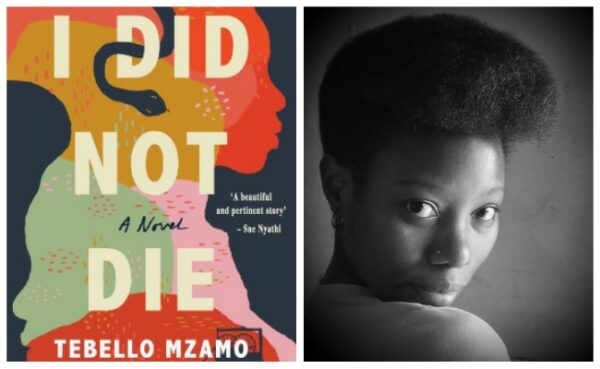
Pictures of book cover and of Tebello Mzamo: https://www.nb.co.za/en/view-book/?id=9780795710735
I did not die
Tebello Mzamo
Kwela
ISBN: 9780795710735
Buy the book from Graffiti
Tebello Mzamo speaks to Naomi Meyer about Tebello’s novel I did not die.
Tebello, congratulations on your debut novel, I did not die. In your story there are characters from a background in one area of South Africa, but they now live in another. You yourself are from Bloemfontein but grew up in Gugulethu, am I right? Please tell me a bit about yourself, your childhood and what you do now.
Botshabelo is in South Africa, Bloemfontein, yes. Just like in the book where Jemina is also from Bloemfontein but ends up living in other parts of SA. On the other hand, Botho Pere is from Lesotho but also lives in South Africa since he works there. I also have extended family in Lesotho myself and some have worked in the mines.
And when I began writing the book, I knew that making Botho come from South Africa would not work, at least for a novel – for a short story maybe. But because I wanted to tell the story in a novel, putting Botho in Lesotho gave me an opportunity to play with time and have a longer story and try making it believable, those tensions when he’s not able to go home, for example. I was able to come up with names for villages and the name of the place where Botho stays and works in Rustenburg. Coming up with the names then led to designing the settings. All these things enriched my novel.
Looking back, I overthought a lot of things while writing this book. It’s fun when you start and you are so inspired, but once it starts becoming real, it’s very scary. And I didn’t think I would get scared. But, in the end, I just realised my focus has to be on quality and doing my job. And understand that I am doing something important, something bigger than me, all of the other things do not matter.
Growing up in Gugulethu, I started writing after high school. I had nothing to do since I was not immediately accepted at university and didnt really know what I wanted to study anyway. But I knew I wanted to do something involving the use of words. I didnt even know anything about writing or that there were people called novelists. But I knew how writing a story made me feel and that it was something meant to be. That no one can ever take away from me. It just came out so natural and something wonderful in my life would happen, whether having short stories published in Drum or winning a silver merit award from the SABC’s I’M A Writer competition. At home there was no enforceable culture of reading books like when one has parents who are teachers, for example. And I would always wish I had that and that there can be a big bookshelf in the house like I saw in movies. But that was not part of my reality. However, there was always some random book lying around since my mother loves books as well and I would read that or walk down to the library. I would then go on to discover Creative writing in university and hence now were speaking about my debut novel.
Your novel is called I did not die. Interestingly enough, your book starts with a prologue clearly about somebody who did/does die. Somebody talking from the grave – he/she was telling that speculations were rife on the day of the funeral. Please tell me about the kind of book, the genre, your book fits into?
I did not die is a magic realism novel.
The book is written about a migrant mineworker and his family, and the story is set in the 1990s. Do you know such families? Where did you get your inspiration from? And when was the day you started writing it?
The story starts out in the 90’s and ends in the 2000’s, specifically in 1994 is when we meet Botho. I started the story during this period because ’94 is a very significant year in SA, when democracy was first declared and everyone, black people especially, had an optimistic view of sharing in the country’s resources. Then enters Botho Pere, a man who has been contributing to the country’s wealth even way before 1994, but until now he has still not gotten his fair share for his labour.
All over the world, there are some families who come from the working class. Myself I have had family members work in the mines and I come from a working class family, so it was not that hard to find inspiration for the story. The idea came to me long ago when I would attend writing workshops at University of the Western Cape and then I went on to produce it as a thesis for my MA at Rhodes university. But I continued to rewrite it even after that.
Why did you write this story?
I wanted to tell a story that gives a voice to the mineworker and I was particularly drawn to the idea of a mineworker telling their own story. And then, of course, there are other factors as well, like the plight of mineworkers, and I myself coming from the working class.
...........
I wanted to tell a story that gives a voice to the mineworker and I was particularly drawn to the idea of a mineworker telling their own story. And then, of course, there are other factors as well, like the plight of mineworkers, and I myself coming from the working class.
...........
In a talk I listened to, you mentioned a mentor (Meg Vandermerwe) who suggested you actually write your story. Maybe give our readers some background about the birth of the book? And also: Maybe you could elaborate on your writing in Paulet House in Somerset East. Do you think writers need some inspiration and a place to write?
I have been so fortunate in my writing journey to have had mentors. And each beautiful experience has led to another one. Meg was just moved by the short piece (and I didn’t even know it was called the short form at the time) but that story led to the birth of the book since I couldn’t leave it alone.
Writing at Paulet House was an opportunity that came about after having submitted my manuscript to Kwela Books. And so I participated in the 2021 Jakes Gerwel Foundation/NB Publishers’ Mentorship programme for upcoming writers, to refine my story. The experience was so enriching and beneficial for a writer with all the mentors and fellow writers. I had never before been to a writer’s residency. Often whenIi was writing my book, I would be in a noisy environment but strangely enough, I have become used to the noise and thus I can write anywhere. I realised that if I keep waiting until I’m at the right place, I will never write. However, writing at Paulet House did make a difference and that’s important for every writer.
Now please tell me the story in your book. Without giving away all the plot twists.
Besides other things, like family, love, the working class, power struggles, having aspirations, this is a story about a man who is here to take what belongs to him. In a previous interview I went on to say what I think that is, but I have come to realise it’s much better to let readers decide for themselves what they think Botho is here to take.
I have heard the mineworker’s story from the perspective of the man, the mineworker himself. But the book starts with Nthatisi and her life, her not hearing from Botho. She is a woman with children, she gets lonely, there are men interested in her. She knows that she should not have an affair, but it is difficult.
Perhaps it’s because she has desire or perhaps it’s because she thinks her husband has abandoned her – who knows? But I do like that we get to hear about how she has been faring and who she is. And cheers to Angela Briggs who was my mentor during the Jakes Gerwel Foundation programme for asking me: Is this all she is?
Please tell me about the themes of religion and superstition in your book.
Well, there is a theme of witchcraft in the story and this was an element which gave me the opportunity to play with speculation with regards to Botho’s journey as well as his marriage. And it was fun too. I think it provides a curiosity to want to hear Botho’s side of the story as he tells it himself.
You are brave, because you write from a female and from a male perspective. Was it easy for you to write from the male perspective? To become a man in your story?
.........
When I was writing the story I was just being a storyteller. And when it comes to different genders, races or ages when writing, I always think of characters as people and that everyone deserves to have their story told.
..........
When I was writing the story I was just being a storyteller. And when it comes to different genders, races or ages when writing, I always think of characters as people and that everyone deserves to have their story told. I had written a story from a male’s perspective before, so it wasn’t that challenging. However, of course I was conscious of the kind of man Botho is and that I should listen and follow where he was leading me.
The tragic part of the story already comes when Batho and Nthatisi are still in love, when their first baby is born, and when he asks her to stay with him forever. She says that she knows about mineworkers and how life turns out for them, but he says that he will never be like that. The reader knows immediately that this will be a love tragedy (and the reader also wishes that it will not be like that and that everything will work out for the two characters!). Please tell me about this part of the story, and if you think this exists in various areas of society and not only in your book.
I think at the heart of it Botho loves his wife. But because people are people as well as social beings, things happen which end up hurting the ones they love. I don’t think Botho wanted to have another family outside of his family, but he ends up having it anyway. And Nthatisi herself ends up having her own scandals. Such experiences can happen beyond class, race or gender.
“Dumela moratuwa”. Does this mean "Morning / good day, my dear?" I think these words translate into a different meaning within different contexts. Do you think your readers, from all walks of South African live, will discover something about the Sotho language and way of expressing themselves when they read the book?
“Dumela” is a greeting that can be said at any time of the day. I hope readers could maybe want to start speaking Sesotho as well. [Laughs].
Your book is set in the ’90’s, as we’ve mentioned. Do you think a lot of things have changed for mineworkers since then?
I’m sure some things have improved – maybe, I don’t know. But we cannot pretend exploitation is not still there.
Now the inevitable happened. Botho got another woman pregnant. He had to think about providing for both families, and he also started caring in a different way for the woman (Jemima) he lived closer to. How complicated is this! How angry and lost it must make people feel. How did you feel when you wrote this part of the story? Who was your favourite character and was it possible not to choose sides?
When I was writing the part where Botho arrives in Rustenburg, I knew there was going to be another woman. Of course I didn’t want him to be cheating on his wife, but again, I had to listen to where Botho was leading me. I have actually never thought of having favourites among the characters – I’ve always felt a sense of duty to them while I was writing. And perhaps it’s because it has not been that long since I wrote them, but I’ve never thought like that. Maybe as time goes by I will have a favourite. What I am sure of, is how each one of them makes me feel. And even if I wanted to take sides, overall, I had to do my job of storytelling.
..........
What I am sure of, is how each one of them makes me feel. And even if I wanted to take sides, overall, I had to do my job of storytelling.
...........
Of course, the more you get to know your characters the more you start to understand that there is a complex microcosmos around all their relationships. The man and the woman once loved each other. Now they move apart. They carry on with their lives, and have new lives. But, as Nthatisi and her daughter say to each other: “Ntate/Dad is never away.” Do you think in South Africa situations like these still reflect the way it works in society?
I think it’s Kamo and Itaoleng who come to a realisation that their father never abandoned them, though he was never perfect. And I think this is another thing that drives empathy for Botho – he really tries to support both of his families. (It’s so strange, whenever I speak of Botho I often find myself as if speaking up for him. But I think readers will see this as well about him.) As for South African society, there are a lot of single-mother households, yes. But I think it’s important to understand that each person has a story. And even the idea of a nuclear family I have come to see as something that both parties have to want to have instead of assuming or following society’s expectations.
The story is about a mineworker, but you don’t often see life in the mine. You read about the story outside of the mine. But the mine’s darkness and the way mineworkers are exploited are carried on outside of the mine. Did you have to do research on mining activities in the country to write the book?
Actually, there are parts in the story where I do show Botho at the mine and his experiences there. And funny enough, I didn’t want to touch on that part since I don’t know much myself about working at a mine. But like I mentioned before, I have family members who have been mineworkers before. And so I would often ask questions to confirm about certain things. So that was my research.
And yet your book has a happy title: I did not die. Or is this happy? To live a life like the lives your characters lead ... Do you think they were happy that they did not die?
I think all of the characters in the book love life and living. Despite the challenges they face, they have aspirations and try to or want to fulfil them.
