

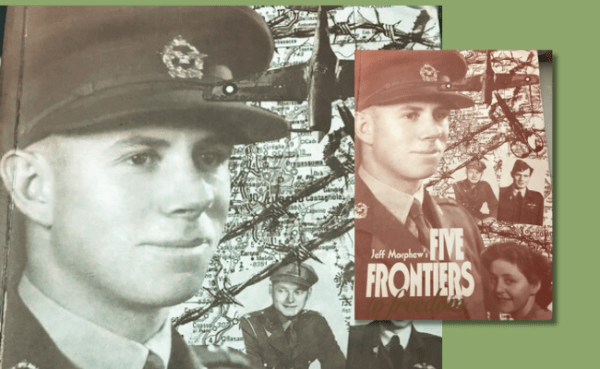
Five frontiers to freedom by Jeff Morphew
I once believed in global peace
Dependent on democracy;
Naively thinking wars would cease,
That we would live in harmony,
Democracy's now out of date,
The planets on a fragile lease,
And destined soon to detonate...
I don't believe in global peace.
(With acknowledgement to C Paul Evans, Spectator, 20 January 2024.)
An nescis, mi fili, quantilla prudentia mundas regatur: Don’t you know, my son, with how little wisdom the world is governed?
– Quote attributed to a Swedish diplomat in 1648.
In 2024, more elections will take place in a single year than ever before. Two billion people in 50 countries are going to the polls. But don’t assume this is necessarily a vindication of democracy in action.
This year is shaping up to be decisive in the global struggle between autocracy and democracy – and it is democracy that is especially fragile right now.
The sinister steps by which democracy gives way to totalitarianism is the theme of much new writing at present, none more so than by the Irish novelist Paul Lynch, whose latest book (The prophet song) is being compared with George Orwell’s 1984. This is one of the most chilling accounts of how we could all be sleepwalking into the demise of democracy I have ever read, and merely emphasises that the mere fact of elections doesn't always guarantee a democratic outcome.
As pundits abroad are already observing, many of these elections are little more than sham window dressing in countries like Russia and Belarus. In India, Narendra Modi promotes something called “ethnic democracy”, and elsewhere corruption is killing the concept of “good government” altogether. Democracy is at risk of being replaced in many cases with despotic oligarchies, and fascist elites. Our “imperfect, but still the best system of government”, to paraphrase Churchill’s definition of democracy, is even under threat in the EU, where right-wing parties with dubious links to history are poised to make electoral gains this year.
........
Democracy is at risk of being replaced in many cases with despotic oligarchies, and fascist elites. Our “imperfect, but still the best system of government”, to paraphrase Churchill’s definition of democracy, is even under threat in the EU, where right-wing parties with dubious links to history are poised to make electoral gains this year.
........
This is why, in this year of global geopolitical change, it’s a good time to remind ourselves of the sacrifices made by the South African Defence Force in the struggle against fascism and dictatorship 80 years ago during the Second World War; a time when democracy was also threatened as never before.
We need symbols – individuals – people like South African pilot Jeff Morphew, the first and only allied soldier living, until his death in 1994, to have escaped from an Italian POW camp in the Second World War while Italy was still at war. Only two others made it before the Badoglio capitulation and they both perished soon after. If ever anyone epitomised the heroism of the times in the struggle against tyranny, Jeff Morphew was just such a symbol.
Not only did he manage to evade his captors, but he risked his life during his escape in occupied Europe to rejoin the battle as a fighter pilot against the dictators.
Jeff returned to South Africa after the war and disappeared into relative obscurity on a KwaZulu-Natal sugar farm, and there he might have vanished altogether, and his remarkable achievement with him, was it not for a rare copy of his private memoir which a kind friend in KZN recently sent to me – an account of Morphew’s escape.
The saga is now available in a limited print edition1 with a foreword by the late Sir de Villiers Graaf, former leader of the United Party, who was also a prisoner of war and liaison officer to escape committees in Modena and Chieti POW camps where Jeff was incarcerated.
By coincidence, the memoir arrived in the mail in the same week when the news broke about a long-vanished Allied aircraft that had been discovered in Dutch waters, shot down by the Germans in 1944. A Dutch Foundation, the Stichting Aircraft Recovery Group, had identified the lost airmen. Johan Graas, of the Stichting, said: “The goal of our foundation is to give men like them an official grave, men who gave their lives for our freedom.
It was typical of the determination of men and women in a previous generation to defend freedom and democracy at risk of their lives; Jeff Morphew was only one of many who took up the cudgels.
His tough, but widely shared resilient approach to life of the 1940s generation, contrasts with the perception of people today being turned into “softies”. The state has stepped in to augment this trend. A good example, as one writer has noted, is the easily available medicalisation today of everyday stress, “which threatens to reduce us to self-pathologising amoebas, a paradoxically flaccid yet also uptight breed of modern human!”
Jeff Morphew’s story
Jeff’s account of his being shot down by the Germans over the Libyan desert on 4 June 1942, early in the morning is gripping.
“The coup de grȃce came when I was in a left-hand turn. A burst of machine gun fire drilled into my cockpit from the left rear. The instrument panel splintered into bits in front of me. At the same time, I felt as though somebody had hit me very hard with a hammer on the funny bone of my left arm and given me a terrific punch on the shoulder from behind... there was blood everywhere. It was sprayed all over the windscreen and instrument panel.”
Flying a South African Air Force Curtiss Tomahawk, Jeff recounts how the Germans took 15 minutes to shoot him down. When finally, his hands had been too badly injured to hold the control column, he had to use his knees to grip the “stick” as best he could, into a crash landing. Amazingly he was successful, doing a belly flop at a hundred miles an hour.
He wound the hood back with his foot, clambered out of the plane and fell backwards onto the ground. Moments later, a burst of machine gun fire raked the aircraft and missed him. It was a miraculous split-second escape.
“I ran like a guinea fowl as soon as I was free of the parachute and the Jerries kept firing at me all the while...”
Jeff took cover behind a small bush which offered no protection against a further ten attacks by the Messerschmitt fighters. They were determined to kill him since fighter pilots were more valuable than the aircraft they flew in those days. Jeff feigned death, pretending to be dead after the last attack, and the Germans flew away.
At this point, the memoir really takes off, as the 24-year-old pilot staggered to his feet and set off towards the east, across an unforgiving ocean of desert, weak with the loss of blood. The German bullet had passed through his arm and grazed his chest, and the pain was by now intense.
All day he stumbled on, scarcely able to put one foot in front of the other, until captured late in the afternoon by an Italian armoured car. Eventually, the wound was dressed in a Red Cross tent, with no painkillers – now and then, one of the Italians would come and hiss domani Tobruk kaput.
And indeed, only days later, German panzer commander Erwin Rommel accepted the surrender of Tobruk from the South African army whose turn it was to defend the Libyan port city after the Australian and British defenders had rotated in turn. This had consequences for Jeff after being shipped by the Italians to Lucca POW camp when he announced to a small group of fellow prisoners that he intended to escape. “Well, well, well,” said an English bystander, “the plucky South African is an example to us all. Pity you didn’t show the same guts defending Tobruk.”
This was a not uncommon reaction towards South African POWs among the British; the controversial surrender of Tobruk by General Klopper and over 10,000 South African troops, had left a very negative impression among the Allies. History has been kinder to General Klopper since. When the South African forces were deployed to Tobruk a short while before the surrender, they discovered the desert defences had been sadly neglected by the previous defenders. On 20 June 1942, the German air force, as well as German and Italian artillery, took advantage of this neglect and pounded the most vulnerable sector, held by the 11th Indian Brigade. German tanks poured through the gap and surrounded the South Africans. Effectively abandoned by the British 8th army, and fearing a massacEkre of his men, General Klopper saw no other option but to raise the white flag.
A fortnight before the fall of Tobruk, the wounded Jeff had been transferred via Lucca, to Chieti POW camp north of Foggia.
From there he was eventually transferred to Modena POW camp north of Bologna, and it was from this camp that he made good his declared intention to escape.
Like many “baby boomer” South Africans, born just after the end of the war, I had grown up intoxicated by the atmosphere of the adventures of our parents in this great fight for freedom. My South African father had also been an SAAF pilot, was the same age (early twenties) as Jeff Morphew, attended the same flying schools, and had spent the war years in Italian Abyssinia and Libya, ending up at the enormous allied flying base of Foggia in southern Italy. With great good fortune, he had come through the war unscathed.
My father’s brother, on the other hand, my Uncle Leon, was wounded at Tobruk and spent the rest of the war in a POW camp, first in Italy and then in Germany.
Nor did the coincidences end there; as I carried on reading Jeff’s compelling narrative, my eye fell on a familiar name – Bob Meintjes, who was the escape committee liaison officer in Jeff's bungalow. Bob Meintjes (later Major-General HR Meintjes, SADF) was none other than the father of my close friend Rob Meintjes – we shared digs at Stellenbosch University in 1969. Rob and I have kept in touch and very recently he confirmed that Jeff Morphew had been a name much mentioned in the Meintjes household.
And it was to Bob Meintjes that Jeff owed the success of his escape from Modena POW camp. Since Italian spies were everywhere, would-be escapees had to conceal their plans. The escape liaison officers were the only ones who could be trusted. Jeff shared the proposed course of action with Bob Meintjes, who secured permission for the breakout from the ultra-secretive escape committee. This committee only gave their blessing to very few escape attempts. In fact, few POWs actually contemplated escaping at all. As the Italians asked rhetorically, why escape when you can spend the duration of the war safely being fed and watered in the camp and avoid the risk of being killed in battle?
It was a good point but Jeff was not tempted. As Sir de Villiers Graaf noted in a foreword to the memoir, “Jeff was not a quitter.” POW life is a severe and merciless test of character. In the case of Jeff Morphew, it revealed a man of immense courage... he had only one purpose in life – to escape and get back into the fight – and for this, he was prepared to make the greatest sacrifices."
Bob Meintjes’ account of the actual escape explains that Jeff and another prisoner planned to pass themselves as Carabinieri guards coming off duty2. The escape committee helped with making the fake uniforms. As Meintjes described it: “... the two came marching briskly out of the bungalow ... the image of a two-man Carabinieri patrol ... they went straight to the gate and rattled it to draw the attention of the sentry who slouched over and opened it...” The two “carabinieri” then casually walked to a secluded corner and climbed over a second fence, patrolled with dogs, and so got away unseen.
What followed was an escape attempt straight out of a thriller. As has been noted by other would-be escapees, because of its geography, intricate dialect patterns and absence of foreign workers with whom escapees might identify, Italy was a more secure cage than Germany or even Germany’s supposedly escape-proof Colditz castle.
This vastly complicated matters for Jeff, who spoke no Italian. Instead, after he and his fellow escapee lost one another in the confusion of a crowded railway station, he headed for the Swiss border on his own, pretending to be deaf if not dumb at times to avoid talking to the always friendly and curious Italians. His nail-biting escape evading the Italian/Swiss border guards is worth a film on its own. He made it, and eventually with the help of a British consul in Switzerland, was given sanctuary.
Switzerland was a kind of dream come true for anyone recently experiencing the discomforts of living behind barbed wire. Very few escapees were prepared to forgo Swiss comforts for yet another escape, once ensconced, but that is exactly what Jeff did, voluntarily crossing the border into dangerous, Gestapo-policed France.
........
Switzerland was a kind of dream come true for anyone recently experiencing the discomforts of living behind barbed wire. Very few escapees were prepared to forgo Swiss comforts for yet another escape, once ensconced, but that is exactly what Jeff did, voluntarily crossing the border into dangerous, Gestapo-policed France.
........
What made his decision doubly praiseworthy was that he had met the love of his life, Joyce, in Switzerland and they had fallen instantly in love, a proper coup de foudre. Duty overruled love, however, and love would have to be postponed.
Once in France, Jeff was helped by a French “escape line” formed to help downed allied airmen. An indication of the insane risks the French took to help escapees in this regard, was that when a previous escape line had been discovered by the Gestapo, they executed the 200 individuals involved, men, women and children – whole families.
In this way after many a heart-stopping narrow shave, Jeff reached Gibraltar, travelling over the Pyrenees and through Spain, and thence to England by air, where he was once again absorbed into the “mindless tyranny of the military machine.”
What rankled was that Jeff was required to declare on oath that he would not publish any details of his escape for at least 20 years. Yet it was noticed that this rule was not enforced upon British and other commonwealth escapers from Germany, who thus got more credit than South Africans for lesser achievements.
After retraining on Hawker Tempest V fighters, he joined “80 squadron” in Holland. After various sorties, he came up against the newest German Me 262 – a proper jet fighter. A high-speed turn led to his eardrums bursting and subsequent vertigo which meant his flying days were over.
He reconnected with Joyce, no easy task in war-torn Europe, and they were married in London and then given passage from Liverpool on the SS Andes to South Africa on Jeff’s birthday, 12 April 1945.
People in those days almost seemed to take it for granted that the Jeffs of this world would automatically take the greatest risks in the fight for democracy and freedom. No trumpets were ever on hand to welcome him back to the war initially. It was only at the end of the war that he was quietly awarded the MBE (military) for his escape and for his resolve in returning to the fight.
The freedom that Jeff fought for, and the incredible risks he took in his escape from Italy, didn’t last long in South Africa after his return. Post-1948 apartheid made a mockery of the democratic ideal. But ever since 1994, the rainbow nation has once again been able to hold its head high in the democratic stable. This year’s elections will be fought under the mantle of democracy.
South Africa is a solid democracy in the BRICS grouping. There are not many other such members, but perhaps working with South Africa will have a positive effect on some of the strange bedfellows to be found in BRICS and reduce tensions with the West. NATO leaders for example this month warned that all-out war with Russia was inevitable within the next 20 years. Western democracies are already responding to such alarming perceptions by re-arming. Sweden has announced a return to conscription as have the Baltic states. A British admiral was on the radio warning the UK to start thinking along these lines as well, and not to be unprepared as it was in the 1930s. Germany has doubled its military budget, and so on. One can see where the auguries are heading.
One should never forget that democracy is a delicate flower, easily blown off course, a prize hard fought for by the Jeff Morphews of this world. It is a freedom to be treasured, and probably the proudest accomplishment flowing out of the Kempton Park constitutional talks which brought the vote for all to all South Africans.
Endnotes
1 Five Frontiers by Jeff Morphew, Vineyard International Publishing, 1999
2 Originally, as mentioned in the escape account, two POWS passed themselves off as Carabinieri – Italian military police. One was Jeff Morphew and the other was a fellow South African called Cecil Koelges, a member of the SA Artillery, captured at Tobruk. After Jeff and Cecil lost one another in the confusion of a railway station on their way to the Swiss border, Cecil was re-captured and endured the rest of the war in various POW camps. Jeff successfully crossed the border to Switzerland on his own and rejoined the war as a fighter pilot against the Germans.
Also read:
RIP Henry Kissinger – influential American diplomat who shaped policy on southern Africa
Migrants: fear of the "Other" changing the face of politics in Europe
General De la Rey and his accidental part in Hitler’s downfall