

https://www.jonathanball.co.za/
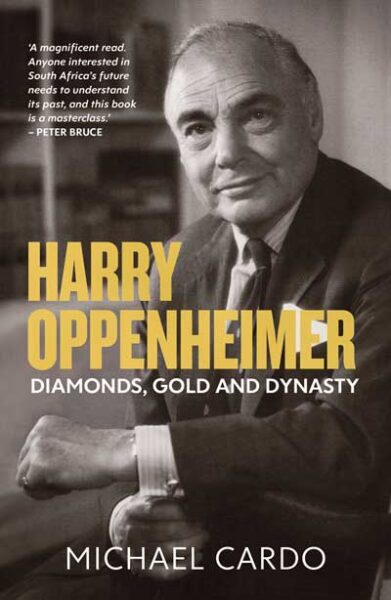
Harry Oppenheimer: diamonds, gold and dynasty
Michael Cardo
Jonathan Ball Publishers
ISBN: 9781868428014
This text contains pejorative terms that readers may find offensive. These terms are quoted in their original historical context.
Stories of personal development (biographies) are mostly read as a means to gain insight into life through lived experiences. Biographies of so-called bigger than individual personalities of the likes of Mandela, Biko and the Oppenheimers should be very useful instruments for inquiring into a nation’s national psyche. In Harry Oppenheimer: diamonds, gold and dynasty Michael Cardo had privileged access to the history not only of the Oppenheimers, but also of its family members, friends and staff. Hence he could go beyond mere historical archival material into personal relationships with one of the country’s richest families at the helm of our national socio-economic past at seed and extant. What Cardo chose to produce from all that is a longue durée history and airbrushed logography of the Oppenheimers. Along the way he also delivers a promulgation for liberal political views and a non-historical vituperation and philippic against the ruling party (ANC). Most regrettable to me is the lack of a balanced view on our national history: social, political and economic.
HFO (to his friends and admirers) was born as the South African Union was being born and died as the 1994 democratic dispensation was being ushered in. Cardo writes about his life in an airbrushed clever way, that Platonic sense of using paradox as a means of intellectual double dealing and occasional smuggling of his political views, especially those he shares with his subject. Most people I know think Plato’s The Republic is a proponent of free thought and democratic systems. Only after you’ve gone through the book do you discover that it is actually a dangerous (veiled) manual for authoritarian impulses. Cardo has mastered this Platonic skill for the promulgation of liberal thought and castigation of what he terms racial nationalism. The book sometimes reads like an outburst of suppressed political feeling in defence of impotences of liberalism in South Africa. Even this wouldn’t have been too much of an issue had it been done just to exhort the governing elite into responsible and accountable behaviour. What is unsettling about Cardo’s book is the manner in which he often tries to disempower genuine grievances with labels like nationalism, cancel culture and identity politics. Naturally, to defend his subject, he even disputes the existence of white monopoly capital and its influence over the ruling party during Mandela’s era of administration. He treats these as bogeyman labels of ignorant – read non-liberal – people who have no substantive argument against what he regard, or they regard, as inevitable progress enlightenment thinking about the world, at least the Western one. The book is also written with a triumphalist tone of liberalism that regards any other views as simplistic and misguided.
Hence it came as no surprise to learn that Cardo is a Democratic Alliance MP. It had already become clear to me that his imagination is tainted by party political views. Tainted in the sense that his political arguments show strains of bias towards liberal political persuasions and ideology. Nothing really wrong with that if he had shown similar respect for what he disagrees with, and treated his opponents with an exercising of virtue and some form of intellectual humility, which is how real political/philosophical debates should be conducted to avoid their disintegrating into sophistry and hectoring. Unfortunately, in this book at least, Cardo betrays himself with not only a grating condescending tone but also some form of selective intellectual disingenuousness. As such, in areas when he ventures into political thought, such as his prolixious Introduction: A Reflection on Legacy and Dynasty, and the last section of the book, IV Monarch, 1990–2000, his irritating habit of arguing by fractious foreclosing arguments is most prominent. In this double-dealing intellectual style, of Platonic origins, he shows the stone on his hand so that you may miss the knife he has put at your throat in this manner:
Oppenheimer was alert to insinuations of collaborations or complicity, and the potential they had to taint his legacy. He believed that his businesses flourished in spite of, not because of, apartheid, and that overall they were a force for progress … Oppenheimer readily admitted that his corporations should have done much more, much sooner, to counteract segregation in the workplace. Anglo American should have pushed harder to house a greater fraction of its black workers in accommodation designed for married couples … But these were belated admissions, offered with the benefit of hindsight. To many, the regrets rang hollow: they had seen the consequences of Anglo’s inaction, quite clearly, long in advance. (XX)
..........
This is how Cardo argues: he admits the truth, then airbrushes it to excuse his subject’s failures.
...........
This is how Cardo argues: he admits the truth, then airbrushes it to excuse his subject’s failures. The obvious tragic consequences of these failures, like the Aids pandemic in the mine compounds, or the lack of proper humane habitation leading to tragic consequence of the Marikana massacre is never acknowledged, just philosophised about in a hollow way, like the fact that Oppenheimer preferred “putting moral arguments in economic terms”. Apparently the reason why Oppenheimer was opposed to economic sanctions against the apartheid government was that “an expanding economy was a better environment for political change than a contracting economy”. So he preferred to fight the apartheid regime by expanding his business horizons. How noble of him. His family’s growing rich from it was just something that couldn’t be helped as a natural progression of things.
Cardo vehemently repudiates what he calls the ANC’s Manichaen worldview, the rotten connection between political office and business corruption. But he never once made the connection to how companies like Anglo American and De Beers were founded, even though Cecil John Rhodes, once a prime minister of the Cape Colony, was known to deal in corrupt business shenanigans. And Sir Ernest Oppenheimer, arriving at the deathbed of Rhodes, took over as an admiring mentee of Rhodes, and went on to become not just the first mayor of Kimberley, but an MP of Kimberley twice. Somehow their wealth was based on a brilliant sense of entrepreneurial spirit and what Cardo calls the “poetry of a business mind”. I hold no beef against him for lambasting the vulturine greed of ANC leaders who frequented the residences of White Monopoly Capitalists for bread crumbs off their tables. But why doesn’t he see that those monkey-see-monkey-do thieves in the ANC learnt from the worst traits of the WMCs? And yes, whether Cardo likes it or not, WMC does exist, personified by the Randlords and their corporate dynasties of five or so families directly and indirectly upholding “the power structures that privileged whites and oppressed blacks”, as he himself expresses it. Hence even the corruptible Jacob Zuma laments that under Mandela the consultations with WMC were regarded as good governance. But when he did the same with the likes of the Guptas it was termed state capture. The reality of the matter is that, corrupt as they may have been, the slice of coal supply to Eskom is nothing compared with the cake-bakes in the same supply. Cardo fulminates and gossips, based on Mrs Bridget Oppenheimer’s gossip about the who-is-who of greedy ANC greasy politicians frequenting the Oppenheimer abode, people now known as the black BEE magnates, who include the current president, Cyril Ramaphosa. Probably Thabo Mbeki is the only one coming out less tainted according to what is revealed in Cardo’s book.
Cardo tells us he wrote the book over six years of immersion in the archives and writing/working in concentrated bursts. Although it is not an authorised biography, he had free access to and cooperation from the Oppenheimer family members. What that means, based on the recent Mashaba-Mashele biography debacle, is anyone’s guess. Cardo’s book unsettles you after you’ve read it, when you think back and notice the patterns of deliberate care in excluding certain historical material, especially that which doesn’t support his thesis. For instance, I started thinking why one would write about the early history of Kimberley without mentioning Solomon Tshekisho Plaatjie. More so since Plaatjie had extensive dealings with Harry’s father, Ernest. It wouldn’t even have taken much effort to get comprehensive facts on Plaatjie since Brain Willan’s seminal biography of Plaatjie. Also, when you go to Kimberley museums, streets, even hotels, like the Protea Hotel, their names are mentioned alongside each other. Ernest Oppenheimer even donated six sheep during Plaatjie’s son’s wedding. Ernest Oppenheimer even partly funded the publication of the Shakespearean books Plaatjie translated into Sotho. And there’s even a hint that Oppenheimer paid for Plaatjie’s transit to Cape Town when he became part of the delegation that went to England to protest the planned introduction of the Native Land Act. As such, despite the ANC’s confused factional calls to support the Nationalist-Labour Pact, Plaatjie was a staunch supporter of and organising activist for black voters to support SAP (South African Party) members, like Sir Oppenheimer and Sir David Harris, who were elected twice, with large majorities, as the members for Kimberly and Beaconsfield. My point is, the parasitic and symbiotic relationship between the ANC leaders and the Oppenheimers didn’t begin post ’94; there’s clear evidence of its existence from the start. And this point doesn’t sit well with Cardo’s thesis, so he chose to exclude it in a rather disingenuous way. Nor do you hear about other critical voices of the Oppenheimers, like the novelist Olive Schreiner, political journalist Ruth First, and the anti-imperialist economist JA Hobson. To be fair, Cardo does mention Kader Asmal. I suppose he could not resist rubbishing his sneering condescending tone in what he calls Asmal’s “tendentious tract entitled Reconciliation through Truth: A Reckoning of Apartheid’s Criminal Governance”. What enrages Cardo about this book is that Asmal likened the role played by the Anglo American directors to that which IG Farben played as the industrial backbone of the Third Reich in Germany by using slave labour from the concentration camps. I placed a quote above where Cardo admits that HFO admitted to the thought crimes, by omission if not commission, of how he misused black labour. Now, using his Platonic paradox trick he is enraged when others take this admission to its logical conclusion. It would have sufficed for Cardo, had he been an impartial biographer, to declare that comparing the mine indentured labour to the concentration camps would be a notch too high in exaggerated degrees, but conceptually similarities are there.
Another point of exasperation Cardo’s logography commissions itself to do is to dispute Anthony Hocking’s biography of HFO that claims that the magnate had “never subscribed to the view that apartheid was morally wrong”. Interestingly enough, in what looks like a rare demonstration of impartiality Cardo begs to differ from the likes of HFO’s wife, Bridget, who thought the statement was “a pernicious libel and a lie”. One needs to recall that Cardo shares the belief of believing in economic answers to moral questions. To the Oppenheimers “the idea of separate development was impractical rather than intrinsically immoral”. Hence they don’t see the statement as libellous.
Anyone from Black Consciousness thinking circles can also tell you, for free, that besides racial bias, there’s very little separating the white and black nationalists. The ANC elites have always been about sharing the spoils of power rather than upsetting the apple cart of the apartheid system and its resultant economic structures. The EFF has politically made this realisation urgent for our age, mostly capitalising on the governance failures of the ANC. But it shares the corruption DNA with the ANC in the same manner that the pseudoliberal of the DA also shares the colonial DNA and legalised sophisticated business corruption with the South African Party of Rhodes and the Oppenheimers. Theirs is the liberal type stock that were recipients of the apartheid system, which made them not just privileged because of their white skin but filthy rich too. They became even richer under the clueless ANC regime whose top brass HFO was astute enough to placate with financial crumbs because, as Cardo articulates in his book:
Just prior to the advent of democracy Oppenheimer warned that it was “extremely dangerous” to be “ruled by people who have no material stake in the country”. That sentiment led him to champion an incipient form of black economic empowerment (BEE) in 1996, through Anglo’s unbundling and sale of JCI to two separate consortia of black investors, one of which was led by Cyril Ramaphosa. (Ramaphosa served as the ANC’s secretary general from 1991 to 1996, before resigning the post to enter business). BEE became one of the ANC’s flagship policies, though it quickly degenerated into a patronage scheme – a system of elite enrichment for the politically well-connected, and a vehicle for state capture. HFO failed to foresee the predatory practices to which BEE gave rise. He would have been aghast at the turn of events. For not only did BEE achieve little for the immersed black majority – in the long run, it deterred fixed investment, put a ceiling on growth, and amplified inequalities – but it also corrupted governance, thus undermining South Africa’s viability as a going concern. (388)
Most disturbing to me is Cado’s treatment of the TRC as just a sparring ring between the WMCs and the ANC, thus reducing to relative insignificance our national pain and trauma, as depicted by endless parents, brethren and siblings who went to that organised shame of purported truth and reconciliation with hopes of getting answers and justice for their beloved who fell on the road towards our now thwarted liberation. The TRC had promised to lance the boils of our past before it became clear that it, too, was just a pretence to preen and absolve the unrepentant elites. That section of the book tested my reserve and tolerance the most, the continued demonstration of callous disregard for the pain of those who lost their loved ones for cheap sparring points between business elites and the discredited moral authority of the ruling party. This attitude of treating a black life with almost contemptuous disregard is probably what I loathe most about some white South Africans. And its seeds were at the roots in our country’s mining complex, as Louis Cohen’s Reminiscence of Kimberley ([1911] 1990) uncannily reveals. This is one of the seminal books about the foundations of Kimberley which Cardo conveniently avoids:
It was no unusual thing for a band of Kaffirs to travel a thousand miles to get employed on the Diamond Fields. How these starving, naked creatures lived on the way, conquering rain, frost, and hunger, I cannot divine, nor does anybody know the small armies of them who left their wasted carcasses on the road to fatten vultures, whilst their companions pressed on to do the same for the gentry who now live in affluence. It is, I am certain, highly meritorious for the British to set up a howl of indignation against the atrocities committed in the Congo, but they forget their own iniquities. A nigger’s life in Kimberley was regarded as possessing about the same value as that of a tiresome fly’s existence, and I have seen them die the cruellest of deaths with out, as a rule, a hand to help them. I never liked niggers, few colonists do; but they had their uses, and the men who enriched themselves by their murder and torture are the charitable magnates, with souls of mud, who head well advertised subscription lists, who attend a place to be seen, who order pictures of the Madonna or Moses type as a penance for the source of their ill-gotten wealth. (291–2)
Instead, on this apologia pro vita sua for the Oppenheimers, Cardo preens and airbrushes the evil deeds these “charitable magnates” did as born-again latter-day saints. He mentions that when he was about to undergo a surgical operation HFO was reading Trollope. To a person who is aware of Trollope’s visit to Kimberley at the height of the diamond rush this mention brings hope that this would be a moment when we get a proper analysis of that era and of the honest foundations of the De Beers empire. As it turns out, this is just another bromide; nothing much follows the revelation – once more the Chekhovian gun doesn’t go off. Trollope, in a cagey manner, tackles the Southern African experience when writing about British colonial patrimony; and the dealings around Eustace Diamonds is probably based on his Kimberley excursion.
Anyone who has flown over Kimberley and Johannesburg would have surely felt the pain in watching the landscape scars and environmental disasters coming from the so-called diamond and gold rushes. There’s nothing touristy about The Big Hole, or the acid waters of the once Whitewatersrand. It cannot be accepted with just a dismissive hand- wave of a price to pay for economic development and city infrastructure-building. And this callous disregard for the damage that mineral extraction companies did in black lives from the colonial era of Glen Grey policies to apartheid laws is disturbing in the book. Is it possible that people like Cardo really don’t realise the role mining companies played in what culminated in the highest tragedy of our era in the Marikana massacre? Do they not see that the rotten collaboration and the tragic dance between the ruling party and WMC is what is inevitably dragging this country towards looming tragic consequences of the so-called Mzansi Spring?
..........
Cardo’s book could easily have been one of our country’s seminal documents, but ends up being a terrible missed opportunity for revisiting that past with sterling intellectual honesty. It could have afforded us a means to discern a better future through learning from the past mistakes at seed to the terrible consequences and patterns in our present. Instead, the book tries to convince us that the miseries born of our nation were inevitable and necessarily characteristic of foundational national and socio-economic identities of many countries.
..............
Cardo’s book could easily have been one of our country’s seminal documents, but ends up being a terrible missed opportunity for revisiting that past with sterling intellectual honesty. It could have afforded us a means to discern a better future through learning from the past mistakes at seed to the terrible consequences and patterns in our present. Instead, the book tries to convince us that the miseries born of our nation were inevitable and necessarily characteristic of foundational national and socio-economic identities of many countries. I do not know how in this day and age one can talk about Kimberley, Rhodes, Oppenheimer and Vooruitzicht (New Rush) only in heroic tones, without at least decrying the mercantile predatory colonial trespass they represent, which sucked and desiccated the socio-economic development of the South African majority.
...........
Be all that as it may, the book contributes some valuable points on our national dialogue despite Cardo’s intellectual schematics of trying to convince us that Harry Oppenheimer was a misunderstood man of business genius who, though not an activist against, was disillusioned by the apartheid system’s lack of business acumen if not the moral imperatives of so-called separate development.
............
Be all that as it may, the book contributes some valuable points on our national dialogue despite Cardo’s intellectual schematics of trying to convince us that Harry Oppenheimer was a misunderstood man of business genius who, though not an activist against, was disillusioned by the apartheid system’s lack of business acumen if not the moral imperatives of so-called separate development. What I don’t understand is why Cardo would think this is an acceptable thing. Without employing religious thought I should think it obvious to any person of goodwill that justifying tragic means by economic gains is an abhorrent way of thinking, otherwise we might as well praise the Nazi system for being one of the best-oiled economic machines that made Germany one of the leading productive economies in Europe. This kind of ethical duplicity is my major criticism of the book. I am both intrigued and annoyed by the footnotes of Plato within the liberal political thought. Their elitist tendencies of believing in the so-called governance of the wise fascinates and exasperates me at the same time. It doesn’t take much to notice that Cardo’s book is also the sprouting seeds of Karl Popper’s The open society and its enemies, which, by the way, was originally subtitled The spell of Plato. Nonetheless, this kind of book stimulates at least this reader, in the same manner that grit stimulates an oyster. Besides, we urgently need to address the condescending tone of the South African white liberal class who thinks the rest of us who don’t support the pseudo-liberal politics of the DA are stupid, or stuck on nostalgic liberation movement politics. What better way to do that than to study their worldview through books like these. Another added value of the book is a good diagnosis of the ANC’s governance failures. We may understand from Fanonian thought why the ANC proved impossible to be better than all-African passé and corrupt liberation parties who failed to transition into proper political parties. It would also be good to hear the neoliberal take on the issue, for a more balanced view if nothing else. Pity that Cardo’s surgical scalpel doesn’t concern itself much with why the South African version of liberal politics has not been successful among the black majority in particular. One would have thought this would be one of the main theme of his book. As for Harry and the rest of the Oppenheimers, I think everyone – including Cardo, for he mentions it several time before airbrushing it – knows the destructive role the mining complex played in our country, and their complicity in it. As such, I wouldn’t call this book a fully rounded portrait of the subject and the times they lived in.
Lees ook:
Enter the lacuna: a review of Harry Oppenheimer by Michael Cardo