

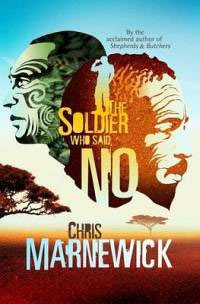
 The Soldier Who Said No
Chris Marnewick
Publisher: Umuzi
ISBN: 9781415201084
Prys: R144.50
In 2008 Chris Marnewick delivered his first novel, Shepherds and Butchers, to critical acclaim. For his novel, which explores legal execution in a stark, harrowing manner, the author – who is a senior advocate practising in Durban – uses factual and fictional elements to interrogate the grim realities underlying the South Africa’s justice system.
Two years later, Marnewick returns with the slick, well-written The Soldier Who Said No, a novel that centres around the fate of Pierre de Villiers (who made an appearance in Marnewick’s previous novel), a police officer who has swapped South Africa for the not-so greener pastures of New Zealand.
Before exploring De Villiers’s gruelling incursions into Angola during the 1980s, and his family’s brutal murder in a housebreaking that belies a thinly veiled attempt at his own life, Marnewick immerses the reader in a cauldron of dislocation, racism and uncertainty as De Villiers is suspended from New Zealand Police Force after making a racist remark against one of his colleagues. Closely followed by an attempted assassination of the country’s prime minister, as De Villiers is an ex-Recce and an accomplished archer, he quickly becomes a prime suspect in the investigation where the main piece of evidence is a poisoned arrow of Bushman origin.
The novel moves between the South Africa of the 1980s and present-day South Africa and New Zealand as De Villiers physically and emotionally tracks back to the land of his birth in order to untangle cloudy memories of the Angolan Bush War with help of the tracker !Xtau. As a man whose refusal to obey direct instructions to assassinate one Robert Mugabe leaves him with the novel’s title, he must confront his own mortality after being diagnosed with cancer, battling against his urge for retribution and justice towards the killers of his family in a country sliding ever further into decay.
The novel’s largely breathless pace will please fans of Deon Meyer, as Marnewick elevates his novel above standard thriller fare with a searching yet grim account of a South African civil society and government grossly corrupt and removed from the man in the street. Marnewick’s descriptions of state collapse and immigrant and emigrant experience strongly echo the pessimism of Eben Venter’s Trencherman, while his view of New Zealand as a divided nation, ill at ease with its own racial and political past and present, and is sobering and deeply unsettling.
Through a poignant portrayal of a soldier’s trauma and search for wholeness and meaning after extreme violence, Marnewick leaves the reader with an intriguing and satisfying mystery and a look into a contested and troubled history. After finishing The Soldier Who Said No, many readers of his fine sophomore effort will be left unsettled, reflecting on their own sense of home and family, while eagerly anticipating the return of Pierre de Villiers in the near future.