

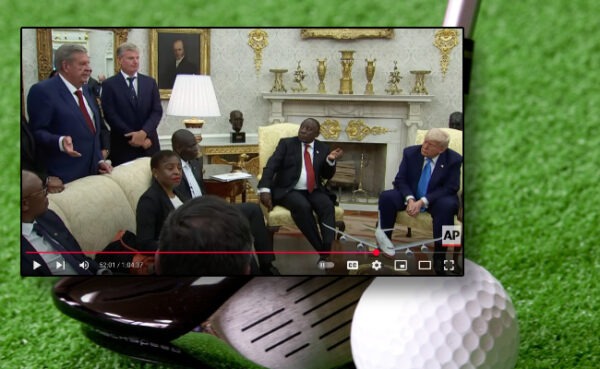
Some years ago, I celebrated the discovery that the only South African to have entered the Oval Office – great stars like Tutu or Mandela, excepting – was Don Sole, the son of Methodists, who was born and raised in Grahamstown (now Makanda), which I call my second hometown.
Sole was the South African ambassador in Washington when the negotiations on the Namibian issue were being finalised, and he carried messages between South Africa’s then President, PW Botha, and foreign minister, Pik Botha, and the then US President, George W Bush.
So, imagine on Wednesday how thrilled I was that Retief Goosen, born and raised in my first hometown, Polokwane (once called Pietersburg), was to be in the Oval Office with two presidents, Trump and Ramaphosa.
The invitation of “the Goose”, Goosen’s nickname, and another golfing rock star, Ernie Els, was nothing short of a brilliant move for the South Africans.
The person who brought this to Ramaphosa’s attention has deep insight into the psyche of America’s forty-seventh president. Using the idiom, “they know what makes the president tick” is to pay the highest compliment to the advisor’s understanding of Trump and golf in the psyche of mid-America.
Plainly, Ramaphosa, Ernie and the Goose presented a countermove to the diplomatic gimmickry for which the US president is gaining a tawdry reputation.
Diplomacy of this strain is rare, because it cannot square the circle between a principled-based conversation on serious matters of state – to intentionally use a grand term – with something which has no value, namely, a gimmick.
Put differently, the gimmick undercuts trust by devaluing with unsubstantiated claims. There was a lot of this in the Oval Office this week, as the world witnessed.
Of course, it is great theatre, but it makes prediction difficult – no, categorically, impossible. Uncertainty rules the times without predictability, which is what the most modern of all international referees – the market – has signalled since Trump came to power.
It is doubt that makes the present international moment so treacherous – an issue Ramaphosa seems to understand well by his team selection. However, failure to signal a direction falls outside the decision framework of Trump and his acolytes, including those who have departed these shores for the United States and elsewhere.
This is one reason why Wednesday’s encounter in the Oval Office seemed replete with a language in search of issues and issues in search of a vocabulary.
If this was one outcome of the meeting, two more deserve attention.
The (sometimes very hostile) exchange between the sides in the Oval Office was only one of some long-standing unresolved international issues – where is South Africa in the world?
Consider these, however:
- Is the US an international player or a global pariah?
- Are the states in the Gulf which threw themselves at Trump’s feet last week bit players or big players in the search for world order?
- What can be learnt from Trump’s failure to bully Canada into submission?
- Is the Western alliance on the way up?
- Is BRICS on the way down?
- What is to be done in Gaza, Sudan, and Myanmar?
Each arrived on the international agenda through a different route; they gestated at other moments in time, and each seemingly seeks a different solution.
The lesson of this is plain: No magic bullet will quell a restless world, and neither gimmickry nor counter-gimmickry will move the needle.
But there is a lesson to be learnt from what was not said in the Oval Office this week ... well, it was almost said by Johann Rupert, scion of Afrikaner capitalism, with his reference to South Africa’s history: Social relationships are embedded in history, which is why history matters and why they should be placed at the beginning of a diplomatic conversation and not tagged at the end.
South Africa is only one of the tremendous historical experiments of the late-19th/early-20th centuries. We might remember that the Boer War (1888–1902) was fought in the very years that the US invaded Cuba (1898–1902) and fought a war with the Philippines (1898–1900’s).
As the idea of “the international” spread worldwide, it intertwined with capital, class, and race. These were embedded in slavery – a form of social relationship – from which the world has not escaped. If anything, this is what the movie clips Trump insisted on showing in a darkened Oval Office revealed.
The core issue in global social relationships is white wealth and black poverty. Without understanding this, not gimmickry, not golf can hide the gore of grinding poverty on which social violence feeds.
Kommentaar
Seeking protection from imperialism, in 1885, three Batswana Chiefs went to Queen Victoria for help. That Ramaphosa went to Trump makes one wonder of the utility of fealty — feigned or sincerely felt — 160 years later.
'Social relationships are embedded in history, whch is why history matters...'
Well said, Peter. Never more true than in the case of not only South Africa, but also Ukraine and Russia.
Good article.