

This reader impression was written and sent to LitNet on the writer's own initiative.
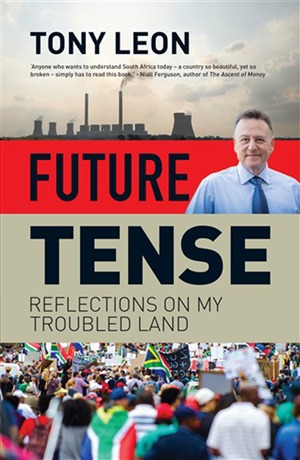
Future tense – reflections on my troubled land
Tony Leon
Jonathan Ball Publishers
ISBN: 9781776190744
Many authors used the level five lockdown in 2020 to write a new book, and we are seeing the fruits of this, one after one, to our delight as readers. Future tense is another result of this. The book is divided into three parts. Part one is titled “Present tense”, part two is called “Past tense” and part three is obviously “Future tense”, which is also the ambiguous title of the book. Leon’s perspective is interesting for obvious reasons, as he is a person whose political career started around the end of the apartheid era, and has continued through the rainbow dreams of the 1990s – with the negotiations and the signing in of the 1996 Constitution by President Mandela – and all the way up to the present. As a former leader of the official opposition, the Democratic Alliance (DA), Leon set the stage for the successful terms of Helen Zille as leader of the DA. The pinnacle of the DA success story was the local government election of 2016, after which things went terribly pear-shaped for the official opposition. After leaving parliament, Leon served as ambassador for South Africa in South America, in countries such as Argentina, Uruguay and Paraguay.
.......
The book is not a scientific study. It is written more in the vein of a memoir, and Leon acknowledges as much in the introduction. It cannot therefore be said to be a book that is objective about what is written. This fact is at the same time a weakness as well as an advantage, as it is written from a specific perspective and gives insights into a particular way of reasoning.
.........
The book is not a scientific study. It is written more in the vein of a memoir, and Leon acknowledges as much in the introduction. It cannot therefore be said to be a book that is objective about what is written. This fact is at the same time a weakness as well as an advantage, as it is written from a specific perspective and gives insights into a particular way of reasoning. There is some attempt at least to give the book some academic credibility, and this comes in the form of a set of endnotes. The overwhelming majority of these are in the form of internet references, and there are also some references to books. Of more importance is that the book is supplied with a proper index, something which is sometimes missing in books on contemporary politics, and which makes the book very user-friendly for future researchers.
In chapter one, Leon sets out by reflecting on the exciting days that were once termed “Ramaphoria” – the early days of the presidency of Cyril Ramaphosa, which at the time were also described as the “new dawn”. It was a time of high hopes and great expectations in South Africa, as the world was delighted to see the back of Jacob Zuma, and the hope started to spread that under Ramaphosa, the country would reset and return to the principles of the founding fathers, as enshrined in the Constitution. But it did not take long for the euphoria to blow over. Leon’s chapter “Ramaphoria” is very brief. It does not really delve into much of the politics, aside from mostly the failing economy. The chapter is, however, a good foundation for what follows next, which will be of much greater interest to the average reader: the demise of the DA.
As much as the African National Congress (ANC) is failing the nation in the way it is governing the country, South African opposition parties can also be described as something of a train smash. The greatest of these is, of course, Leon’s own party, the DA. The DA has been totally unable to juggle the interests of their established support base on the one hand, while making inroads into ANC support on the other hand. Leon takes a critical view of most of the DA leaders. While heaping praise on the leadership potential of Mmusi Maimane, Leon argues that Maimane’s ascent to leadership was too fast, concluding that Maimane “never really got footing in any of the many posts he held between his recruitment in 2010 and his election as national leader in 2015” (28). Despite the short-term success for the DA that followed Maimane’s election, critics always argued that Maimane did not reflect the “real” DA, and that his election was just an artificial way of capturing opposition votes. This accusation kept haunting Maimane and the DA all the way to 2019, when Maimane’s resignation was seen as proof of exactly that. Leon is also quite critical of Helen Zille (he refers to her 2016 autobiography as “science fiction”) [p 28] and also Herman Mashaba in this long chapter, in which he reflects on the blunders of the DA, from Zille’s controversial tweets to the fallout with Patricia de Lille.
In chapter three, Leon continues his inquest into the DA’s fall from grace. In the 2019 national elections, the DA lost some 450 000 voters, and this is attributed mainly to the now famous Schweizer-Reneke incident, where DA leaders acted as self-appointed online judges, but where the situation terribly backfired. Of course, this was not the only reason for their decline in support, and it did not help the DA much when the party went into a coalition with the controversial Economic Freedom Fighters (EFF) in Johannesburg. This chapter is of particular interest, as Leon describes his role as part of a “review panel” that was set up to investigate the DA’s declining support at the 2019 national and provincial elections. According to Leon, Maimane at first supported the review panel, but after a lengthy process of interrogations of the DA leadership structures, and the compilation of a report advising that Maimane and others be relieved as leaders of the DA, Maimane and other leaders, including John Steenhuisen, joined up “an imaginary cast of fellow-victims to destroy any chance of our report being accepted” (47).
Even if it were just for these two chapters, the book would already have been worth the read, as it captures interesting internal political developments within the DA that are not well documented elsewhere. Part one of the book then continues to reflect on issues such as the government’s handling of the COVID-19 pandemic, the lasting effects of the Zuma presidency, the decline of free speech (particularly at universities and in the media) as well as the flight of capital from South African shores due to the anti-capitalistic policies and ideology of the ANC. The last point particularly comes to the fore in chapter seven, where Leon notes that under the ANC, “South Africa’s ranking for ease of doing business dropped from a respectable 28th position out of 151 countries surveyed in 2006 to a lowly 74th out of 190 countries on the 2017 list” (102). The result is there for all to see, as the unemployment rate has been climbing steadily and is now sitting at record heights. The government continues to fail in creating a safe and accommodating environment for people to do business up to this day.
Moving on to the second part of the book, the focus shifts to the popular topic of the legacies of the Nelson Mandela and Thabo Mbeki eras. Chapter 11 [the third chapter in part 2] has a strong economic focus, and Leon quickly points to the fact that despite substantial economic growth, the government under Mbeki was not really able to make a significant dent in the challenge of poverty. In addition, the decay of the public service was a noticeable legacy of the Mbeki era. In addition to this, there was the poorly performing education system, as well as the notorious issue of “cadre deployment”, which remains an important talking point even in the run-up to the 2021 local elections. In addition, Leon reflects on the development of the Employment Equity Bill of 1998, as well as the policy of Black Economic Empowerment. These policies and legislation also failed to bring about significant change, as the government sought to gain more and more control over all aspects of the economy at the expense of economic growth.
Part three of the book is the shortest, constituting only three chapters, but is also interesting, as this is the part of the book where Leon moves from critique to suggested solutions to some of the challenges facing the country. This concludes what was for me a quite enjoyable book, one which is an important addition to the literature on South African politics, and of which the main subject of importance is Leon’s exposé of the internal DA politics.
.......
This concludes what was for me a quite enjoyable book, one which is an important addition to the literature on South African politics, and of which the main subject of importance is Leon’s exposé of the internal DA politics.
........
Even after all the blunders, as documented by Tony Leon in this book, the DA continues to find it a challenge to keep their hands clean, as has been seen again with the messy Phoenix election poster debacle in the run-up to the 2021 local government elections. The tragedy of this is that despite the mammoth mess of corruption and state capture in which the ruling ANC has left the country – with all the ills of a crumbling infrastructure, unemployment, rising crime and gender-based violence, dysfunctional government structures and a flight of capital and business from South Africa – the opposition is also failing to take proper advantage of all the shortcomings of the dysfunctional ruling party.
