

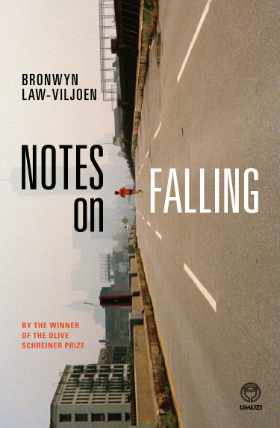
 Title: Notes on Falling
Author: Bronwyn Law-Viljoen
ISBN: 9781415210741
Publisher: Umuzi
Bronwyn Law-Viljoen has written a novel for the connoisseur – the connoisseur of photography as an art form, of the experimental performing arts in 1970s New York, of exquisite prose. Underpinning this is her protagonist’s painful quest to find answers to the enigma of her maternal origins.
We first meet Thalia photographing an explosion during the construction of the Gautrain. She’s not a press photographer recording events for posterity. What she captures on film is destined for art galleries and expresses a more complex meaning through the aesthetics and semiotics of composition.
The story is narrated in the third person but – in describing people, places and events – the narrator seems to mimic the way a photographer would view the world. When you enter a space, it’s as if the reader is looking through the viewfinder of a camera, composing a shot, noting details that reveal something about the character of the occupant/s of the space, seeing telling touches that locate us in history, being made to notice specifics about clothing that lend insights into the popular culture of a period and the tastes of the characters.
...
Bronwyn Law-Viljoen has written a novel for the connoisseur
...
The novel moves through time as freely as if someone were sifting randomly through a portfolio of photographs. Chapters are not always arranged in chronological order and the reader needs to remain alert. The narrative spans several decades and, although few dates are provided, when characters refer to events – the World Cup (in South Africa), the bombing of the World Trade Centre, the kidnapping of John Paul Getty III or the recent release of Fargo – it’s possible, should the reader wish to do so, to locate a scene in a historical moment.
We discover Thalia was brought up in Johannesburg by her father, a newspaper journalist reporting on atrocities during the dying years of apartheid and working closely with renowned photographers of the 1980s – Magubane, Carter, Oosterbroek. Her first encounter with photography is in the newspaper’s archive, but it’s not the kind of photography she’ll embrace as a medium of self-expression. Because her father is gay and has a black lover, she learns the importance of secrecy and not asking too many questions. Possibly the most important question she learns not to ask is, “Who was my mother, and where is she?”
During her student years in Grahamstown, she builds up a photographic portfolio that secures her a place in a master’s programme in New York City. While she’s there, she decides she wants to find out more about her mother and – from a safe distance – emails her father and asks him to tell her what he knows. Her mother was a ballet dancer called Paige Dawson. She’d had a brief sexual relationship with her father then disappeared. Ten months later she arrived on his doorstep with a baby, told him she was going to New York to pursue her dance career and said that if he didn’t take the baby, she would put her up for adoption. He couldn’t describe exactly what she looked like – said she’d have some idea if she looked at herself in the mirror – and emailed her a photocopy of a passport photo Paige had left behind.
That’s all Thalia has to go on. She knows her mother came to New York and when she lands a job at the archive of the university library and starts ordering their photographic collections of 1970s dance troupes, she begins searching through the images for evidence of her mother. She becomes fascinated by the photographs of Robert Sander and is convinced that – although indistinct and blurred – she may have found her mother’s image in one of his photographs. Two-thirds of the way into the novel the narrative focus shifts away from Thalia and remains for some considerable time with Robert who, at one point, has a fleeting encounter with Paige.
Notes on Falling does not easily yield up its meaning. The reader is required to assemble and make sense of disparate story fragments and construct meaning in much the same way Thalia tries to make sense of her quest. It’s fascinating, absorbing, challenging and well researched. It doesn’t provide answers to all the questions it raises and doesn’t tie up loose ends that – in art as in life – are sometimes best left dangling. At times the form is as unconventional as the work of the performing arts groups Thalia pores over in Robert Sander’s photographs, but all these elements are drawn together by the emotion of Thalia’s determined quest to find her mother. And when that happens, the novel doesn’t disappoint.