

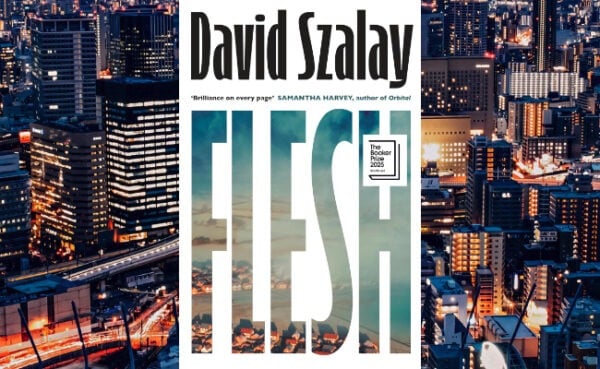
Because this book won the Booker Prize 2025, I am gonna do something I almost never do: talk about a book I didn’t finish. So, more than a book review, consider it an explanation why I dnf(ed) it. I liked the writing technique so much, I am almost certain it is the only thing that made me go as far as two thirds of the book. My second caveat is that this is only the third book of Szalay I have read, all of which I have dnf(ed).
David Szalay has long been one of the most perceptive chroniclers of the modern European condition. His men are rarely heroes; they drift, observe and despair. After the continental sweep of All that man is and the fragmented precision of Turbulence, Flesh turns inward – to the body, to desire and to the desolate interior of a life that has lost the coordinates of meaning.
At first glance, Flesh is a study in erotic melancholy of a middle-aged man, divorced from both love and purpose, who moves through a series of encounters that hover between physical need and existential dread. Beneath its quiet surfaces, Szalay’s novel probes the cultural unease of our time – the exhaustion of liberal optimism, the backlash angst against “wokeness” and the waning of faith in collective redemption.
Szalay’s writing is exact, almost ascetic. Every gesture, thought and fragment of dialogue feels pared down to its elemental truth. The effect is both sensual and sterile – the prose of a man recording his own disintegration. The body here is not a site of pleasure, but of revelation. It exposes what the mind can no longer rationalise: decay, loneliness and the longing for contact that no longer redeems.
The novel’s title carries a double resonance. “Flesh” refers not only to the erotic and the carnal, but also to humanity’s frail, transient and doomed condition. Szalay’s protagonist embodies a Europe that has consumed itself in irony and comfort. His search for meaning in the body (materialism) is a quiet surrender into meaninglessness of the human condition beyond hormones and blood heat (flesh).
Szalay’s fiction is unmistakably white, Western and male – but not triumphantly so. The world of Flesh is defined by the solitude of whiteness, a moral and cultural vacuum that has replaced the grand narratives of progress or empire. Race, class and history hover as deliberate absences as the protagonist moves through cosmopolitan spaces cleansed of difference, which can be interpreted as a symptom of Europe’s insulated modernity.
There is a faint postliberal melancholy in Szalay’s work, a sense that the promises of liberal modernity (freedom, mobility, sexual liberation) have become sources of ennui. That sensibility sometimes overlaps with the “anti-woke” mood of contemporary Western discourse, though Szalay himself is never polemical. What distinguishes Flesh is that it neither protests nor defends this condition; it simply observes it.
The protagonist’s detachment from moral or political conviction is obviously reactionary. But Szalay’s intention is clearly diagnostic rather than nostalgic. He is not lamenting the loss of tradition or masculine certainty or privilege; he is mapping the vacuum where those certainties once stood.
Because Szalay refuses the moral pieties that dominate much contemporary fiction, Flesh can easily be mistaken for a conservative or “anti-woke” text. There are no redemptive arcs, no politically virtuous characters, no explicit reckoning with patriarchy or privilege. The novel’s sexual encounters are rendered with clinical frankness and without apology. This choice may unsettle readers on the left who are accustomed to fiction that situates desire within explicit ethical and political frameworks.
Though Szalay’s detachment is not ideological rebellion but moral inquiry, it is not free of fault. His restraint forces the reader into complicity with its attitude. It wants us to feel the void his characters inhabit, rather than judge it. The absence of commentary might be the novel’s ethical stance, but it doesn’t mean the reader cannot see where its sympathies lie. Indeed, it exposes the emptiness of both self-pity and outrage, but its neutrality, as is always the case with moral choices, has a standpoint. Recall Archbishop Desmond Tutu’s pertinent saying, that choosing neutrality on moral issues is siding with the evil. In that sense, Flesh might not be blatantly anti-woke but show a post-moral stance, though it wishes only for a vocabulary of non-judgemental, cultural war that is preoccupied with what remains when ideology has burned out.
As in All that man is, Szalay’s great theme is the erosion of identity. Here, though, he finds no solace in travel or multiplicity – because the protagonist’s crisis is not merely personal; it is civilisational. The Western subject (rational, self-contained and free) has discovered that his freedom is a form of exile.
Szalay writes with the precision of an anatomist and the pity of a confessor. The prose is stripped of ornament. This forces the reader to confront the body as the final truth, mutable, desiring and perishable as it may be. “We are all meat,” the protagonist thinks. This is the devotional theme of the book, a bleak form of grace we have known in literature since the most ancient of times, which the Preacher summed up in these biblical terms: “Vanity of vanities. It is all vanity, I say.”
There are echoes of Coetzee’s Disgrace and Houellebecq’s The elementary particles, but Szalay’s tone is quieter, less polemical, more resigned. If Coetzee’s fiction exposes moral failure and Houellebecq’s mocks it, Szalay’s simply accepts it as the natural condition of being alive in late post-everything modernity.
Flesh is a novel not of ideas but of atmosphere, and an existential echo chamber piece about the slow corrosion of meaning. It will appeal to readers fatigued by ideological fiction. Its real strength lies in its compassion for the condition it depicts. Szalay neither blames nor absolves. His gaze is pitiless, but not cruel.
Flesh is not conservative or progressive, and not even anti-woke, but is a tragic-humanist writing that is devoid of hope. It insists that our politics, our ideologies and our identities all dissolve before the inescapable fact of mortality. What remains is the body: desiring, decaying and silently bearing witness to the passage of time.
Despite his demonstrable strife for neutrality, I would say Szalay belongs to the revolutionary pessimism school of thought, which believes we are doomed and no one's coming to save us. And all human ideas fail, which – by the mere fact that we exist, cheerfully sometimes – is demonstrably false. Though tragic, sometimes our humanity has an annoying (to pessimists) tendency of surprising even ourselves when things come to the crunch and succeed against all odds. I think this calls for more of us to be realist revolutionary optimists.
Kommentaar
An accurate summary. I read and finished All That Man Is but there was an unattractive blankfaced pessimism. I'm with the optimists. Don't think I will get through Flesh either.
A challenging book, very perceptively reviewed. Its pared-down style asks much of the reader, and this reviewer’s angle(s) of entry speaks equally to our own late-capitalist ennui: identity has so little motivational use, when not deployed in the service of ideology.