

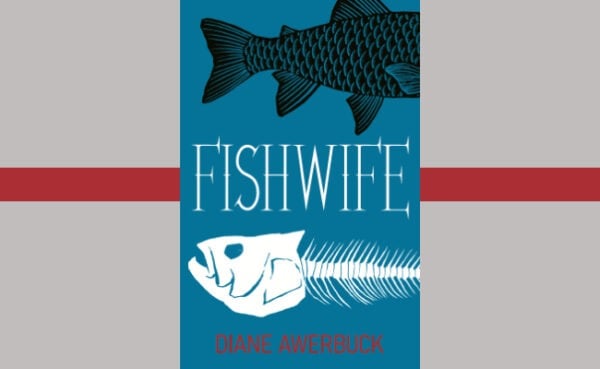
This reader’s impression was written and sent to LitNet on the writer’s own initiative.
Title: Fishwife
Author: Diane Awerbuck
Publisher: Modjaji Books, 2026
ISBN: 9781991240682
A fishwife is a woman you can hear from the other end of the harbour. She sells fish, haggles and swears, and nobody can shut her up. Diane Awerbuck has taken that insult as the title of her first collection of poems, and by the time I finished reading Fishwife the word had become something of a clarion call.
This is a collection about voice and agency under conditions of attachment – marriage, motherhood, sex, family history, grief, the body, a place, getting older, to name a few. The women in these poems are always caught in something, and Awerbuck almost never offers release as a clean escape. Sometimes the hook is chosen; love is often the hook, and sometimes the woman being caught is also doing the fishing.
The title poem is spoken by a mermaid at the far end of her fairytale: “To live with the prince/ I gave up song and argument,” she begins, and then gives us the aftermath: “He inherits the throne,/ our children have souls,/ the youngest won’t learn.” Her feet hurt. They’ve “rusted and spread,/ red as the tide that brought me.” I read this as the book’s negative proposition. Andersen’s sea witch cut out the little mermaid’s tongue, and Fishwife spends the next 50-odd pages handing women their song and their argument back.
It complicates that straight away. In “Catfish”, a daughter has been consoled with the old line about plenty of fish in the sea, and has taken it rather literally. “I do not swerve the iron hook,” she tells us, and then, flatly: “At least I chose the rod.” The poem is asking what choosing looks like when every choice comes with a hook.
On the facing page, in “Virginia, Sylvia, Ingrid”, a mother at the school gate admits she swam out that morning and thought about not coming back. The speaker answers with “The trouble with suicide/ is you can only do it once” and, when she’s asked if she’s always so negative, keeps the real answer to herself: “You should see the shoals of my dead,/ harvested and frozen for transport/ in the tanker of my heart./ I am a regular fishwife.” Three poems in, fishwife already means lover, mother, mourner, survivor, keeper of the dead and teller of their stories.
The author’s note does the same to the word from the other side. The author’s note describes the author as “the great-granddaughter of Raphael the seller of fish; the granddaughter of Ettie the player of scales; and the daughter of Anne the teacher of schools of fish. She lives in Fish Hoek with her fingerlings.” The insult turns into a family tree, an address and a vocation. Readers who know her fiction will recognise how long she has been fishing in these waters. Her story “The ones that got away” is one of my favourites in her masterful collection Inside your body there are flowers. “Catch and release”, in which a father takes his daughter “fishing, by which I mean drinking,/ by the brown waters of Riverton-on-Vaal”, feels as if it swam out of the same pool. Nets, fish, women, bodies, monsters and transformations make up an imaginative ecology she has been building for a long time. In the acknowledgements, she calls the work of making the book a “craft of catch and release”.
Myth is everywhere. The Little Mermaid, Sappho, Medusa, Diana, Leda, the Queen of Sheba, Lot’s wife, Rumpelstiltskin, Baba Yaga, Charon, Ra, Baron Samedi, Hermes and Hamlet all pass through. What Awerbuck does with them runs in two directions. She domesticates myth. Baba Yaga becomes banana bread. Lot’s wife gets her first name back (Edith; at the launch, Awerbuck told us it really is her name – you just have to dig for it) and stands salty by the road while “the passing oxen lick at her feet”. The vampire’s wife, newly free, is “in my bra, fearless and frying bacon./ No human man will tax me here./ I might live forever.” At the same time, she mythologises the apparently ordinary. In “Compound”, a widow, pinned against the door by her dead husband’s friends, becomes a Medusa. In “Verdigris”, two women crossing at the traffic lights end up like a bronze statue, “our skins greenish at the wrist”. In “Panopticon”, a first-year teacher watches a 14-year-old teach herself to swim and sees “a coelacanth, a saint”. The traffic between myth and kitchen runs both ways.
“Six months with Solomon” is a particular joy. The Queen of Sheba arrives, announcing, “Call me kingdom, not woman,” with 6 000 youths dressed in purple and a white camel “saddled only with frankincense”. She plans to prove the king with hard questions, and she already knows how he’ll answer the hardest: “Death and life are in the power of the tongue.” A book that introduces us to a mermaid who has given up her voice, thus, by midway, has a queen asking about the tongue. When I asked Di at the launch whether the whole collection is about getting the tongue back, she said that’s simply what poetry does, and that she’s trying to make things that carry themselves, “because fish don’t have handbags”.
Formally, the collection moves around a great deal, and the container changes with the emotional job. Most of it is free verse. There are narrative lyrics, persona poems, elegies, dramatic addresses and poems built out of things people actually said. There’s a run of wicked little epigrams where the punchline is also the turn. “Myth #69” reads, in full, “The clitoris/ is hard/ to miss.”
“Triptych” sets a visit in three frames. “Patrix” plays a shooting backwards, from the bullet’s path to the emptied barrel to the gun buried in the cupboard. And one of my favourites, “If there be paradise on Earth, it is this, it is this, it is this”, picks up rhyme and something close to comic ballad to tell the story of a marriage and a house whose “two sides there did not quite meet”. The husband shrugs that it’s not the Taj Mahal. It isn’t. “But now it is the Taj Mahal:/ a monument to love, a tomb.” The sing-song surface makes it hurt more.
It’s worth reading the book in spreads. Many poems face a partner across the gutter: “Good fences” and “Hot flash”, “Leda and the light perpetual” and “Verdigris”, “Wetland” and “Whistler”. They work almost like visual couplets. Diane compared sequencing the book to making a mixtape, with the typesetter’s widows and orphans getting a say.
Grief is the book’s strongest current, and in Awerbuck’s hands it’s nearly always material. There are suicides, accidents, a cremation, a body given to the hospital, missing and murdered bodies, ageing parents, old dogs, ghosts. The dead are rarely just “remembered”; they turn into salt, ash, forest, stars, rust, copper, water, reeds, mud, bone, moon sand. In “Clearing”, the speaker thought that early losses had made her immune. “But the elder trees keep falling,/ one and then another/ and then a whole forest.” “Ichthyology” goes back to a woman whose body lay for two months in a wetland, “rotting gently into the waterways,/ silting the reeds with your small flesh,” and ends with a warning nobody will heed: “No one should build a home here./ The new houses are bone-white against the hill.” Water carries a lot of this – tears, swimming pools, tides, rivers, wetlands, the sea. People are lost in it, carried and changed by it, and sometimes given back.
And then she makes you laugh. In “Your heart is not a feather”, a friend stands in the crematorium car park with “the small box of your mother” and decides to put her in the boot, because “She won’t mind. She never made a fuss.” In “Recreation”, a son explains that his mother does the frame of a puzzle first, and he waits till she’s nearly done: “I like to finish what she started./ She couldn’t do it without me.” She has already thought, and not said, “One day I will be dead/ but not missing.” The jokes land exactly where another poet would ask for reverence, and they refuse to let grief have only one register. At the launch, Di put it simply: “Light-hearted is not lightweight.”
After “Charon”, the book turns downward through Ra’s night boat in “Insomnia”, “The other side”, “Yahrzeit”, “The missing stair” and “Ichthyology”. It closes in a theatre. “Ghost light” takes its epigraph from Rob Murray, who says that people should leave a play different from how they walked in. Hamlet wears his black velvet, the boards under his feet remember northern forests, and the poem ends: “Here he is now,/ behind the curtain,/ waiting to be known again.” A ghost light is the single lamp left burning on an empty stage.
The first poem has been waiting for that ending. The speaker of “Familiar” is an uncanny woman “like a skeleton key” who goes where she likes and overhears everything, and on the way she rewrites Psalm 46: “Be still/ and know that I am your fellow.” She looks like your cousin, your little sister, “your beloved girl back from her travels”. She has “a common face”. There’s something very Awerbuckian about the arc from that poem to the last. The strange thing was ordinary all along, the ordinary dead come back as strange presences, and the writer’s job is to recognise them.
Fishwife is a slim book. Awerbuck says that about two thirds of what she first gave her editor, Kobus Moolman, made it in, and you can feel the discipline. What’s left is lean, very funny and full of the dead. Several of its lines have lodged themselves permanently somewhere behind my ribs, “clear, and cold, and stinging”.