

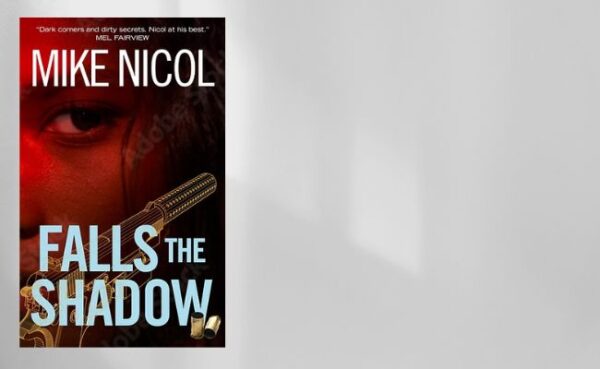
Book cover: Catalyst Press
Falls the shadow
Mike Nicol
Catalyst Press
ISBN: 9781960803313
In Falls the shadow by Mike Nicol, the author opens the book with a grotesque act of violence. A police officer kills his family before turning the gun on himself. He leaves behind a cache of illegal firearms. Now, if you’re South African, seeing a headline like this in a newspaper or on a news site may not shock you. What Nicol does, however, is expose the story behind the story – the one people shy away from reporting. From that shocking opening, he builds a propulsive crime novel that asks, “Who polices the police?”
The answer isn’t simple, but at the centre of the narrative is Captain Zara Dewane of the Internal Crime Unit. She is tough, with a vulnerability that she has been trained to hide. As a single mother and a woman working inside a male-dominated and increasingly compromised police force, Zara carries both professional and personal risk. She is restless. She is not easily placated and believes that, despite all of the corruption and lawlessness surrounding her, justice must prevail. Early on in the novel, she is nicknamed “the Jackal” by the other police officers. They’re afraid of her no-nonsense approach and her ability to see them as ordinary citizens who are not above prosecution. Zara’s pursuit of the truth places her and her family directly in the crosshairs, turning the investigation into a fight for survival.
One of the book’s greatest strengths is its fearless portrayal of institutional corruption. Nicol refuses to treat corruption as a set of separate incidents committed by a handful of ill-intentioned officers. Instead, he shows us a network of misdeeds that spreads through the ranks of the force and all of the relevant offices associated with it. He shows us how these relationships are maintained through silence, blackmail and deep fear, while being propelled by the promise of money and career advancement. The stolen guns moving from police armouries to gangsters are more than a plot device. They’re a symbol of how easily power is transferred and abused when loyalty to one’s colleagues becomes more important than the rule of law.
........
In exploring these themes, Falls the shadow feels rooted in the truths of modern South Africa.
.........
In exploring these themes, Falls the shadow feels rooted in the truths of modern South Africa. The brittle lines between law enforcement and criminal enterprise echo real-world anxieties about confidence in governmental institutions. Nicol does not offer easy reassurance. This lends the novel a sense of discomfort that sits with the reader throughout. We are forced to confront the possibility that corruption at the top can render ordinary citizens powerless. A scary but rampant realisation.
Nicol’s prose is sharp and economical. His scenes unfold with clarity and precision, while allowing the tension to build naturally rather than through excessive description. There is a propulsive quality to his writing that keeps the pages turning, but it never feels rushed. Each chapter pushes the narrative forward, while deepening the sense of danger surrounding Zara and those close to her.
Another of Nicol’s strengths is his ability to craft authentic dialogue. He captures a wide range of South African voices through his words. When reading his characters, you feel as if you are speaking to someone you already know. Conversations between officers carry the weight of unspoken hierarchies and grudges, revealing as much through what is withheld as through what is said. The result is a novel that feels topical and grounded, even as the stakes escalate to life and death levels.
What makes Falls the shadow especially compelling is how it balances its thriller elements with its social commentary. The plot delivers the suspense and surprises expected from crime fiction, but it never loses sight of the broader consequences of its story. The violence that explodes in the opening chapters is not treated as spectacle. Nicol respects his story and his characters enough to let their motivations remain the priority, rather than the need to keep the reader turning to the next page. Although he ensures that brilliantly as well.
Zara’s struggle becomes characteristic of a larger battle for culpability. Her determination to expose the truth, even when ordered to stand down, highlights the personal courage required to challenge entrenched power. Nicol portrays this resistance as both admirable and dangerous, acknowledging that doing the right thing often carries severe consequences.
By the book’s end, readers are left with a sense of both resolution and concern. The immediate mystery is addressed, yet the deeper issues surrounding corruption and governance remain. Nicol resists the temptation to provide neat moral closure, choosing instead to reflect the messy realities of a world in which justice is often partial and hard won.
Falls the shadow succeeds as a gripping crime novel and as a pointed examination of the hidden machinery of power. Through Zara Dewane’s story, Mike Nicol exposes the dangers of institutional corruption within government and policing, and the human cost of confronting it. It is a novel that entertains while also provoking reflection, urging readers to question the structures that are meant to keep society safe and to consider what happens when those structures begin to fail.
Also read:
PenAfrican: The nights are quiet in Tehran by Shida Bazayr – a book review