

 |
Writing South Africa Now: Twenty Years On is a graduate conference on South African literature that took place at the University of York, UK, in June 2014. The event is the second in a series of annual colloquia initiated by the University of Cambridge, aimed at making new critical voices within the field of South African Literary Studies heard. A selection of abridged papers has been made available on LitNet, including the following article by Dominic Davies, "Drawing South Africa Now: Writing Urban Environments in the Graphic Novel Form?".
|
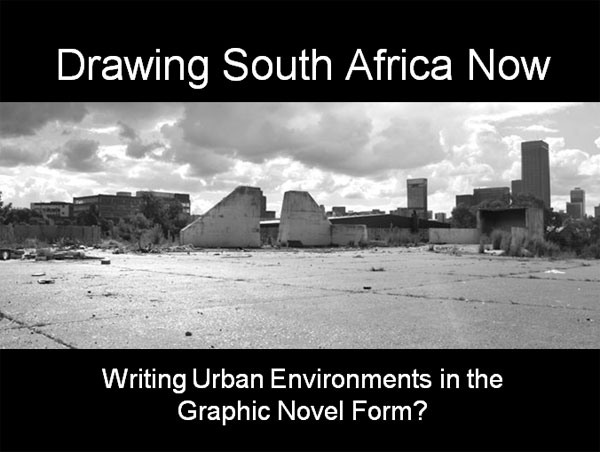
In recent years there has been a renewed and vigorous attempt to represent the multidimensionality of the South African landscape, but especially the increasing infrastructural complexity of its cityscapes, through experimentations in narrative form. In fiction and non-fiction, but also in sociological and literary critical texts, there is a recurrent recourse to visual elements within contemporary urban depictions of Johannesburg, and South African cityscapes more generally – texts that “write South Africa now” also appear to need to “draw” or “map” it as well. Such a trend signifies a recurring attempt to grapple with and depict the complexity and multidimensionality of South Africa’s urban spaces. Therefore I want to speculate here on the generic trajectory into which this pattern might fit.
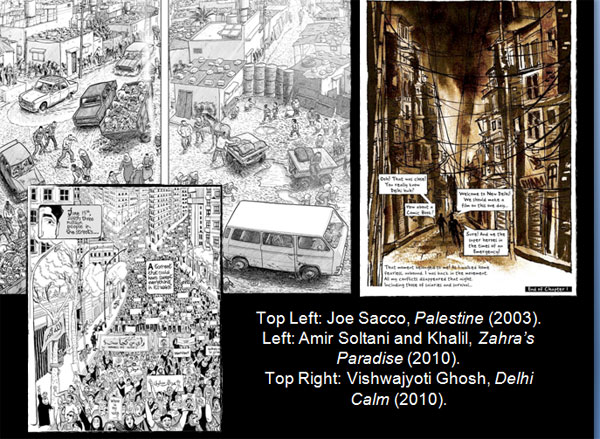
Narrative depictions of colonial and postcolonial cityscapes across the world, from Jerusalem to Delhi to Tehran, are becoming increasingly represented in the rising genre of the “graphic novel” – or as critics such as Catherine Labio, who see this new term for the genre as nothing more than an attempt to make a “low” form of cultural production more palatable for an academic audience, would put it, the “comic form”.1 While it seems there is a distinct anomaly in this pattern when it comes to the depiction of South African urban space with relatively few graphic novels emerging from the region, we should ask whether the recourse to visual supplements that dominates South African narratives – and one that has risen sharply in the past few years – might gesture towards a particular generic suitability of the graphic novel to this representational dilemma. Or turning this question on its head: Do certain recourses to the inclusion of visual and pictorial mediums in South Africa actually have much more in common, in their genre and form, with graphic narratives from other parts of the globe?
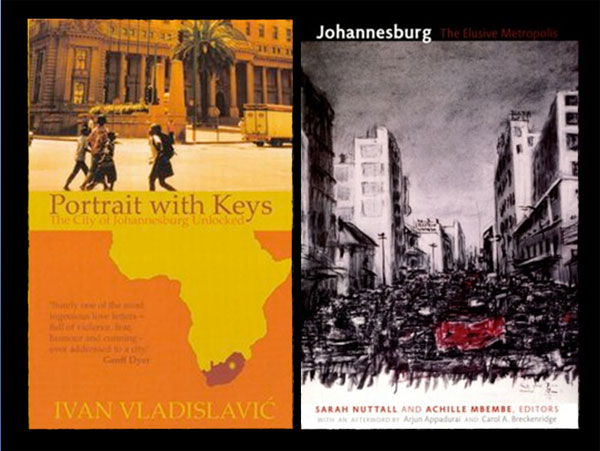
Two of perhaps the most well-known works published in recent years to take Johannesburg as their topic of focus are Ivan Vladislavi?’s Portrait with Keys, The City of Johannesburg Unlocked (2006) and Sarah Nuttall and Achille Mbembe’s Johannesburg, The Elusive Metropolis (2008). The titles of both of these texts gesture towards their self-conscious preoccupation with their own capacity to represent the spatial and topographical dimension of the city. Vladislavi?’s text is a self-proclaimed “portrait”, suggesting a distinct spatiality, or framing, a process most often associated with visual mediums. The text itself takes on a multidimensionality by configuring itself as a map – the narrative runs across two sections, from “Point A” to “Point B” – within which a fragmented style splits its linearity into a series of frames, or portraits, perhaps evocative of the medium of the graphic novel or comic.2
Nuttall and Mbembe’s edited collection of essays asserts “the elusiveness of Johannesburg” by attempting “to point to the gap between the way things actually are and the way they appear in theory and discourse”, highlighting how cities “always outpace the capacity of analysts to name them”.3 Their text is interspersed with visual material, primarily drawings of Johannesburg’s cityscape by the South African artist, William Kentridge.
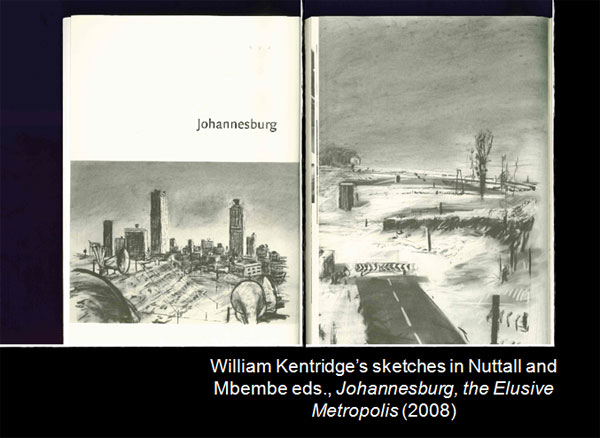
The drawings are typical of Kentridge’s work and operate as a visual embodiment of Nuttall and Mbembe’s thesis. The heavily sketched lines of thick, blurred charcoal construct a cityscape out of shifting, elusive boundaries, as though embodying what Mbembe calls “the aesthetics of superfluity”. Kentridge’s drawings seem, albeit paradoxically, to fix and signify that which Mbembe seeks to describe in words. The visual image seems to complement, if not enable, this critical attempt to develop a more nuanced representation of Johannesburg’s cityscape.
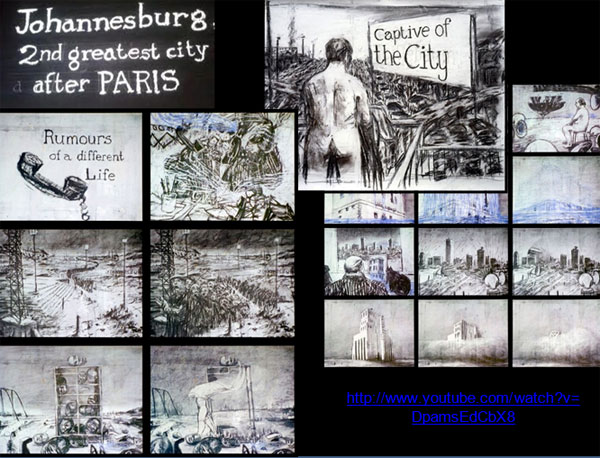
Kentridge has in fact used his charcoal and pastel studies of Johannesburg to make short, animated films, collected in a series entitled Drawings for Projection, all of which are “set in the devastated landscape of South Johannesburg” where, the Tate website tells us, “derelict mines and factories, mine dumps and slime dams have created a terrain of nostalgia and loss”.4 Kentridge draws a single scene, photographs it, then erases and redraws it. The first film in this series, Johannesburg, the Second Greatest City after Paris, was made in 1989 and comprises only 25 drawings.
These are positioned in frame sequence and the limited number of images Kentridge uses results in a stuttering, awkward and uneasy representation of what is nevertheless a shifting, “elusive” landscape. The medium rejects or resists a filmic one while also explicitly attempting to narrativise across separate images, perhaps evoking the medium of the graphic novel.
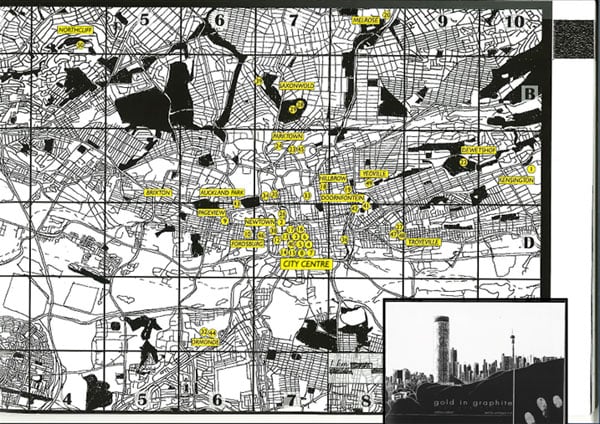
Zafrica Cabral’s Gold in Graphite, Jozi Sketchbook (2010) is more explicitly a graphic novel, of sorts. Comprised of sketches Cabral made of the city from 2005, an astonishing map operates as a frontispiece to the text, with the numbers locating the various buildings that appear in the book within their geographical context, showing how they relate to one another and constructing a self-consciously spatial narrative mode. The shift from the two-dimensional map to the three-dimensional images introduces a topographical element to this visual depiction of the city.
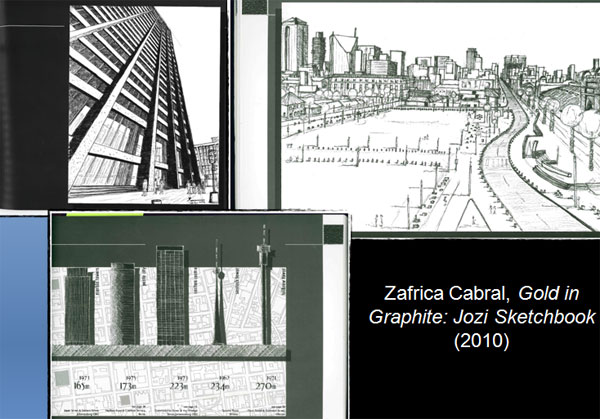
Sketches of buildings such as the Carlton Centre and a range of Johannesburg’s skyscrapers, as well as urban spaces such as Mary Fitzgerald Square, run through Cabral’s text, and his use of graphite references Kentridge’s elusive charcoal lines.
However, though there has been a proliferation of the socio-political or journalistic graphic novel, in the work of artists such as Joe Sacco and Guy Delisle, in recent years, it appears that this has yet to be taken up as a genre in South Africa or by South Africans more generally – with one or two exceptions, most notably the work of Anton Kannemeyer and Conrad Botes in their Bitterkomix series. Nevertheless, we might be about to witness a fruitful generic intersection that will develop new visual or graphic-narrative ways of representing South African space, and I hope the optimism and excitement of this concluding assertion will justify its speculative and hypothetical nature.
1 Catherine Labio, What’s in a Name?: The Academic Study of Comics and the “Graphic Novel”, Cinema Journal, Spring 2011, 50(3):123–6.
2 Ivan Vladislavi?, Portrait with Keys, The City of Johannesburg Unlocked (London: Portbello Books Ltd, 2007).
3 Sarah Nuttall and Achille Mbembe (eds), Johannesburg, the Elusive Metropolis (North Carolina: Duke University Press, 2008), p 25.
>>>>Back to the conference's index page for more papers.

|