

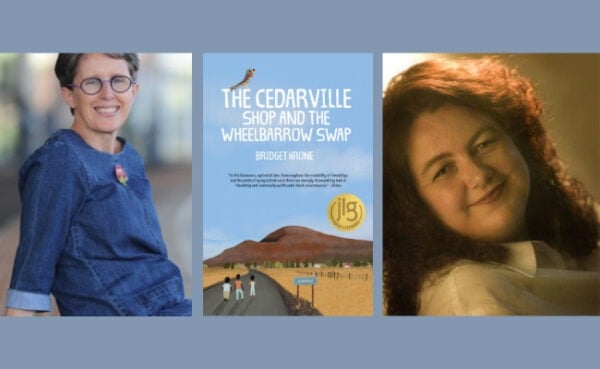
From the award-winning author of Small mercies, named Best Middle-Grade Book of 2020 by Kirkus Reviews, comes The Cedarville shop and the wheelbarrow swap by Bridget Krone. It is one of the books on the Junior Library Guild Gold Standard Selection list.
Many things can feel just out of reach in 12-year-old Boipelo Seku’s small, impoverished village of Cedarville, South Africa. The idea of one day living in a house that’s big enough for his family is just a faraway dream. But when Boi stumbles on a story about a Canadian man who traded his way from a paper clip to a house, Boi hatches his own trading plan, starting with a tiny clay cow he has moulded from river mud. Trade by trade, Boi and his best friend, Potso, discover that even though Cedarville lacks so many of the things that made the paperclip trade possible, it is fuller than either of them has ever imagined.
...
My first challenge is to write a really good story that readers will invest in. I try to weave in satisfying resolutions that readers won’t see coming. It takes me ages to get the plot sorted out and tie up all the loose ends."
...
You are an adult. How hard was it to write a book through the eyes of a child?
Fiction, whomever it’s aimed at – kids or adults – is always a big act of imagination. You must dive deeply inward to construct that world, and it’s always an effort! But I think I do have an affinity with and respect for children, and that helps. I just go with the stories that make my heart beat, and those happen to be children’s stories.
How do you approach a new book for young readers? Where do you start, and which spark do you need for the story to take shape?
I always need a spark to get me going – and when it ignites, I feel it quite physically. I’ve written only two novels for children, and both times I had an unshakeable feeling that I was “on track”.
For The Cedarville shop, it began with a conviction that I should use Cedarville as a setting. I went to the village to interview people, but came away with a great feeling of despair; the stories I heard were so hard, and there was so much suffering. For about three weeks, I sat with this confusion. Then, one day, in desperation, I googled something silly – I think it was “crazy ideas”. Buried on the second page, I found the story of Kyle MacDonald, who traded his way from a red paper clip to a house – and bam! I had my idea.
In some ways, Boi’s plan mirrors all creative experiences. Creativity (whether it’s a novel or a plan to trade a clay cow for a house) often starts with a relatively simple idea and a lot of enthusiasm. Then doubt starts to creep in; things get difficult; odd things happen that encourage you; you almost give up because it feels so messy – then, near the end, something takes over, and out of the mess and muddle, something is born! Magic – every time.
The theme of cultural appropriation in books for teens was a major topic at the recent Toyota US Woordfees. How do you feel about this, and what would you say to people who might accuse you of cultural appropriation?
I was very aware of the risks I was taking when I wrote this story, especially using a first-person narrator! I do believe that we can write outside of our realities (class, race or gender), but that it needs to be done with the greatest respect we can muster. For me, this involved researching details methodically. I also gave the manuscript to several sensitivity readers to make sure that I was honouring the cultures represented in the book. I did everything I could to avoid cultural stereotypes. Now that the book is out in the world, my responsibility is to listen and take seriously any mistakes that I might have made. A few reviewers in the USA have commented on the fact that I am a white person writing about a black boy, but no one so far has taken issue with a detail, character or custom that I got wrong. But if I have erred or offended, I must listen with an open heart. The line between cultural appropriation and cultural appreciation is very fine, but I think the values of “respecting” and “honouring” are critical.
What is your biggest challenge when writing books for young readers?
My first challenge is to write a really good story that readers will invest in. I try to weave in satisfying resolutions that readers won’t see coming. It takes me ages to get the plot sorted out and tie up all the loose ends.
My next challenge is tone. I like clean, unsentimental writing that is spiked with humour, and that takes time and a lot of rewriting.
Do you have a notebook handy to jot down descriptions like that of the swallow at dusk, the Egyptian geese or the leaky bucket, for later use? Or how do these come to you?
Oh, notebooks are vital! I forget everything without them. But how and why ideas arrive is mysterious; they are very unpredictable. Some, like the metaphor of the bucket, come when I am sitting at my laptop hard at work. Connections are made: bucket … leaky bucket … there’s a hole in my bucket … you need a bucket to fix a bucket … poverty. But sometimes ideas sneak in when I’m not staring them down. I might be hanging out the washing or driving to the supermarket when they slip in quietly.
Others come directly from my own life. I love the sound made by the wings of Egyptian geese. If I’m weeding my garden and they fly low overhead, that sound of their wingbeats rewires my brain. So, I gave Boi that experience as well.
What kind feedback have you received from young readers that has warmed your heart and will keep you going with the next book?
I love it when kids come up to me and tell me that they went dressed as a character from one of my books for World Book Day. Or when I hear that they spent their birthday money on one of my books. I have one young fan who never read at all until he read The Cedarville shop. His grateful mom sent me pictures of him completely engrossed.
Last week, I took a broken clock to two young girls who were learning to fix electronics with the help of their patient dad. When they recognised my name, they were really excited: they’d read Small mercies twice and were so looking forward to getting The Cedarville shop. These encounters really do warm my heart.
Grown-ups read children’s books, too! Last week, I got a three-page, handwritten letter from a dear man who read my book while he was on holiday.
I will keep writing. I have an idea for my third novel, but I’m so busy writing stories for textbooks at the moment, that it’s still at the notebook stage. I’m a late bloomer when it comes to writing. I’m willing to be patient for the right story and the right time.